Chronicle Editor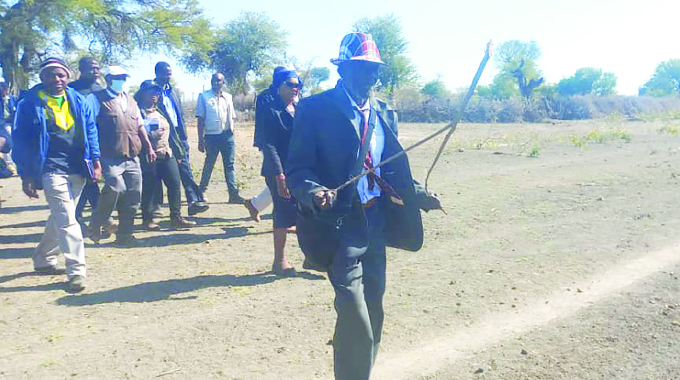
Sukulwenkosi Dube-Matutu, [email protected]
AT the venerable age of 101, Joseph Ncube, affectionately known in his Garanyemba community in Gwanda as Dzinodla (the productive one), has come to the rescue of many. His expertise in traditional water surveying techniques has proven invaluable, especially after modern methods had faltered.
Ncube’s tools of choice are whips crafted from the resilient grewi tree species, including umtewa, umklampunzi, umpumpulwane, and umbhunzu. With these, he employs a V-shaped whip to divine the presence of water. Grasping the whip horizontally by its forked end, he allows the straight, pointed end to lead the way.
As he traverses the land, the whip reacts to the hidden veins of water beneath; a quiver or a shake indicates a find. Remarkably, Ncube notes that in areas abundant with underground water, the force is such that the whip might even snap.
In a generous act of community spirit, Ncube has imparted his knowledge to others, ensuring that the skill of locating water — a lifeline in arid regions — continues to flourish among the people. His legacy is thus not only in the water he finds but in the wisdom he shares.
“One night when I was sleeping I had a strange dream. A voice told me to look for a whip and go to a certain area to look for water. The voice told me that I had to look for a certain man who was a village head in our area so that he would show me how to look for the water.
“I approached him and he showed me how to do it. He is now late. Within a few hours I had mastered the technique of locating water underground. “A number of villages have water points because I managed to locate the water. I have worked with Government departments on many occasions.
At times they have engaged me after failing to locate water after several times. When I locate water I mark the area and those that drill boreholes then come in. I have also been engaged by community members whom I have helped to identify water points on their properties.
“In my opinion I think the water has some kind of magnetic force on the whip which explains its movement when it gets to a water point. The magnetic force is intense when there is a lot of water which explains why the whip can break or why it wobbles a lot,” he said.
Ncube, with a confidence born of years of experience, asserts that his ability to locate water is unfailing. He is undeterred by the occasional shortcomings of modern machinery. Echoing this sentiment, Chief Sitaudze of Beitbridge District venerates the time-honoured tradition, affirming that the art of divining water with a whip is steeped in history.
“This practice is part of the indigenous knowledge systems which have remained vibrant in communities up until now. I’m glad that Government also values this rich treasure by engaging some of these elderly people who survey water,” he said.
Chief Masendu from Bulilima District stressed the enduring role of traditional water divination in his community. He highlighted the expertise of certain elders, some of whom have even mastered this practice. He said there are some instances where the modern technique of surveying water has failed and the traditional method has come with the solution.
Renowned historian and author Pathisa Nyathi reinforced the value of the practice, calling it a prime example of African science. He underlined the need for further research to understand its mechanisms. Nyathi lamented the marginalisation of indigenous knowledge systems, often dismissed as primitive despite their demonstrable contributions to daily life.
“We sometimes disregard African Science and classify it as barbaric or outdated. Sometimes we disregard it is as practices which are associated with evil spirits. I have witnessed the practice of locating water the traditional way and in some cases it’s proven to be more reliable than the modern way.
“These traditional methods are a science of its own which relies on energy. We should uphold these practices and research more on them. Our traditional ways have to be used concurrently with modern practices. These indigenous knowledge systems should be documented so that they are preserved,” he said. — @DubeMatutu


 Online Reporter