Online Reporter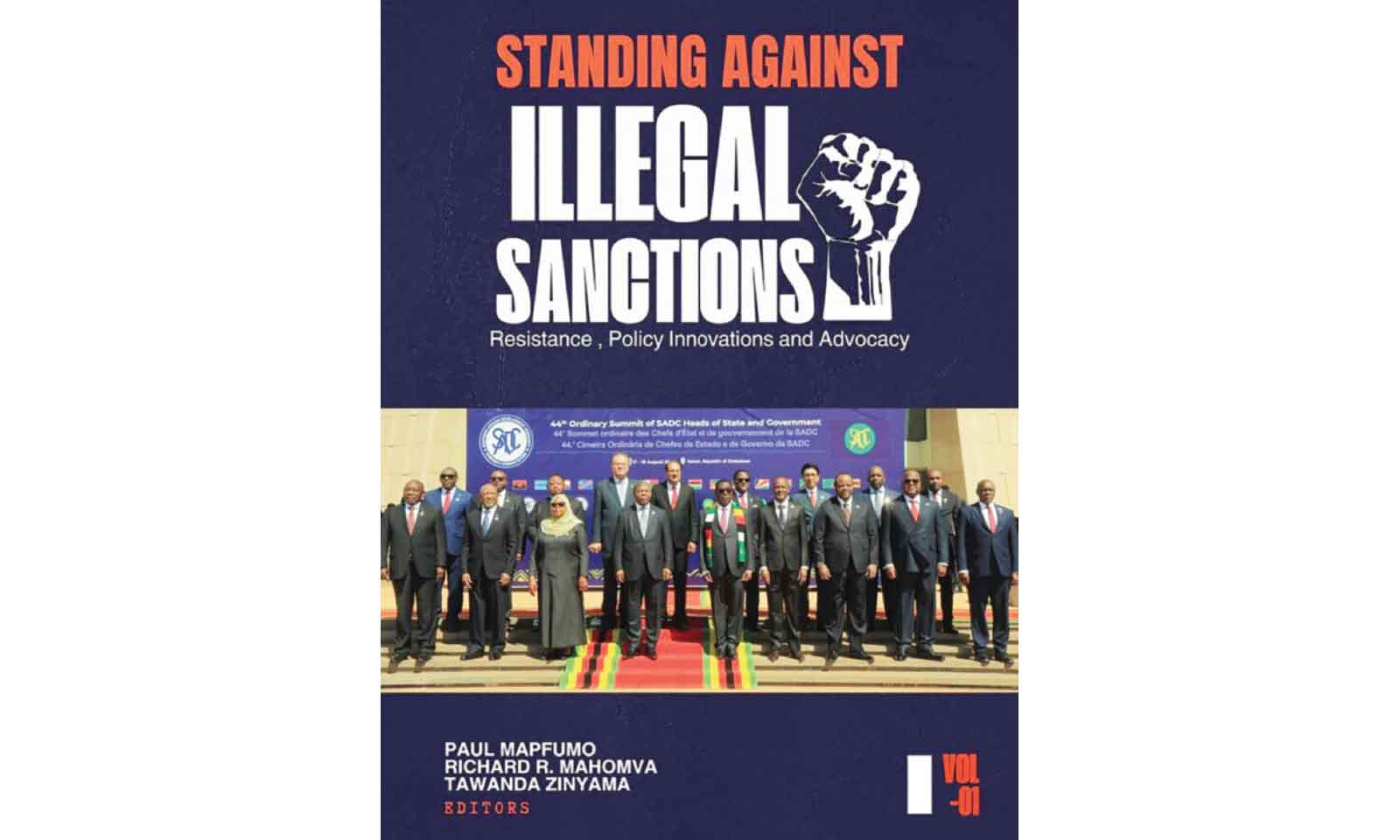
Rutendo M Nyatsanza
The book under review, Standing Against Illegal Sanctions: Resistance, Policy Innovations and Advocacy offers a comprehensive critique of how unilateral coercive measures have shaped Zimbabwe’s political, economic, and social landscape.
Drawing on the Government of Zimbabwe’s 2021 submission to the UN Special Rapporteur, Alena Douhan, chapter 4 of the book by Maubrey Chisekochevana frames sanctions as measures that undermine sovereignty, weaken national development and raise fundamental legal concerns (Douhan, 2021).
It highlights interconnected themes that define the national sanctions debate, including the contested legality of unilateral measures (Ronen, 2019), the broader legitimacy challenges tied to political motives (Giumelli, 2020), and long-standing sovereignty tensions emerging from external interference. Economic and financial disruptions, humanitarian pressures on public services, and the political restructuring of State-civil society relations are also central issues.
The chapter situates Zimbabwe’s experience within wider African and Global South debates about post-colonial power, global inequality, and the effectiveness of sanctions as policy tools (Mamdani, 2018).
These themes establish the basis for understanding the chapter’s central argument that sanctions operate through multiple channels and their consequences must be analysed holistically rather than in isolation.
Economic Impact of Sanctions on Markets, Investment, and Financial Access
A central issue developed in the chapter is how sanctions have intensified Zimbabwe’s economic difficulties, particularly by limiting its access to global markets, investment, and credit facilities.
According to the Government, these sanctions do not operate in isolation, but rather interact with existing structural weaknesses, deepening long-term economic vulnerabilities (Government of Zimbabwe, 2021).
Scholars such as Chingono (2020) support this argument, noting that sanctions have contributed to de-industrialization, declining productivity, and the withdrawal of major financial institutions.
The chapter emphasises that sanctions have contributed to a climate of heightened financial risk, prompting international banks to avoid transactions linked to Zimbabwe out of fear of penalties, a phenomenon known as over-compliance (Kufakurinani, 2021).
This over-compliance, combined with the country’s limited access to concessional loans, has further constrained liquidity, reduced investment inflows, and increased the cost of doing business. These dynamics illustrate how sanctions, even when framed as targeted, can generate widespread economic disruption by reshaping the incentives and behaviour of international financial actors (Hufbauer et al., 2007).
Historical Roots of Zimbabwe’s Economic Vulnerability Before Sanctions
The research also situates the impact of sanctions within a longer historical timeline, arguing that contemporary economic challenges in Zimbabwe cannot be understood separately from earlier neoliberal reforms.
It notes that the Economic Structural Adjustment Programme (ESAP) of the 1990s weakened the industrial base, reduced the capacity of state institutions, and heightened vulnerability to external shocks (Bond & Manyanya, 2002).
This historical grounding reinforces the argument that sanctions, introduced after 2000, struck an economy already struggling with unemployment, capital flight, and deteriorating infrastructure. Therefore suggests that sanctions accelerated pre-existing economic decline rather than initiating it, a position that aligns with Mamdani’s (2018) broader critique of external interventions in African governance.
By integrating historical, economic, and political factors, the chapter underscores that sanctions operate within complex environments, making their effects multidimensional rather than linear or easily isolated.
Humanitarian Consequences: Effects on Public Services and Social Welfare
Another major focus of the research is the humanitarian impact of sanctions, particularly how they restrict Zimbabwe’s ability to provide essential public services. The Government argues that sanctions have disrupted supply chains, reduced fiscal space, and constrained its capacity to deliver healthcare, education, and social protection (Government of Zimbabwe, 2021).
Scholars such as Chari (2021) have similarly highlighted how financial restrictions hinder the procurement of medicines, medical equipment, and agricultural inputs, thereby worsening health and food security outcomes.
The research notes that these challenges have contributed to increased informalisation of labour, higher poverty levels, and reduced social welfare coverage. While the Government has introduced initiatives such as BEAM and targeted cash transfers, the chapter states that these efforts remain insufficient in the context of broader economic isolation.
This section uses humanitarian evidence to argue that sanctions, even when intended to affect political elites, often have disproportionately harmful effects on ordinary citizens (Lopez & Cortright, 2018).
Political Effects: Rise of Parallel Governance and NGO-Centred Aid Systems
Beyond the economic and humanitarian dimensions, the chapter examines the political environment shaped by sanctions, arguing that they have altered the country’s institutional dynamics. Zimbabwe contends that sanctions have facilitated the rise of parallel governance structures through NGOs and civil society organisations, as donors increasingly channel resources outside state systems (Government of Zimbabwe, 2021).
This argument echoes Gatsheni’s (2020) critique of external interventions that create competing centres of authority within African states. According to the chapter, the shift of donor funds toward non-state actors has weakened coordination, reduced transparency in development planning, and amplified political tensions between the state and civil society.
While some scholars dispute the degree of political interference attributed to NGOs, the chapter acknowledges that sanctions undeniably reshape donor behaviour, thus influencing the political landscape in complicated ways (Bratton & Masunungure, 2018). This reinforces the view that sanctions are not only economic tools but also political instruments that can restructure power relations within targeted states.
Sanctions and Zimbabwe’s International Image and Diplomatic Isolation
Additionally, the chapter explores how sanctions reshape international perceptions of Zimbabwe, influencing diplomatic relations and shaping global narratives about governance, democracy, and human rights.
According to the Government, the sanctions regime has contributed to a persistent portrayal of Zimbabwe as a “pariah state,” which in turn reinforces investor hesitation and limits opportunities for economic re-engagement (Government of Zimbabwe, 2021).
Scholars such as Meredith (2020) argue that these perceptions can become self-reinforcing, as countries under sanctions often struggle to shift global narratives once negative reputations solidify. The chapter notes that this reputational damage interacts with material restrictions to create a form of diplomatic isolation, reducing Zimbabwe’s bargaining power in regional and international forums.
By highlighting these dynamics, the chapter suggests that sanctions function not only as economic constraints but also as symbolic tools that shape the global political imagination surrounding targeted states.
How Sanctions Reshape Domestic Policy Space and State Decision-Making
The analysis further considers how sanctions influence domestic policy choices and state behaviour.
According to the chapter, sanctions restrict policy space by forcing governments to prioritize short-term survival strategies over long-term development planning.
This argument aligns with broader scholarly critiques, such as those by Adebajo (2021), who notes that sanctions can narrow governing options and distort policy priorities. The chapter argues that Zimbabwe’s fiscal and monetary responses, often criticized for inconsistency, must be evaluated within the context of restricted access to credit, donor withdrawal, and reduced institutional capacity.
As a result, the Government faces the dual pressure of maintaining macroeconomic stability while navigating international hostility. The chapter concludes that sanctions create a governance environment characterized by limited choices, constrained resources, and heightened political pressure, which collectively hinder effective policy implementation.
Debates on the Legality and Legitimacy of Unilateral Coercive Measures
Furthermore, in synthesising Zimbabwe’s arguments, the chapter reinforces the broader legal debate surrounding the legitimacy of unilateral sanctions.
According to Ronen (2019), unilateral sanctions lack clear legal grounding under international law, particularly when imposed without UN Security Council approval.
Zimbabwe’s submission relies heavily on this argument, asserting that sanctions violate the UN Charter, principles of state equality, and established norms governing international economic relations (Government of Zimbabwe, 2021).
The chapter also references the growing body of scholarship that critiques sanctions for producing unintended humanitarian consequences that contradict international human rights standards (Giumelli, 2020).
By engaging with these debates, the chapter positions Zimbabwe’s case as part of a larger global conversation about the legality, proportionality, and accountability of unilateral coercive measures.
Conclusion: Zimbabwe’s call for Sanctions Removal
In conclusion, the chapter presents Zimbabwe’s call for the removal of sanctions as grounded in legal, humanitarian, economic, and political arguments, while also recognising the complexity of attributing all national challenges solely to external factors.
The analysis situates the Zimbabwean experience within global debates on sovereignty, external intervention, and the ethics of economic coercion, drawing on scholarship that critiques sanctions as blunt instruments with often counterproductive outcomes (Lopez & Cortright, 2018).
The chapter’s contribution lies in its ability to integrate Government narratives with academic literature, offering a comprehensive view of how sanctions reshape state capacity, public welfare, and political dynamics. In doing so, it highlights the need for more nuanced policy approaches that consider both the intended and unintended consequences of sanctions in developing states.
The conclusion emphasises that while sanctions have clearly contributed to Zimbabwe’s challenges, their long-term impact raises fundamental questions about justice, legitimacy, and the role of coercion in international relations.