Chronicle Editor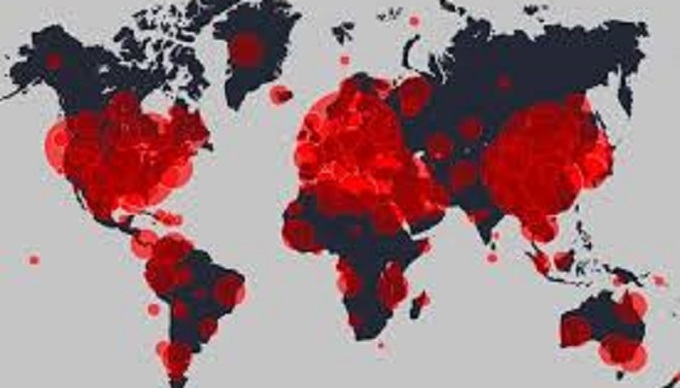
Cetshwayo Zindabazezwe Mabhena
All the signs point to that the coronavirus pandemic will slowly but surely graduate into a world endemic. The disease will gradually become a known and manageable side of life where human social culture will change to accommodate its rules.
The disease will not change to accommodate our habits and hobbies. Rituals of social distancing, sanitising, enhanced personal hygiene and masking are most likely going to be integrated into daily life.
In their post-political imagination academics have lately been busying themselves with questions concerning what a post-coronavirus world will look like.
Post-politically the scholars have been imagining a day when the world will one day announce a total victory against the disease. Just the same way some scholars, led by Francis Fukuyama, once claimed the arrival of the end of ideological wars in the world where neo-liberal politics and economics fronted by the West would takeover the world and men and women will live happily ever after. Political and ideological conflicts did not end as imagined and the world has adapted to the reality of right wing and left wing struggles among many other conflictual relations.
To ponder what the corona world might look like becomes a much more pragmatic engagement than it is to dream of the day victory will be declared against the pandemic. The real victory might after all be in the brave acceptance that the disease is with us.
Political Economy fundamentals of the pandemic
A seemingly uppity but actually telling social media persona posted a message from the USA that is circulating worldwide. As the All Lives Matter Movement rages on, the persona wanted to remind the activists that some of them were prepared to open the US economy even at the expense of lives of the vulnerable.
Ste-Fawn asked: “How are you gonna say All Lives Matter when just two months ago you wanted to sacrifice your grandma for the economy?” The world over, countries face the painful paradox where economies finally need to be opened even with the dark knowledge that economic activity will increase the spread of infections and lead to some lives being lost. For the poor and vulnerable of the world the choice is between dying of hunger at home or braving the pandemic out there trying to make the loose ends meet.
Slavoj Zizek does not stop emphasising that the capitalists are willing to imagine the end of the world not the end of capitalism. Other non-believers go further to make the scary claim that capitalist economic has always put economies and profits ahead of human lives; coronavirus has only made the cruelty of it all obvious. This has led Zizek to claim that a communist world would have handled the coronavirus far much better than our capitalist world that literally worships profits ahead of human survival. Capitalism tends to sacrifice human life on the altar of profit.
In the present world people need to circulate socially and work in order to afford life. Social circulation and work expose people to the marauding pandemic. By locating itself centrally in the sexual economy of human beings HIV/Aids became a trap that waited for people in the site of reproduction which they could not avoid forever. Coronavirus has become a trap that is located centrally in the social economy of life that people must circulate in or perish. This commonsensically means that we have to navigate and negotiate the virus in the social and work sphere. In other words in our hands we have a real war of human survival against an invisible but deadly enemy. We need to be warlike.
The first victory in any war is the knowledge of ourselves first and then the knowledge of our enemy next. It appears to the human world now that lockdowns, quarantines and isolations are strategies employed to delay the enemy, not to defeat him. Engaging in combat, close combat, seems to be the scary but only solution. A kind of the survival of the wisest war is with us.
Coronagnosis
Alongside Niccolo Machiavelli of the West, the East has the Sun Tzu as the arch-philosopher of war. Both Machiavelli and the Tzu wrote treatises on The Art of War. Today I want to feed from the Sun Tzu. He notably said: “If you know the enemy and know yourself you need not fear the result of a thousand battles.” The wisdom we can harvest here is that we have to know the coronavirus and ourselves in order not to be afraid of the present war against the pandemic. The Sun Tzu added that: “If you know neither yourself nor the enemy you will succumb in every battle.” Self-knowledge and knowledge of the enemy, the coronavirus, in this case, appears to be our key to survival.
If the coronavirus is an enemy that we have to fight while we live with it then it means that we must know our enemy well. And understand ourselves well too. What makes this monster tick and how can we suffocate it are stubborn questions that we have to ask and also answer. Gnosis, by the way, is a philosophical term that refers to deep knowledge of an object or a subject. The disciplines of Philosophy and that of Medical Science both use the word gnosis which means that it is an old word that comes from those ancient times in the West when Philosophy and Medicine were one discipline.
Diagnosis demands that we get to know how to identify and detect the coronavirus as a condition and a disease, understand its characteristics. We know already that it hides in human oral and nasal fluids. If we avoid interpersonal exchange of these fluids the disease has no way of travelling from one body to another.
So, at work and at home, we have to totally prevent the exchange of these bodily fluids to immobilise the virus, which is a lot of work but one that has to be done or we lose the war. Cardiognosis refers to the knowledge of the heart or depth of things. What does this virus survive on, what is its existential engine? The little we know is that it is a parasitic virus that lives on other bodies and can only survive on non-living surfaces and objects for a given time.
Preventing it entering and sheltering in our bodies is a central way of suffocating it, therefore.
Sanitising surfaces and objects is another battle against the monster. Prognosis refers to our knowledge of the future and how life must now proceed going on, given the reality of this pandemic. We can no longer live the way we used to. We have to abandon certain habits and behaviours that were so dear to us. We have to bury a large part of our daily social and bodily rituals of our very peoplehood. Where we used to celebrate love and friendship through regular bodily contact we now have to show solidarity through distance, contact by avoidance.
Finally, epignosis refers to faith in what we know and what we do. We have to know and carry ourselves as soldiers in the war against a pandemic. And believe that we are winning. We have to be confident of victory so that victory can be real. In that way, we are involved in a Holy War against evil, a battle of life against death. The struggle against coronavirus is a real Armageddon, one only has to imagine what will happen if we lose to understand the gravity of this war.
We are on our own
Vanguard intellectuals and their post-political imaginations should take a backseat and be rearguard thinkers. The corona world is with us. The closure of borders and stoppage of migration everywhere means that each country has chosen nationalism over internationalism. Every community must contemplate its survival on its own. It is Zizek again that loves to remind philosophers of the awkward moment between Vladimir Lenin and Trotsky a day before the October Revolution. Ever the pragmatist, Lenin asked, “what will happen with us if we fail?” The idealist that he was, Trotsky retorted, “and what will happen if we succeed?” The message is that failure and success are two sides of one struggle and they both have to be contemplated. Coronavirus, for instance, has taught us that as countries we are fundamentally on our own for survival.
Not only that, but as individuals too, social distancing and self-quarantine mean that effectively each human body must avoid infection that can possibly come from any other body.
Our own Amilcar Cabral taught of Unity in Struggle, in our social distanciation and strategic isolations we must be united in the war against the Virus. Isolated and distanced from each other in unity we stand!
Cetshwayo Zindabazezwe Mabhena writes from Gezina, Pretoria: [email protected]



 Online Reporter