Online Reporter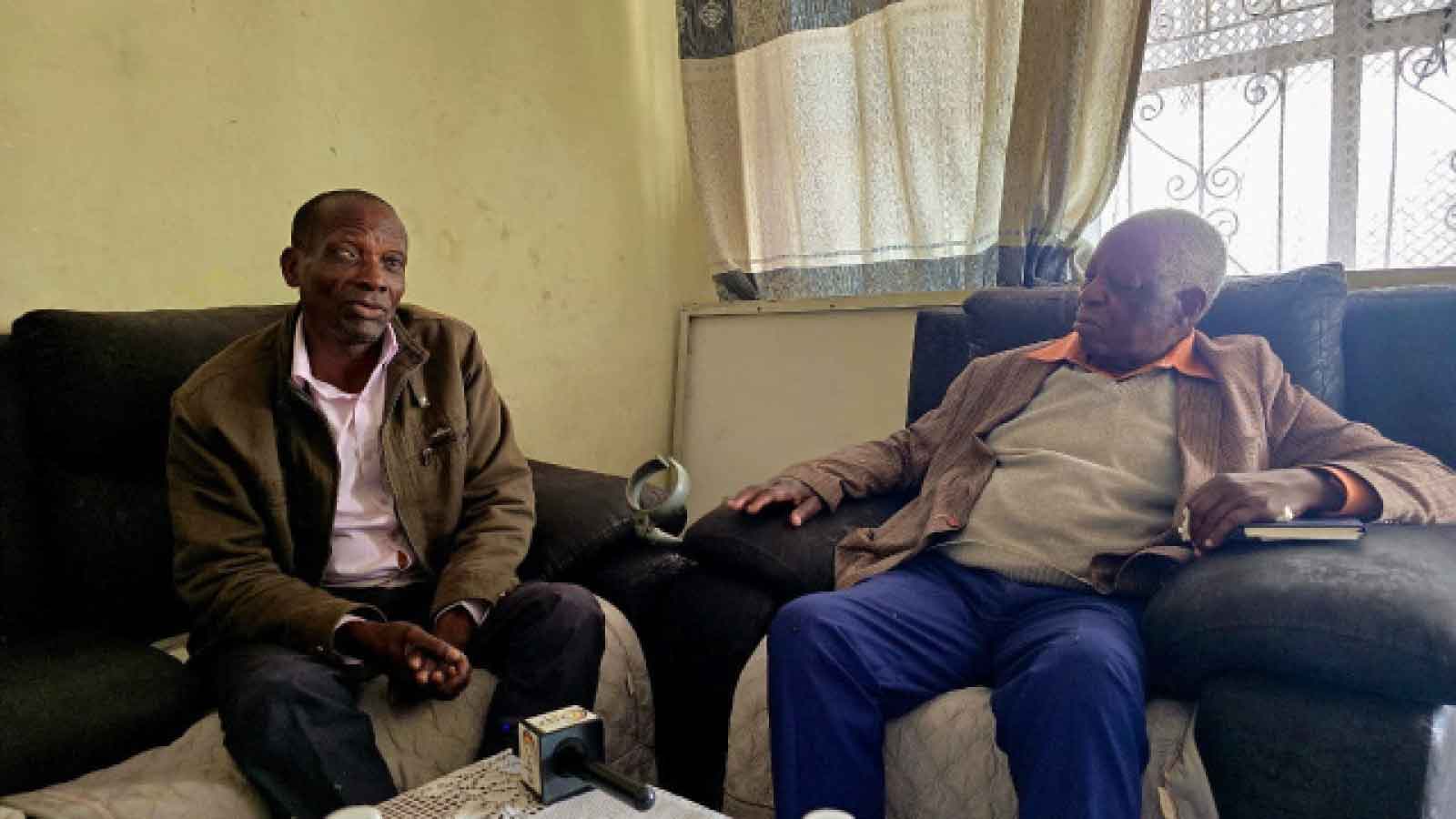
Richard Muponde and Mabasa Sasa
PRESIDENT Mnangagwa has once again demonstrated that the Second Republic will not abandon the men and women whose blood, sweat, pain and sacrifice laid the foundations of an independent Zimbabwe after extending US$5 000 towards the medical needs of veteran freedom fighter Cde Benson Nicholas Kadzinga, popularly known by his nom de guerre, Sadat Kufamazuva.
The assistance, handed over this Friday, in Mt Darwin by Institute of African Knowledge chairman Professor Simbi Veke Mubako, comes as the nation continues to give practical meaning to this year’s Heroes Day commemorations theme, “Lest We Forget”.
For Cde Sadat, now living in Mt Darwin, the President’s intervention is not merely financial assistance.
It is recognition of a living witness to one of the darkest and most consequential moments of Zimbabwe’s liberation struggle, the devastating Rhodesian-sponsored bombing in Lusaka that killed the late Zanu national chairman, Cde Herbert Wilkshere Chitepo, and Cde Silas Shamiso on March 18, 1975.
Born in 1952 in Murehwa, Cde Sadat attended St Albert’s Mission, a Roman Catholic-run institution where, during his early years, he served the priests popularly known as the Fathers.
From those humble beginnings emerged a committed son of the soil who would later join the nationalist movement and become Cde Chitepo’s office assistant during the defining years of the armed liberation struggle.
On that fateful morning in Lusaka, Cde Sadat was in the vehicle with Cde Chitepo when the powerful explosion tore through the car.
Cde Chitepo and Cde Shamiso were killed, while Cde Sadat survived after being thrown from the vehicle unconscious and suffering extensive and serious injuries.
But the physical wounds were only the beginning of another ordeal.
In the aftermath of the assassination, Cde Sadat, General Josiah Magama Tongogara and Cde Joseph Chimurenga were accused of involvement in the killing of Cde Chitepo and prosecuted before the Zambian High Court.
Professor Mubako led the legal defence that resulted in the acquittal of the three comrades.
The prosecution’s case ultimately collapsed for lack of evidence, while confessions allegedly obtained through torture were rejected.
The acquittal became a crucial moment for the liberation movement, which had been plunged into turmoil following Cde Chitepo’s assassination.
Cde Sadat and Cde Chimurenga subsequently returned to the liberation struggle, while General Tongogara went on to lead ZANLA forces until the ultimate victory of the revolution.
The enemy may have detonated the bomb that killed Cde Chitepo, but it failed to kill the revolution.
It failed to extinguish the people’s determination for freedom. And it failed to destroy the revolutionary spirit embodied by surviving cadres such as Cde Sadat Kufamazuva.
Today , more than five decades after that explosion changed his life forever, Cde Sadat said he was deeply touched by President Mnangagwa’s intervention.
“I want to thank President Mnangagwa for the donation. It will go a long way towards my medication. With this donation I will deliberate with my wife to see how I can be assisted medically. She is taking good care of me,” said Cde Kufamazuva.
His gratitude also extended to Vice President Dr Constantino Chiwenga, who recently intervened after learning that his health condition had worsened.
“However as I pass these gratitudes, my wish is to make them in person to President Mnangagwa and Vice President Chiwenga. He also helped me last week when he heard that my condition had worsened. He sent people to collect me to see a doctor in Harare.
“So my gratitude needs these people to be present so that they see my sincerity and for the benefit of my wife to see the people who are helping us.”
Cde Sadat also paid glowing tribute to Professor Mubako, whom he affectionately described as “gweta rangu, baba vangu”, thanking him for travelling all the way from Harare to personally hand over the President’s donation.
The intervention dovetails with President Mnangagwa’s repeated declaration that Zimbabwe has a permanent obligation to honour both its fallen heroes and the surviving veterans who bore the brutal burden of the liberation struggle.
Addressing the nation at the 46th Heroes Day commemorations on August 10, President Mnangagwa said the theme, “Lest We Forget”, was a “clarion call for us to remain mindful of the weighty obligation we have, to those who laid the foundations for the Zimbabwe we are today”.
“We stand on the shoulders of giants, many of whom are not recorded on glittery books or epitaphs of stone, but their blood is eternally blended with the soils of our land,” said the President.
President Mnangagwa said Zimbabwe owed its freedom to both the celebrated heroes whose names dominate the country’s history and countless other patriots whose sacrifices may never have received the same prominence.
“They have given this country an immeasurable gift through their service. To them and those departed, the nation is forever indebted and grateful,” he said.
Significantly, the President stressed that Government’s responsibility extended beyond ceremonial remembrance.
“Lest We Forget”, he said, the liberation struggle involved “the collective efforts and dedication of all communities, our war veterans, non-combatant cadres, war collaborators, political prisoners and detainees”.
“Government is, therefore, implementing seamless welfare support and economic empowerment initiatives to cover this special category of our demography,” said President Mnangagwa.
That commitment is being translated into concrete programmes.
At the Fourth National Assembly of the War Veterans, Ex-Political Prisoners, Detainees and Restrictees League in June, President Mnangagwa announced the scaling up of programmes including the expansion of the War Veterans Family Wealth Trust Fund, securing land title deeds and support for productive land use, specialised health centres for veterans, entrepreneurship and skills development programmes, scholarships, vocational training, housing schemes, support for war veteran-led enterprises and access to affordable financing.
“Under my leadership, the welfare of our veterans is inseparable from that of their families,” the President declared.
President Mnangagwa has also emphasised that honouring the liberation struggle means preserving the stories and memories of those who fought, suffered and died for the country.
Government has been undertaking work to preserve liberation heritage, including historical research and biography updates, digitisation of liberation war archives and the integration of liberation heritage into education and tourism programmes.
This year’s Heroes Day commemorations were held under the theme “Lest We Forget”, reinforcing the national determination that the sacrifices which birthed Zimbabwe must never be reduced to distant history or empty ceremony.
Cde Sadat Kufamazuva’s life is a powerful embodiment of that message.
He was there when the liberation struggle was under attack.
He survived the bomb that killed one of Zimbabwe’s foremost nationalist leaders.
He endured serious injuries, accusations and prosecution.
He survived to see the revolution triumph and the Zimbabwean flag finally rise on April 18, 1980.
Today, living quietly in Mt Darwin and battling health challenges, the veteran freedom fighter has received a reminder from the highest office in the land that the nation has not forgotten him.
For the Second Republic, the message is unmistakable. The freedom fighters who carried the revolution through the darkest days of colonial repression must not be discarded when their strength fades.
The fallen heroes must continue to be honoured wherever they lie, inside or outside Zimbabwe, while living veterans must receive dignity, welfare support and opportunities for empowerment.
The Rhodesian bomb of March 18, 1975, may have killed Chairman Chitepo and left Cde Sadat scarred for life.
But it did not kill the revolution.
It did not destroy ZANU.
It did not stop the armed struggle.
And, under the enduring national pledge of “Lest We Forget”, Zimbabwe will not forget those who paid the price for the freedom it enjoys today.