admin
admin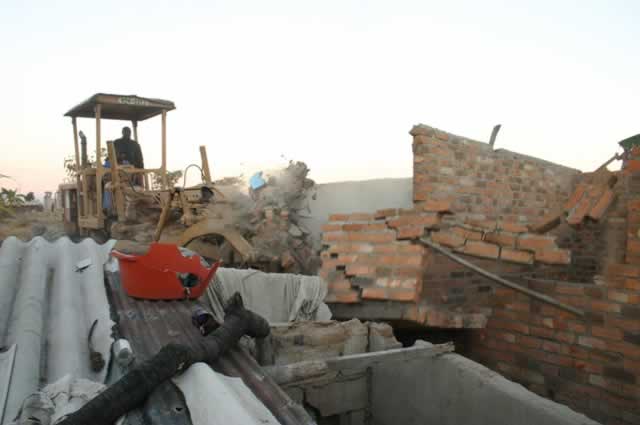
Pardon Gotora Features Correspondent
For one reason or another, evictions are imminent especially to people occupying pieces of land that were planned for other uses in terms of the land use planning laws.
Some evictions also result when Government wants to use the land, like the case in the diamond mining areas of Chiadzwa.
A tenant or lodger who resides in rented accommodation can be evicted by the landlord/landlady. Another form of eviction involves vacating your place of residence and the subsequent demolition of the buildings. For some time, Government has been facing a number of challenges in providing decent and affordable accommodation.
Because of the inclement economic sanctions imposed on the country at the turn of the millennium, Government, the largest employer, found it difficult to pay the workers a decent salary which commensurate with the poverty datum line.
The situation was exacerbated by the hyperinflation for almost a decade.
As a result civil servants and many other workers were surviving from hand to mouth and they could not save money to buy a residential stand or a house.
The unemployment rate is very high as well, and other people resort to vending in the streets to gain an income.
But, they sometimes play cat and mouse games with municipal police resulting in them failing to sell anything. Such people also have a dream of getting decent and affordable accommodation of their own one day.
Owning a decent house has remained a pipe dream for the majority of the people, save for those benefiting from the Government’s housing policy after independence. This was when the sitting tenants were allowed to purchase the houses they were renting from Government and councils paying over a period of 25 years after which they would get title deeds as security of tenure.
Only 10 percent of the houses were reserved for rental housing.
Today, most people cannot afford to pay monthly rentals and rates in addition to other demands such as school fees, transport and food.
As a result, they resort to illegal occupation of every open space, be it along the stream banks, State or council land that has not yet been developed or even on wet lands. That is how informal settlements emerge and it usually begins with one or two families.
Others watch from a distance and if the first occupants are not evicted within a short space of time then the occupation becomes “legal” and some begin to clandestinely sell the stands to equally desperate home seekers.
Startlingly, the fraudulent estate agents or developers target the same desperate low income people to fleece them.
In no time, the area will be awash with shacks. Others might even have the guts to build permanent structures following assurances from the property dealers.
The land is unplanned so all developments there are unsanctioned by the planning authorities. The occupants are usually not bothered to follow procedure. In some cases, the stand dealers produce fake layout plans, which they use as a basis to deceitfully sell the stands to unsuspecting home seekers.
There are a lot of planners who just produce draft designs for proposed developments, but they will not be submitted for approval for the obvious reasons.
However, every local authority has its own by-laws, which must be adhered to.
The department of physical planning in the Ministry of Local Government, Public Works and National Housing must approve the layout plans before any development takes place.
Now the bone of contention is, the land would not have been allocated by the responsible authority, hence it would be impossible to submit the “layouts” for approval.
But the land is occupied and there are structures. What do the authorities have to do — evict the illegal settlers or regularise the settlement?
If eviction is imminent what are the procedures?
Some lobbying organisations like Slum Dwellers International (SDI), headquartered in India, and its affiliates as well as other human rights organisations will fight with their backs on the wall to defend the illegal settlers or squatters.
At the same time the international community, especially the West, will have an easy prey once there are evictions of that genus.
In Kenya, for instance, Kibera has become a tourist attraction due to the nature of its squatter settlements and is even a fertile ground for scholars who wish to study on squatter settlements.
Another example is Soweto in South Africa and Epworth in Zimbabwe.
There is a lot of literature on Epworth.
The Constitution of Zimbabwe Amendment (No. 20) touches on freedom from arbitrary eviction.
It states that “no person may be evicted from their home, or have their home demolished, without an order of court made after considering all the relevant circumstances”.
From a layman’s point of view, evictions do occur, but what are the relevant circumstances that can warrant an eviction?
Furthermore, the 2012 National Housing Policy states clearly that there will be no evictions without alternative accommodation.
This position was reached at after the experiences of Operation Murambatsvina, the clean-up exercise that was done in 2005 to rid of illegal settlements and side-buildings.
The concept is too good to be true and it sounds easier said than done.
Providing alternative accommodation requires substantial funding to construct houses and the basic requisite infrastructure.
Before relocating the evicted people, it means there have to be structures ready for occupation. Those who were relocated from the Chiadzwa area, had some beautiful houses already built for them at the Arda Transau by the mining firms. Some houses were even better than what they previously owned.
This was a blessing in disguise for the Manicaland Province and it is an envy of many a people who have had the chance to visit the new settlement. But how often do we get such kind of gestures as a country whenever an eviction is irrevocable?
Assuming that it is the council or the Government who want to evict illegal settlers, the policy insists on alternative before eviction, do they have the financial muscle to effect evictions even if they possess a court order?
Can they afford to build for those to be evicted yet they have failed to build for them before they illegally grabbed the land?
There is an acute shortage of capital to fund development of off-site and on-site infrastructure in the country.
The same institutions expected to deliver housing are faltering due to lack of adequate funding, yet they will be expected to provide alternatives with the basic water and sanitation services. One wonders how this is practically possible though on paper it sounds implementable.
The notion is in line with the Habitat Agenda 21 and it was advocated for by the people who were victims of Operation Murambatsvina, but can we afford that as a nation when we are failing to provide for legal settlers.
The other dimension is that, if one benefits from the alternative, it would imply that illegally occupying stands befits the conduit pipe to own a decent house in the urban areas or anywhere else.
Can we cut corners by creating informal settlements which the Government is expected to regularise later as a way of protecting human rights or to provide alternative accommodation in order to get rid of them? Are we not creating brisk business for fraudsters who will manipulate the window provided for in the policy and make money out of nothing?
If we are to legalise and regularise their stay, are we not condoning lawlessness? At the same time can we just wish away slums/squatters and informal settlements?
It is high time that the housing sector puts the heads together to fight this scourge. Similarly, we have had programmes such as urban renewal put on hold due to lack of funding.
Areas such as Tagarika Flats in Harare, Rimuka in Kadoma (Musana Wenzou houses), Chinotimba in Victoria Falls, benefited from urban renewal programmes. But these were not enough and more needs to be done. Furthermore, some houses are old enough to be replaced.
Pardon Gotora works as a Housing Officer in the Ministry of Local Government, Public Works and National Housing. He writes in his personal capacity. Opinion and his views must not be viewed as the views of the ministry. For feedback: [email protected]



 Online Reporter