admin
admin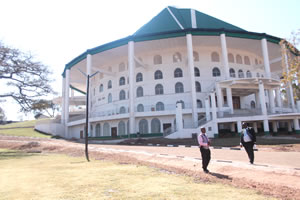
Masvingo, Bikita and Mutare can clearly see it towering 20 kilometres from the popular Roy bus stop over.
Standing tall in the heart of a rural community, the structure, like a big lone mushroom rests on a mountain at Mbungo Estates along the Masvingo-Mutare Road.
Many visitors and passers-by alike have mistaken it for a hotel and questioned the business sense behind constructing such a structure deep in a rural area.
At one time, it is said, a group of bikers coming from Nyanga trooped into the premises seeking accommodation.
But lo and behold, those who had other ideas about this place have been surprised after finding out that it is a multi-million dollar conference centre for the Zion Christian Church.
Some now call it the Star Temple on account of its shape which depicts the star on the church’s badge.
A tour around the facility recently brought out how the conference centre which was officially opened by President Mugabe in April this year is not just a mere big building but proof of the church’s faith in itself. It is also an indication of what churches can do to empower their members and surrounding communities at large.
Construction begun is 2005, at a time when the country was facing the highest inflation rate. But because of determination, the church worked hard and managed to build what people admire today.
Theirs is a success story as they have exposed the Bikita community to a rare brand of architecture and technical expertise which is now likely to be designated as a religious tourism shrine. The conference centre is not just religious site, but also an extremely beautiful architectural masterpiece built on 5 000 square metres of land.
With an estimated membership of 1,5 million, the church’s pilgrimages are attended by between 50 000 to 100 000 both local and from neighbouring countries each year.
The time we spent here revealed that while all churches are beautiful and mysterious in their own way, there are some that stand out from the rest.
Upon arrival at the estate, we are welcomed by a guard who quickly jots down all required information and asks the purpose of our visit.
The guard uses a radio to communicate with his superiors, opens the boom gate and gives us directions to the offices of one of the people in charge.
He asks us if we want their holy water spinkled on our faces and we agree. An elderly man holding a tin presides over the process and wishes us well.
As we drive along the 100 metre tarred road, a blanket of green welcomes us. Several women are weeding onions and green leafy vegetables. A handful of men and women are moulding bricks while bulldozers, combine harvesters and lorries belonging to the church are stationery next to them.
Two women carrying roofing planks on their heads walk to an administration block under construction while others are cleaning the premises.
We meet Mr Nathaniel Sanctions Mutendi who is the chairman of the media committee, Mr Raymond Muungani the church education secretary and member of the media committee and Mr Micheal Machote who is in charge of operations at the estate. But I have to wear a skirt and cover my hair with a cloth as the area we are about to go into is holy. I abide by the rules and our journey begins.
We are told that the conference centre was built by volunteers from the ZCC church and construction began in 2005.
Architects, builders, brick molders, carpenters, electricians, painters, lorry drivers among many others are all church members.
Most of the people had little or no knowledge of some of the areas they volunteered to do, it was all on-the-job training.
“All these women and men are members of our church doing voluntary work. This building is a reflection of the hard work by our members,” says Mr Muungani as he leads us to a big gate.
Holding the hinges of the gate are replica models of the Great Zimbabwe’s conical towers. Mr Mutendi then explains the importance of the replica of one the country’s most important historical sites.
“These are an indication of Zimbabwe. You first arrive in Zimbabwe before you get to this place. Secondly, we are in Masvingo which houses such architectural sites and besides, the founder of this church Samuel Mutendi is of the Rozvi totem so the ruins have a significance in the family. The vaRozvi are the ones who built the Great Zimbabwe,” he explains.
As the wide gates open, the three let us in on how the massive structure came to being. The church bought the 1 200 hectares of land in February 1981 and only one fig tree stood.
The fig tree is still at the church as it is an important piece of history for them. If it would talk it would say a lot of things it has seen in its lifetime.
“We had our first big Sunday conference during the Easter holidays the same year. The idea was to gather here three times a year during our pilgrimages and other Christian holidays.
“We had problems whenever rains fell and saw the need to find shelter with the guidance of the Holy Spirit. We believe this was a gift from God,” revealed Muungani as he guided us to a staircase leading to the conference facility’s main entrance.
He points out they used bulldozers to dig up a section of the hill the church sits on.
“Naturally we are Zionists and love our mountains. Our God is found in high places. The star shape of the building is representation of our badge. The design of our church is supposed to reflect our uniform whose colours are the green cloth badge, white, blue and gold,” said Mr Muungani.
The gold coated large brass handles and hinges that support the weight of the large hard teak doors blend well with the designs.
We stroll into the mezzanine area, which has a reception area. The area has both walled and floor tiles.
From there we move to the main conference area. There is a large star inscribed ZCC in the middle of the floor, while another makes the centre of the roof made of green traffic chromadel.
“We chose green traffic chromadel because of its lighting and it does not put a huge load on the building. It is also maintenance free. By design, it fits well with steel and timber structure we have,” said Mutendi.
The floor is a cream blanket of tiles, so are the terraces in the 24 000 seater facility.
There are 24 terraces on each of the 10 bays. The VIP section and podium face the main entrance and the shape of the conference room makes it easy for people in all bays to see the core.
“We used more than 10 thirty tonne trucks for wall and floor tiling. This is a house of God and we want the best. We are not very concerned about the VIP issue and as you can see this conference room has this shape and same materials because everyone is important in the eyes of God,” adds Mutendi.
As we move around, some church members are busy mending some tiles and certain areas they feel were not properly done. They are also repainting some sections of the large building and say they strive for perfection. They say they are also preparing for their annual conference in August.
We are led to a large briefing room which can also be used as an overflow if the main conference room is filled to capacity. Televisions will be fitted in the overflow rooms.
“The President was the first to be briefed in this room when he came in April,” adds Mutendi.
Next to the briefing room are sanitary facilities and a room which will be used as a clinic when there are large gatherings.
“We have doctors who attend our church and they will take care of all those who fall sick during the conferences. There are also eastern and western entrances that can all be used without anyone going through the main conference centre. The second floor is used for storage of church equipment that cannot be handled by anyone while the third floor houses eight offices and six lecture rooms.
“The lecture rooms can be used by anyone from the church. For example the youths, women and men groups can utilise them,” Muungani explained.
He said they will use a massive cordless public address system that can be audible both inside and outside the conference room. Mr Mutendi then explained that the money used to build the conference facility was purely from church member subscriptions.
“There have been talks that the some Chinese nationals helped us built this church. It is not all true as all the money came from our members who also took part in the construction,” he emphasised.
Mr Mutendi said they faced numerous challenges during construction of the multi-million facility and chief among them was hyper-inflation and the exchange controls.
“We were still using the Zimbabwean currency and exchange controls hindered the construction of conference facility since we had to import a lot of materials.
“This was a heavy challenge but we realised that our God is a great one. We triumphed and this conference facility became our point of testimony,” Muungani said.
He said they will be using the commercial world and community for their forthcoming conference.
“Leading food outlets will provide catering during the conference. We will build temporary structures for them for use during the period. It will be a hive of activity and more of an exhibition as the community will also come out to sell their merchandise to conference delegates,” he added.
They have also built an eight roomed accommodation facility with luxurious ensuite bedrooms. So determined were they to build the conference centre that their leader Nehemiah Mutendi an avid Coca Cola lover had to forego drinking his favourite beverage for close to six years.
He only drank it for the first time at the official opening in April as he gave his testimony.
“This was in solemn recognition of work. He did this to show us that we had to tighten our belts as we put our hands on the plough. This was to show that you can forego the things you like in life to make dreams come true,” said Mr Mutendi.
He said their church and conference centre at Mbungo Estates is likely to be designated as a religious tourism shrine as recommendations have been forwarded to Tourism and Hospitality Industry Minister Walter Mzembi for approval. Zimbabwe Tourism Authority chief executive officer Mr Karikoga Kaseke is on record saying plans were already underway to make the ZCC church a religious tourism shrine.
He said the physical size of the church and its spiritual meaning made it an ideal facility to be declared a religious tourism shrine.
“We have already made recommendations to the Minister (Mzembi) for the ZCC church complex and conference centre at Mbungo Estates to be made a tourism religious shrine. We came up with that idea after considering the fact that there is no other church in sub-Saharan Africa that is physically big as the Mbungo church.
“Moreover the ZCC church is bigger in terms of spirituality as tens of thousands of people regularly converge there to develop themselves spiritually,” Kaseke said.
He added that they were now waiting for Minister Mzembi to give them the nod to make the ZCC church complex and conference centre a religious tourism centre.
“Once that is done we hope that both local and international religious tourists will flock to the complex just to see it and its enormous size and also to develop themselves spiritually,” he said.
Minister Mzembi also said the declaration of the ZCC church complex at Mbungo estates, as a religious tourism centre would be a positive development for Zimbabwe’s tourism.
“We are still working on the issue but it’s a positive development that will improve and add another dimension in Zimbabwe’s tourism. We would be able to have declared the ZCC church complex a tourism religious shrine before the church’s annual conference that is set for August and will be graced by thousands of foreign visitors,” said Minister Mzembi.
He said plans were already underway to install a public viewing centre at the church complex to enable some of the visitors who will not be able to be accommodated inside the church to view proceedings from outside.
This will not be the first time that a country would have used religious shrines as tourism spectacles as millions of tourists annually flock to the Vatican’s St Peter’s Basillica in Rome and Mecca in Saudi Arabia as pilgrims thereby benefitting those countries as religious tourists.
ZCC is one of the oldest indigenous churches in Zimbabwe, having been founded in 1913. The church regards the year 1913 as the year that God remembered them after the founding father Reverend Samuel Mutendi received his spiritual bath while he was serving as a police officer in Chegutu (then Hartley).
Reverend Mutendi was a powerful preacher, who also had the rare gifts of faith healing and rain-making, which made him very popular among the rural folk.
He healed people with holy water, his holy rod (Mapumhangozi), ordinary salt and coffee.
[email protected]


 Online Reporter