Online Reporter
Zimpapers Business Hub
Businessman Mutumwa Mawere, one of the country’s successful black entreprenuers from the mid-1990s to the early 2000s, who died in South Africa on Thursday, once built an expansive business empire that straddled key sectors of Zimbabwe’s economy.
Mr Mawere, who had turned 66 on January 11, died on Thursday morning at the Mediclinic Sandton Hospital in Johannesburg, where he had been receiving intensive medical care at the specialised facility for several months.
The businessman had earlier been diagnosed with an acute neurological condition, but medical details of his death are yet to be revealed.
His elder brother, Mr Vincent Mawere, confirmed the businessman’s death on Thursday saying the family is still awaiting the full details of the medical complications that led to his death.
“I received the news that my brother passed on in South Africa, where he was staying. He suffered a stroke in 2024,” said Mr Vincent Mawere.
“I am still to get full details about what actually transpired.”
According to Mr Mawere’s close business associate, Mr Tichaona Mupasiri, his health challenges began on June 12, 2024, when he suffered a stroke during a dinner in Morningside in South Africa after attending a court session in Johannesburg.
Mr Mawere’s educational and professional background spoke a lot about the successful businessman he later became.
The businessman was educated in Zimbabwe, Swaziland, the United Kingdom and the United States. Mr Mawere held a BSc (Economics), MSc (Management) and MBA (Finance & Investments) degrees, as well as other professional qualifications.
He began his professional career as an actuarial student in 1984.
In late 1984, he joined the Industrial Development Corporation of Zimbabwe as a Research Economist and rose through the ranks to become a senior research economist in 1987, before joining the Merchant Bank of Central Africa in the same year as a Corporate Finance Executive.
In 1988, he joined the World Bank as a young professional. After completing his training programme in 1989, he was appointed as an investment officer for the International Finance Corporation (IFC), the private sector lending arm of the World Bank.
He rose through the ranks to become a senior investment officer in 1994. In 1995, Mr Mawere resigned from the World Bank and migrated to South Africa.
The businessman is recognised as a pioneer of black economic empowerment in post-independence Zimbabwe from the time he ventured into the realm of entrepreneurship.
He successfully acquired key assets during the country’s privatisation era, notably the Shabanie Mashaba Mines (SMM) conglomerate, and diversified his holdings into an empire spanning mining, finance, manufacturing, agriculture and telecommunications.
At its peak, his companies employed thousands and generated substantial turnover.
The fact that Mr Mawere’s businesses once employed over 20 000 people speaks volumes about the vast business empire he built.
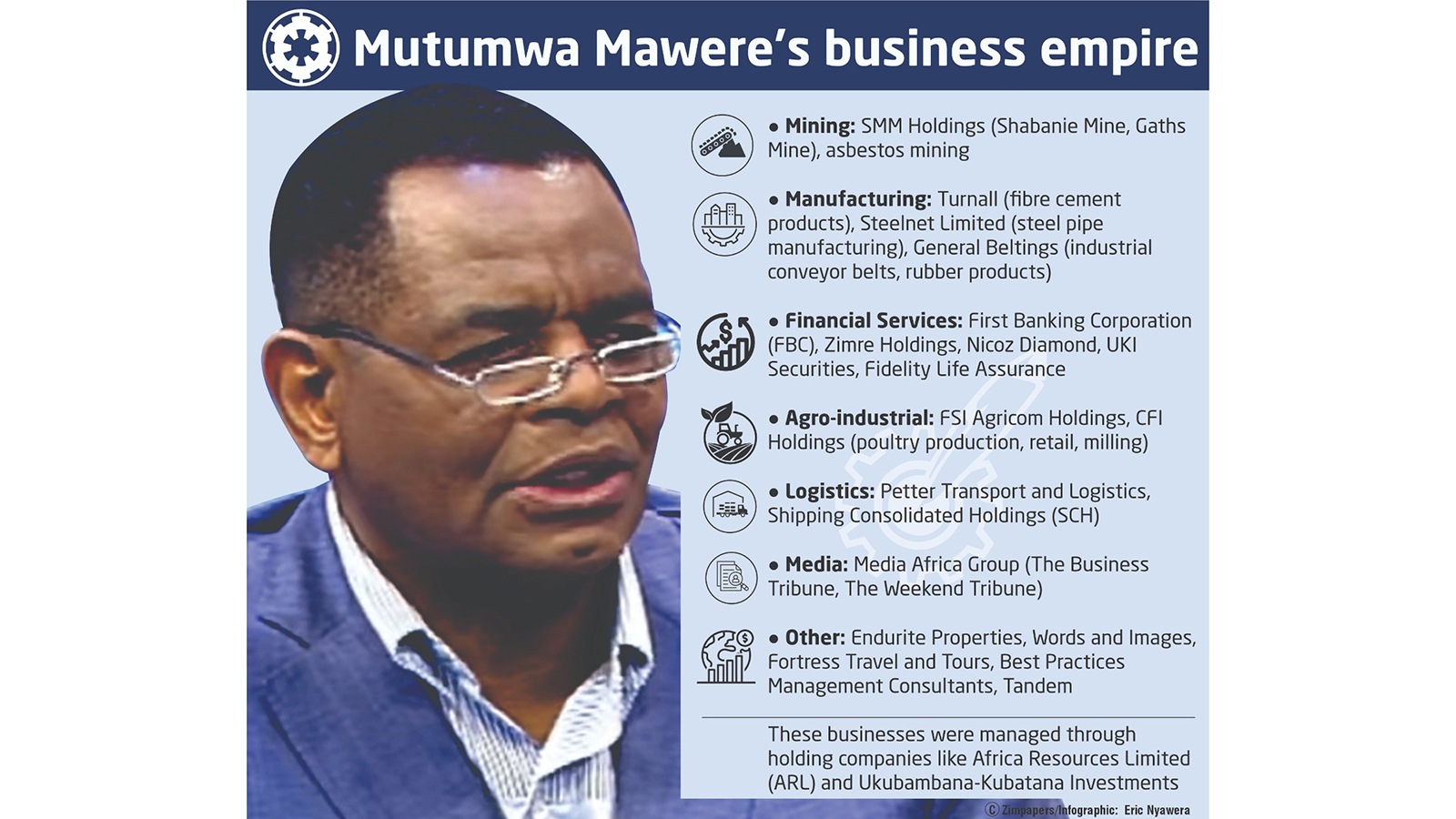
At the peak of his business success, Mr Mawere had built an empire that touched nearly every corner of the Zimbabwean economy, managing an extensive investment network primarily through his wholly-owned holding company, Africa Resources Limited (ARL), alongside investment vehicles such as Ukubambana-Kubatana Investments (UKI) and Endurite Properties.
The cornerstone of the industrial giant was the acquisition of asbestos mining assets, which provided the essential liquidity to fuel its aggressive expansion into a multitude of other sectors.
At the heart of his industrial operations was Shabanie Mashaba Mines (SMM) Holdings, the parent company for Shabanie Mine in Zvishavane and Gaths Mine in Mashava, which was the sole producer of chrysotile asbestos in Zimbabwe and a dominant force on the global market.
The vertical integration was strengthened by his significant stakes in Turnall, a leading manufacturer of fibre cement products like roofing and piping, and Steelnet Limited, which specialised in steel pipe manufacturing through Tube and Pipe Industries.
Complementing these heavy industries was his ownership of General Beltings, a key producer of industrial conveyor belts and rubber products essential for the mining sector.
Mr Mawere also secured major stakes in privatised State entities to build a robust financial services investment portfolio.
He founded First Banking Corporation (now FBC), which has evolved into one of the country’s leading commercial banks.
His influence extended into the insurance sector, where, through UKI, he became the largest shareholder in reinsurance giant Zimre Holdings, subsequently overseeing the merger of Nicoz Insurance with his own Diamond Insurance Company to form the market leader Nicoz Diamond, while also unbundling Fidelity Life Assurance and establishing UKI Securities as a dedicated stockbroking firm.
His agro-industrial interests were further bolstered by FSI Agricom Holdings, which provided comprehensive supply chain solutions for farmers, and a significant interest in CFI Holdings, a group encompassing poultry production via Suncrest, retail through Farm & City, and specialised milling operations.
The reach of the ARL empire was rounded out by a sophisticated network of logistics, media, and professional services designed to support the group’s internal needs and the broader market.
This included Petter Transport and Logistics and Shipping Consolidated Holdings (SCH), which managed international forwarding between Durban and Zimbabwe, as well as Media Africa Group, the publisher of The Business Tribune and The Weekend Tribune.
These were supported by specialised firms such as Words and Images for public relations, Fortress Travel and Tours, Best Practices Management Consultants for human resources, and the heavy-duty trailer manufacturer, Tandem.