Vusumuzi Dube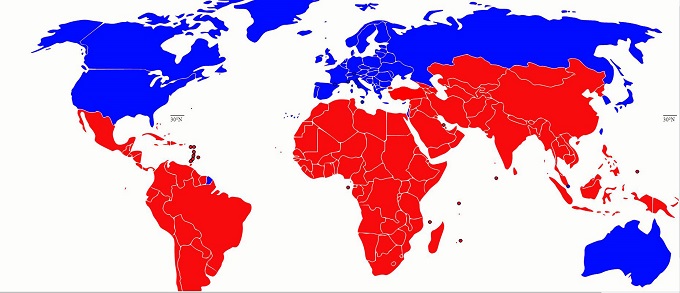
Alpha Pasanai, Correspondent
In the development and social sciences circles the terms developed and developing countries when describing the disparities in development across regions have lost their popularity. The concept of the Global North and South has gained significant attention in the development and social sciences discourse as a way to understand and analyze the dynamics of power, development, and inequality in the world. The origins of these terms can be traced back to the mid-20th century and the emergence of post-colonial studies.
The terms “Global South” and “Global North” are widely used in the field of social sciences to describe the economic, political, and social disparities between different regions of the world.
The concept of the Global South emerged as a result of decolonisation movements and the subsequent struggle for economic and political autonomy by countries that were formerly colonised. It was initially coined by economists and political scientists to describe the countries of the developing world that faced similar challenges in terms of poverty, underdevelopment, and dependence on the global economic system dominated by the Global North.
On the other hand, the term Global North refers to the industrialised, economically advanced countries of the Northern Hemisphere, primarily in Europe and North America. These countries have historically been the centers of economic and political power, enjoying higher standards of living, advanced technological capabilities, and greater influence in global affairs.
The division between the Global South and North is not merely geographic but also reflects the historical legacy of colonialism and the unequal distribution of resources and power. The Global South is characterised by high levels of poverty, limited access to education and healthcare, political instability, and dependence on the Global North for aid and investment. In contrast, the Global North enjoys economic prosperity, political stability, advanced infrastructure, and greater control over global institutions and decision-making processes.
It is important to note that the terms Global South and North are not fixed or static categories, but rather represent a continuum of development and power dynamics. Some countries may transition from the Global South to the Global North due to economic growth and improved living standards, while others may experience setbacks and fall into the Global South category.
In conclusion, the terms Global South and North emerged from the need to analyze and understand the profound disparities in economic and social development between different regions of the world. These terms highlight the historical legacy of colonialism and the ongoing struggles for economic and political autonomy in the Global South, as well as the privileges and advantages enjoyed by the Global North. By acknowledging these disparities, researchers and policymakers can work towards addressing the root causes of inequality and promoting more equitable development globally in pursuant of achieving the global sustainable goals (SDGs) 2030.
The Author Alpha Pesanai is a Member of the Project Management Institute (USA) and is a Project and Development Management Specialist. He holds a Master of Social Science Degree in Public Policy and Development Management, Bachelor of Social Science Honours Degree in Monitoring and Evaluation Studies, Bachelor of Commerce Honours Degree in Finance and an Executive Certificate in Project Management. E-mail [email protected].



 Online Reporter