Online Reporter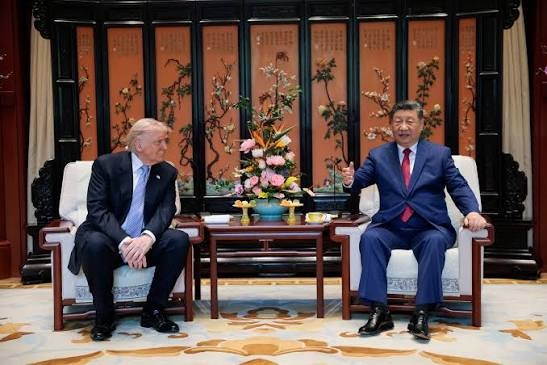
Saxon Zvina
The meeting between Chinese President Xi Jinping and US President Donald Trump in Washington on 23–25 September arrives at an unusually important moment for international affairs. China has confirmed Xi’s state visit at Trump’s invitation, marking the second face‑to‑face encounter between the two leaders within six months. Chinese Foreign Ministry spokesperson Guo Jiakun described the reciprocal visits as carrying “historic, milestone significance.”
For Africa and the wider Global South, however, the summit’s significance lies less in any single bilateral agreement than in what it could mean for the broader international environment.
A New Rhythm in Great‑Power Diplomacy
The Washington meeting follows Trump’s May visit to Beijing, where the two leaders agreed on a framework described by Xi as a “constructive China‑US relationship of strategic stability.”
China defines that concept around four elements: cooperation as the mainstay, competition within proper limits, manageable differences and an expectation of lasting peace.
Whether this framework can hold amid continuing disagreements over trade, technology, Taiwan question, rare earths and other strategic questions remains uncertain. Yet the very frequency of high‑level engagement carries signal value.
The two governments are already discussing mechanisms for managing economic disputes and artificial‑intelligence risks. Ahead of the summit, senior Chinese and US officials held talks on trade and AI, while Washington and Beijing also agreed to establish an AI dialogue.
The immediate objective, therefore, may not be to eliminate strategic competition, but to prevent it from hardening into uncontrolled confrontation. Whether such mechanisms can durably contain structural disagreements over trade, technology and other strategic issues remains an open question.
That distinction matters enormously to the Global South.
Why the Global South Has a Direct Stake
Most developing economies are economically connected to both China and the United States. They participate in supply chains linked to Chinese manufacturing, rely on Western capital and technology, and depend on relatively open global markets.
A prolonged US‑China confrontation would therefore not remain confined to Washington and Beijing. Tariffs, technology restrictions, financial fragmentation and competing standards could impose costs on countries with little influence over the underlying dispute.
Conversely, greater stability between the two largest economies could create additional room for developing countries to pursue diversified foreign, trade and investment policies without being forced into rigid geopolitical blocs.
This is particularly important for Africa.
African governments increasingly seek partnerships with China, the United States, Europe, the Gulf states, India, Japan and others. A world in which those partnerships are treated as mutually exclusive would narrow Africa’s strategic choices. A world in which major powers compete while maintaining functional relations would grant greater diplomatic and economic flexibility.
Africa’s Opportunity: Strategic Autonomy, Not Alignment
The potential African benefit from the Washington summit is therefore indirect but substantial.
First, reduced geopolitical tension could lower the pressure on African states to choose sides. African countries could engage China on infrastructure, manufacturing and trade while simultaneously cooperating with the United States and Europe on technology, investment, education and security.
Second, greater predictability in China‑US relations could shape the future of critical‑mineral supply chains.
The rare‑earth dispute illustrates the issue clearly. China remains central to global rare‑earth processing, while the United States and its partners attempt to diversify supplies. For African producers, this creates an opening to negotiate investment not merely in mining, but also in processing, refining, infrastructure and technology transfer.
Yet the nature of that opportunity could shift if China‑US competition becomes more institutionalised and predictable. Rather than profiting from geopolitical uncertainty, African countries could pursue longer‑term arrangements in which they participate in diversified supply chains while retaining control over their own development priorities.
That would represent a more durable form of leverage. Realising that opportunity also depends on Africa’s own domestic reform, investment‑climate improvement and institutional capacity‑building.
From Being Discussed to Shaping the Rules
There is another important dimension.
The Global South is increasingly demanding a greater role in setting the rules governing trade, technology, finance, energy and critical minerals. The question for Africa is not simply whether China and the United States reach accommodation. It is whether African countries can use the resulting diplomatic space to strengthen their own negotiating position.
That requires continental coordination.
On critical minerals, for example, African countries could seek common approaches to local beneficiation, infrastructure investment, long‑term offtake agreements, environmental standards and technology transfer. Rather than competing exclusively for foreign capital, they could increasingly compete on the quality of the industrial ecosystems they build around their mineral resources. Developing local processing capacity faces tangible bottlenecks including power‑supply gaps, limited digital infrastructure, skilled‑labour shortages, institutional‑capacity limits and cross‑jurisdictional regulatory‑coordination hurdles. Such industrial upgrading carries objective thresholds and cannot be rushed through short‑term implementation.
The same principle applies to artificial intelligence, digital infrastructure, energy and manufacturing.
A more stable international environment creates space for African agency, but it does not automatically produce that agency.
The Summit’s Inherent Limits
Expectations should nevertheless remain calibrated.
The Washington summit is fundamentally a bilateral engagement. Its immediate agenda includes trade, technology, AI and other areas of Sino‑US disagreement. Current reporting indicates that rare earths and AI are among the issues receiving particular attention.
Nor is there any guarantee that leader‑level agreements will eliminate subsequent disputes. The relationship remains competitive, and substantial differences persist.
For Africa, therefore, the summit should not be treated as a guarantee of geopolitical stability. Its significance lies in whether the two powers can establish mechanisms that render disagreements more manageable and reduce escalation risks.
The Real Test: Turning Space Into Agency
The true importance of the 23–25 September meeting may ultimately be measured not by the number of agreements signed, but by whether China and the United States demonstrate that major‑power competition can coexist with dialogue, economic interdependence and crisis management.
For the Global South, such an environment provides valuable strategic space.
For Africa, that space should be used to deepen economic diversification, strengthen regional integration, attract competing sources of investment, develop local processing capacity and expand its voice in global rule‑making.
The Washington summit cannot write Africa’s future. But if it contributes to a more predictable international environment, Africa will have greater room to write more of that future itself — a process that will depend on sustained domestic reform and institutional capacity‑building, rather than on external goodwill alone.
—
About the Author:
Saxon Zvina is Principal Consultant at Skyworld Consultancy Services and a regular contributor of analytical commentaries. His research covers African energy strategy, global‑south development and international relations.
Email: [email protected] | X: saxonzvina2