admin
admin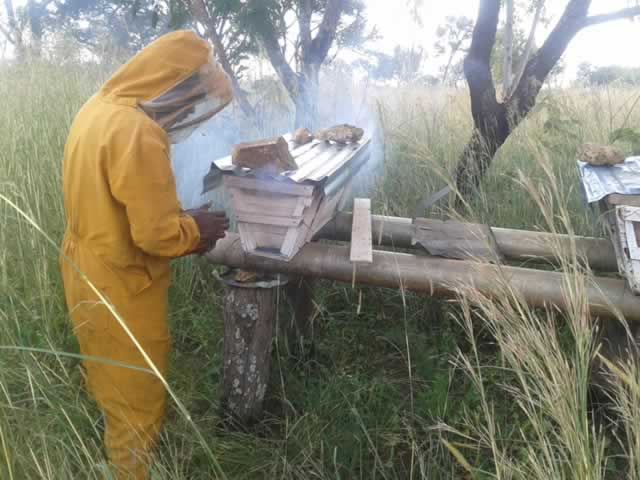
Petros Zivengwa Features Writer
Not many would dare to understand or see the brilliance associated with bees, let alone keeping and protecting the beautiful insects from a seemingly harsh environment. Some will do everything to ensure that they do not cross their path despite being some of the most valuable insects in the world.
As such apiculture or beekeeping is an industry only for the most cunning and daring.
Quite understandable, because bees have a nasty sting and are considered to be dangerous.
In most countries, Zimbabwe in particular, apiculture is remains marginalised.
Despite honey’s “extraordinary abilities” in health issues, bees remain one of the insect groups that many people do not understand.
In fact, the majority of people hate them.
But for Midlands’ beekeeper Mr Cephas Hove (52), who has specialised in bee capturing and management, hive manufacturing and honey production for the past 17 years, bees are valuable friends that every farmer must have.
That is considering their role in pollination and the healing properties of honey.
Mr Hove has grown to be a “friend of bees”.
“I worked as an agricultural extension officer for 28 years and that is when l realised that beekeeping projects were marginalised throughout Zimbabwe and I then developed a passion to study about bees,” he said.
“I realised that bees are not comfortable with smoke which is why I use only smoke to contain them.”
Mr Hove uses smoke from grass or trees and a bee suit to capture bees and transfer them to secure areas.
The father of four abandoned his career to start the beekeeping project in Gweru in 1998 after becoming aware of its business potential in a seemingly harsh economic environment.
Today he owns more than 1 600 hives and earns an average of $4 500 per month.
Mr Hove said he harvests honey everyday and supplies most of the supermarkets in Gweru.
He has won several awards too.
“I get a lot of money in my project and I have sent my children to study abroad,” he said.
Hove said that it was easy to contain and capture bees.
“I use a smoking machine to control and capture problem bees (those at unwanted places) after that I put them in a sack or a bag with their queen. When kept in a hive they will simply start a new life there,” he said.
Hove said a queen bee was the lifeblood of a hive.
“The most interesting story about the relationship of the queen bee and other bees is that the others are loyal and submissive to their queen and they take good care of her like their celebrity,” said hove.
Mr Hove said that most African traditional leaders use the queen bee to maintain their power and control their subjects the way a queen bee is treated.
“I don’t know the magic behind it but there is a strong belief that when a leader, for example the chief, uses the queen bee together with certain juju, his or her subjects will be very loyal and submissive to his or her orders,” he said.
He also said that a queen bee is worth about $2 000 when selling it to tyrant chiefs.
The other interesting nature of the queen bee is that it can live for about five to seven years while ordinary bees only live for just three months, Mr Hove said.
As a beekeeper, according to Mr Hove, it was vital to constantly check whether the queen bee is healthy or not.
“The queen bee is the heart and soul of the honey bee colony. She is the reason for nearly everything the rest of the colony does. The queen is the only bee without which the rest of the colony cannot survive,” he explained.
Mr Hove charges not less than $40 for capturing problem bees.
He, however, said bees are also sensitive to colours and they hate red and blue the most.
Mr Hove said in most cases bees attack people wearing clothes with such colours.
“Bees do not like red and blue colours and people with such colours are the first to be attacked by problem bees while colours like grey, white, orange and green are fine,” Mr Hove said.
He said bee suits are made with favourable garments in a bid to contain their anger.
Mr Hove also runs a clinic which earns him some money.
“People come and get a bee sting for $1 because people are slowly getting to know that a single sting can boost the immune system for one year,” he said.
Mr Hove also said he was engaged in other projects in schools around Gweru urban as well as the Midlands State University.
“My vision is to extend my projects to other cities and join forces with major stakeholders so that we maximise honey production for commercial purposes,” he said.
For many years, honey has been celebrated as one of the most natural home remedies to cure a wide array of ailments ranging from asthma, chest infections and pain among a whole lot of health problems.
Mr Hove said bees had the potential to contribute much to the healthy sector and that Government and stakeholders should support the beekeeping industry.
“What is most impressive about a bee sting is that it is a powerful immune system booster perhaps owing to its antioxidant and anti-bacterial properties as many medical doctors put it,” he said.
“What many people have overlooked is that honey possesses carcinogen-preventing and anti-tumour properties. There are now more and more studies pointing to the potential role of honey in the prevention and the progression of tumour and cancer.”
Honey is also used as a natural cure in first aid treatment for wounds, burns and cuts because it absorbs moisture from the air and promotes healing.
Feedback:[email protected]



 Online Reporter