dyton mupawaenda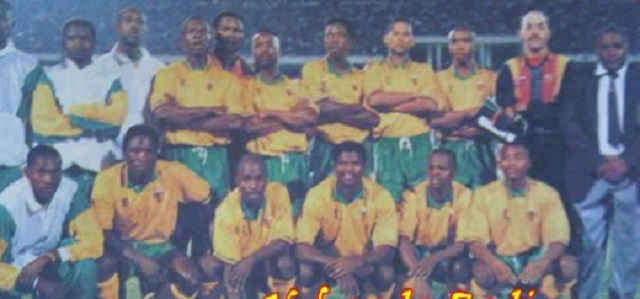
Sharuko on Saturday
FIFTEEN years ago, on July 12, 2008, Reinhard Fabisch lost his lengthy battle against cancer and died in the small German city of Munster.
It has a population of about 320 000 people, with a significant chunk being students.
It’s probably the perfect example of what they meant when they came up with the phrase “far away from the madding crowd.”
Given that our national game has lost its soul, infiltrated by destroyers masquerading as leaders, it’s not a surprise that no one, among them, chose to remember the 15th anniversary of his death.
Maybe, they don’t even know that he used to be one of us.
And, during his stay here, he created a movement which dragged our game to the fringes of the paradise where football angels reside.
There will always be an argument from some that Fabisch’s Dream Team was a collection of perennial failures who, despite the talent in their squad, failed to qualify for the AFCON finals.
Well, to them it doesn’t matter that only 12 teams, which is half the 24 teams which play at Nations Cup finals today, used to qualify for the showcase back then.
Without the television that we have these days, the majority of our opponents simply turned their home grounds into giant cheating fields, where they bribed referees and shamelessly manipulated results in their favour.
It was common, back then, for matches to be played for 115 to 120 minutes or, to put it mildly, until the home team scores.
If you think that was not possible in African football, then what about AS Adema thrashing Olympique L’Emyrne 149-0 in Madagascar?
Or Plateau United hammering their opponents 79-0 on the final day of the season in Nigeria?
Plateau’s feeder team were in a head-to-head battle for promotion with Police Machine with the race being decided by goal difference on a climatic final day of the campaign.
By the time the two matches ended, Plateau won 79-0, with 72 goals coming in the second half, while Police Machine won 67-0, with 61 goals coming in the second half.
Today, thanks to television and increased scrutiny from authorities, a lightweight nation like Lesotho can go to Nigeria and force a draw, something which was virtually impossible in the ‘80s and ‘90s.
This is why I will always argue that Fabisch and his Dream Team lifted our football profile to levels which no other generation of the Warriors had done or have done.
They were not the most attractive of teams to watch but, shaped in the steely character of their firebrand coach, they were an efficient Germany unit and, more often than not, they found a way to grind the right result.
And, boy oh boy, everyone loved them.
“What I remember the most about the Dream Team, in the early nineties, is that they seemed to me to have been a cult of some sort that almost everyone wanted to be a part of,” said Favisch’s widow, Chawada.
“And, of course, the leader of this group was a very charismatic man by the name of Reinhard Fabisch who, together with his 22 disciples, had the ability to gather over 50 000 people on a weekend into a stadium and entertain them for 90 minutes.”
HOW CAN I FORGET THE DREAM TEAM?
I will never forget the Dream Team as long as I live because, like the residents of Chicago, during the days of Michael Jordan, they were my version of the Bulls.
Like the amazing football-mad people of Chegutu, they are my Pirates, my Zaire and my Dzinza. They are everything my football dreams ever yearned for — their indomitable fighting spirit, their amazing brotherhood, their respect for their country, and everyone who believed in them, and their remarkable fearlessness.
They were a proper team – the big guys in the heart of defence, the tiger in the heart of their midfield defensive shield called Benjamin Nkonjera, the pace and skill in attack where the likes of Peter and Adam Ndlovu and Agent Sawu featured prominently.
Peter was the poster boy, and rightly so, the boy who was destroying defences in the English Premiership and tearing the hurdles which African defenders were putting in his path on the Mother Continent.
He was the guy the opposition feared the most, and for good reason too, and the one we loved the most and, for obvious reasons, too.
This week, Edelbert Dinha, the guy we used to call Phil Collins, went on social media and put in some videos of Peter Ndlovu and declared he still struggles to find another player who flew on the wings like the Flying Elephant.
I would say Ryan Giggs but it’s a compliment to Peter’s magical gifts that Liverpool wanted to make him their record signing because, in him, they felt they could provide the player to match Giggs.
But, Nkonjera, just like Roy Keane during his time at Manchester United, was the glue that used to bind the team together, its unsung hero, the man who did all the dirty work.
“Reinhard always told me that it was the best combination of players he ever had as a coach,” said Chawada.
“Although he was proud and fond of all his players, the one he loved most was Benjamin Nkonjera, both as a footballer and a person.
“When he first saw him as a young player, he knew straight away he was a great talent and wanted him on his side.”
I have been thinking about the Dream Team this week because this year marks the 30th anniversary of the unforgettable year when those gallant Warriors took us to the edges of football’s Garden of Eden.
That was in 1993, the year when we almost pitched up in heaven and, like Peter Drury loves to put it across, came very close to shaking hands with paradise.
For us, unlike Messi and his Argentina teammates, just qualifying for the World Cup, and not winning it, is the ultimate benchmark of achievement.
And, if we had beaten Cameroon, in that winner-take-all showdown in Yaounde for a place at the ’94 World Cup finals, I can only imagine how Peter Drury would have captured our finest hour.
“Thirteen years after their Independence and return to international football, here finally is a nation’s throng of immortals.
“Fabisch will be feted, Peter will be sainted, the little boy from Makokoba has pitched up in heaven and shaken hands with paradise.
He climbs a galaxy of his own, he had his crowning moment and he wasn’t alone, Benji was there with him, childhood friends who became the beating heart of their nation’s favourite team.”
NUMBER 10 IN AFRICA, 43 IN THE WORLD
Sometimes, the real debate is lost in the mist of qualifying, and not qualifying for a Nations Cup, which now draws half the CAF membership as if it has become an invitational tournament.
The other side will keep saying but these guys didn’t qualify for any tournament so they will never be my heroes.
It’s the same argument I have had with others, asking them if they can say that Rodwell Chinyengetere was a better player than Stix Mutizwa because he won two Soccer Stars of the Year and Stix didn’t win any?
If they can really say Walter Musona is a better player than Joel Shambo because he has a Soccer Star of the Year trophy in his cabinet and Jubilee, one of the greatest midfielders of his generation, didn’t have any.
For me, a team which played 12 World Cup/Nations Cup games in 1993, won five of those matches, drew another five and lost just two — in Cameroon and in Guinea — is the stuff of legends.
In 1993, the Dream Team achieved an impressive 55 percent success rate in their World Cup/Nations Cup qualifiers and, when they faced Senegal in a friendly, they won the game 2-0. In four games against their biggest rivals, either side of the Zambezi and Limpopo, Chipolopolo and Bafana Bafana, the Dream Team did not lose a match.
They took four points from Bafana Bafana, in an AFCON qualifier, including a 4-1 win in Harare in 1992, and a 1-1 draw in Johannesburg in which Nkonjera scored.
There was no winner in their two showdowns against Chipolopolo, which ended in draws in Lusaka and Harare.
It’s a measure of how strong we were that the Chipolopolo side, which needed a late equaliser in Harare to qualify for the ’94 AFCON finals, at our expense, went on to play in the final of that tournament.
They lost to Nigeria, who needed to come from behind, to become African champions.
In October ’93, thanks to the Dream Team, we were ranked number 10 in Africa and the Zambians were ranked number three, behind Nigeria, who won the ’94 Nations Cup, and Cameroon, who went to the ’94 World Cup finals.
We were number 43 in the world that month and we are now number 124, just below Malawi. Of course, I didn’t expect the Dream Team to be remembered by anyone in our current football leadership.
I doubt whether they know that we even had a team like that and, 30 years ago, those gallant Warriors took us to the edges of paradise.
To God Be The Glory!
Peace to the GEPA Chief, the Big Fish, George Norton, Daily Service, Sitting Bull, Crazy Horse and all the Chakariboys still in the struggle.
Come on Chegutu Pirates!!!!!!!!!!!!!!!!!!!!!!!!
Zaireeeeeeeeeeeeeeeeeeeeee!
Text Feedback 0772545199
WhatsApp 0772545199
Email – robsharuko@gmail,com



 Online Reporter