Vusumuzi Dube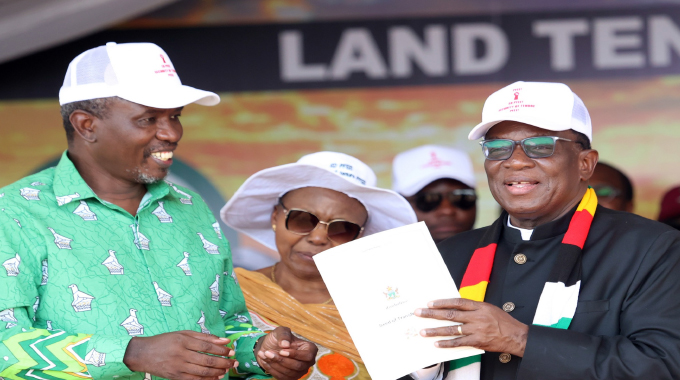
Rutendo Nyeve, [email protected]
President Mnangagwa is quietly but decisively reshaping the country’s economic landscape, driving a programme that is turning land from a dormant possession into a living, working asset.
As Zimbabwe marks another Independence Day, this initiative stands as a fitting tribute to the liberation struggle’s promise: that land, the very foundation of the nation’s sovereignty, would not remain a symbol of the past but become an engine of prosperity.
Secure tenure, in this light, is not merely an economic tool; it is the enduring fruit of independence itself, turning sacrifice into sustainable livelihoods and transforming a hard-won freedom into bankable, bread-on-the-table reality for millions.
At full maturity, the initiative is projected to unlock as much as US$16 billion over the next two decades, while handing more than 360,000 farmers something long denied to them: bankable, secure title deeds that change how land is seen, valued and used.
Speaking at his Precabe Farm in Kwekwe, where he launched the Land Tenure Implementation Programme, President Mnangagwa said the land reform programme is irreversible and that land is the cornerstone of economic growth.
“We are determined to deliver broad-based empowerment and transformation, leaving no place and no one behind,” he said.
“Our Constitution gives rights to every Zimbabwean citizen to acquire, use, or dispose of agricultural land. The land tenure system is critical.
“It encourages investment and production and productivity. With secure land tenure, our farmers can secure loans and improve their yields. The importance of a bankable, secure land system cannot be overemphasised.”
The president urged banks to accept the land documents.
“The handover of title deeds is testimony of the Government’s desire to empower the people,” he said. “The State is transferring title to a new holder and the recipient is challenged to defend the revolution. The handover has happened because there was a land revolution to emancipate Zimbabweans.”
For years, farmers operating on offer letters and permits found themselves locked out of the financial system.
“Without secure tenure, land could not be pledged as collateral, and investment stalled. Worse still, the land could be withdrawn at any time through administrative action, leaving families, including war veterans, exposed and uncertain about inheritance and long-term security.
That lingering uncertainty drained confidence, discouraged capital injection and reduced land to little more than subsistence ground. The Land Tenure Implementation Committee was established precisely to dismantle those barriers.
Bringing together youth representatives, women, war veterans, bankers and private sector leaders, the Land Tenure Implementation Committee was created to support Government institutions in executing a modern, credible and transparent land tenure system. Its work spans legal compliance, valuation frameworks, digitisation of records and deep engagement with stakeholders across the country.
At the heart of the programme lies a critical shift: converting offer letters and permits into full title deeds. This single step repositions land as acceptable collateral, opening doors to finance that were previously sealed shut.
President Mnangagwa has deliberately eased the path for farmers by approving a 60 percent discount on land valuations. The move is designed to leave headroom for borrowing, enabling farmers to raise capital for infrastructure and productivity improvements.
The framework pays particular attention to those who fought for the land in the first place. War veterans benefit from an additional 15 percent discount, with the first six hectares valued at just US$10 per hectare. Long-serving government employees are also recognised, qualifying for further discounts ranging between 2,5 percent and 5 percent.
The economic ripple effect of the programme is expected to be substantial. Over the next 20 years, Government anticipates generating close to US$16 billion from land payments. These funds will be channelled through a tightly managed escrow account, ensuring transparency and strategic deployment.
Of the total, 22,5 percent will be set aside for compensation of former commercial farmers, as prescribed by law. The balance will be directed towards reducing sovereign debt, upgrading infrastructure, funding agricultural loans and supporting war veterans and traditional leaders.
Beyond ownership, the Land Tenure Implementation Committee is equally focused on ensuring productivity. To that end, it is rolling out a comprehensive booster kit facility for A1 farmers. The package includes boreholes, irrigation infrastructure covering two to four hectares, starter inputs and on-farm structures — all financed over a period of seven to ten years.
Crucially, farmers will also be covered by drought and fire insurance, a safety net that allows them to focus on farming rather than disaster contingency.
To illustrate what is possible, the committee has already developed models showing how farmers in provinces such as Mashonaland and Manicaland can profitably cultivate high-value crops, including tomatoes, potatoes, cabbage, onions, maize and wheat, achieving viable yields and consistent margins.
Looking ahead, the ambition is bold. Within the next decade, the programme envisions 360,000 hectares of A1 land under irrigation. At full scale, optimal use of the 10,8 million hectares acquired by Government is projected to drive the national GDP towards US$258 billion by 2050.
Speaking at the recent Zim CEOs Policy Roundtable in Victoria Falls, the committee’s chairman, Mr Kudakwashe Tagwirei, painted a picture of a reform agenda already in motion, one firmly anchored in the Second Republic’s vision of translating land ownership into measurable national wealth. The objective, he said, is to unlock the full economic value of land acquired through the Land Reform Programme and finally allow it to work for those on it and the country at large.
“The President, in his wisdom, realised all these challenges that we are facing. He said, ‘What is the best solution?’ Let us just give these people a title to solve this problem,” Mr Tagwirei said.
At the Victoria Falls engagement, Mr Tagwirei was flanked by senior figures whose presence underscored the reform’s historical and technical weight — war veteran Cde Happison Muchechetere, a former provincial commander during the liberation struggle, and respected land policy authority Professor Mandivamba Rukuni.
“The real essence of the war was to reclaim the land,” said Mr Tagwirei.



 Online Reporter