Tawanda Musarurwa
CHECK POINT DESK
THE image spread quickly — a man crouched over a small fire on a pavement in Harare’s central business district, cooking sadza as darkness settled around him.
There was no kitchen, no shelter, just a pot balanced over glowing coals and the glare of passing cars.
The moment was the message.
Here was a man working where he could, when he could — outside shopfronts that had closed, in a city that no longer had space for him in its formal setup.
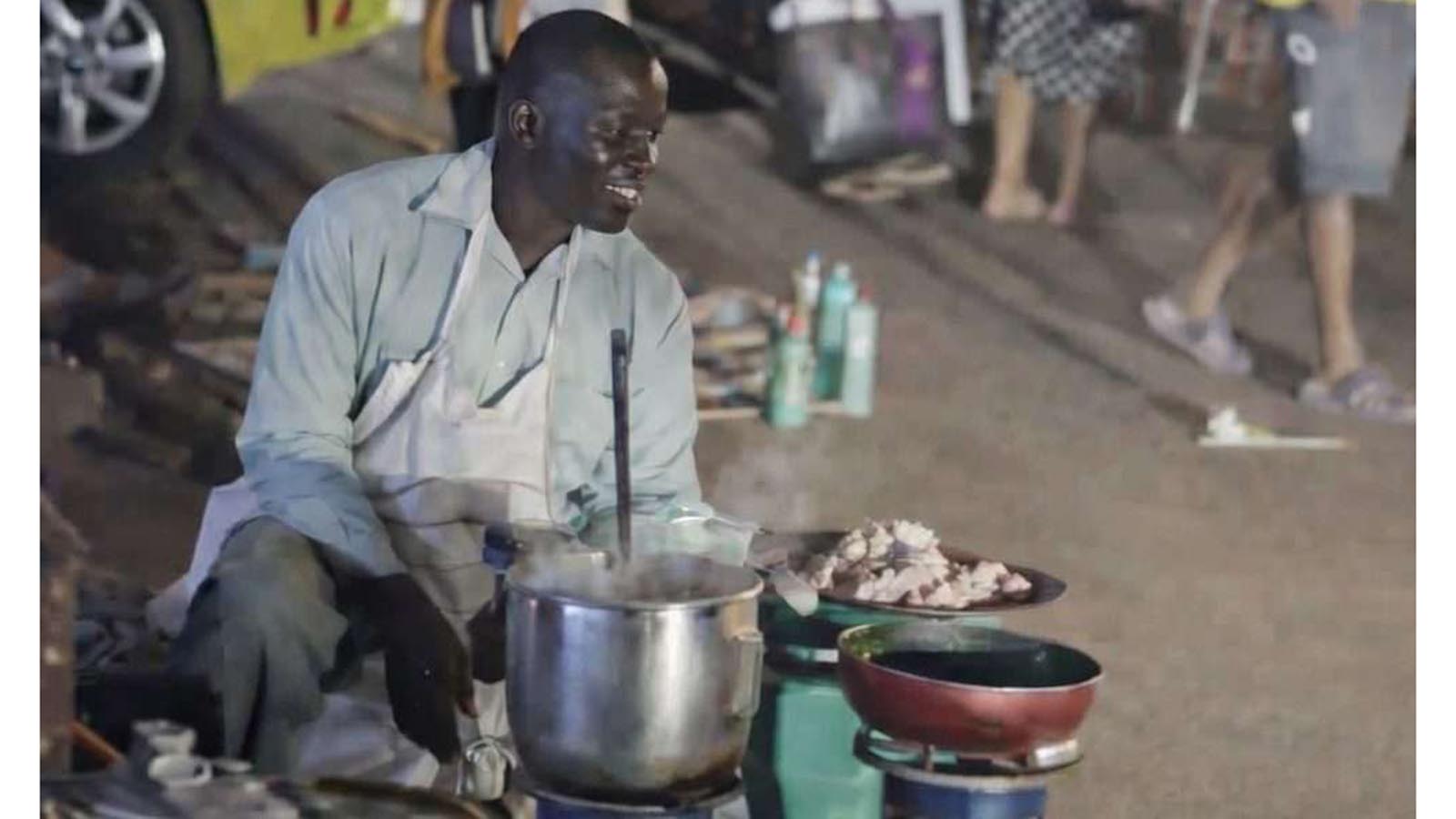
His small, improvised setup was not a business in the conventional sense; it was survival carved out of necessity.
It is this reality — visible in that dimly lit street corner — that the country’s new National Formalisation Strategy and National Employment Policy (2026-2030) now seeks to confront.
An economy built outside the system
Zimbabwe is attempting a complicated economic transition — moving millions of workers from informal activity into a regulated, tax-paying economy, without destroying the very livelihoods it seeks to improve.
Cabinet’s recent approval of the National Formalisation Strategy and the National Employment Policy (2026-2030) is the most ambitious attempt in a generation to tackle this structural challenge.
Crucially, the policy framework itself recognises the depth of exclusion embedded in the current system.
The National Formalisation Strategy seeks to integrate informal workers and enterprises into the formal economy by improving access to social security, labour rights and financial services.
It also aims to address challenges commonly faced in the informal sector, including lack of social protection, unsafe working conditions, low incomes and limited representation.
“The eight strategic priorities include macro-economic policies for employment, regulatory review, enterprise development, market and finance access, strengthening representation and supporting marginalised groups, particularly youth, women, persons with disabilities and veterans of the liberation struggle,” said Information, Publicity and Broadcasting Services Minister Dr Zhemu Soda during a post-Cabinet media briefing on April 14.
The country’s employment data makes the task look like an economic reconstruction.
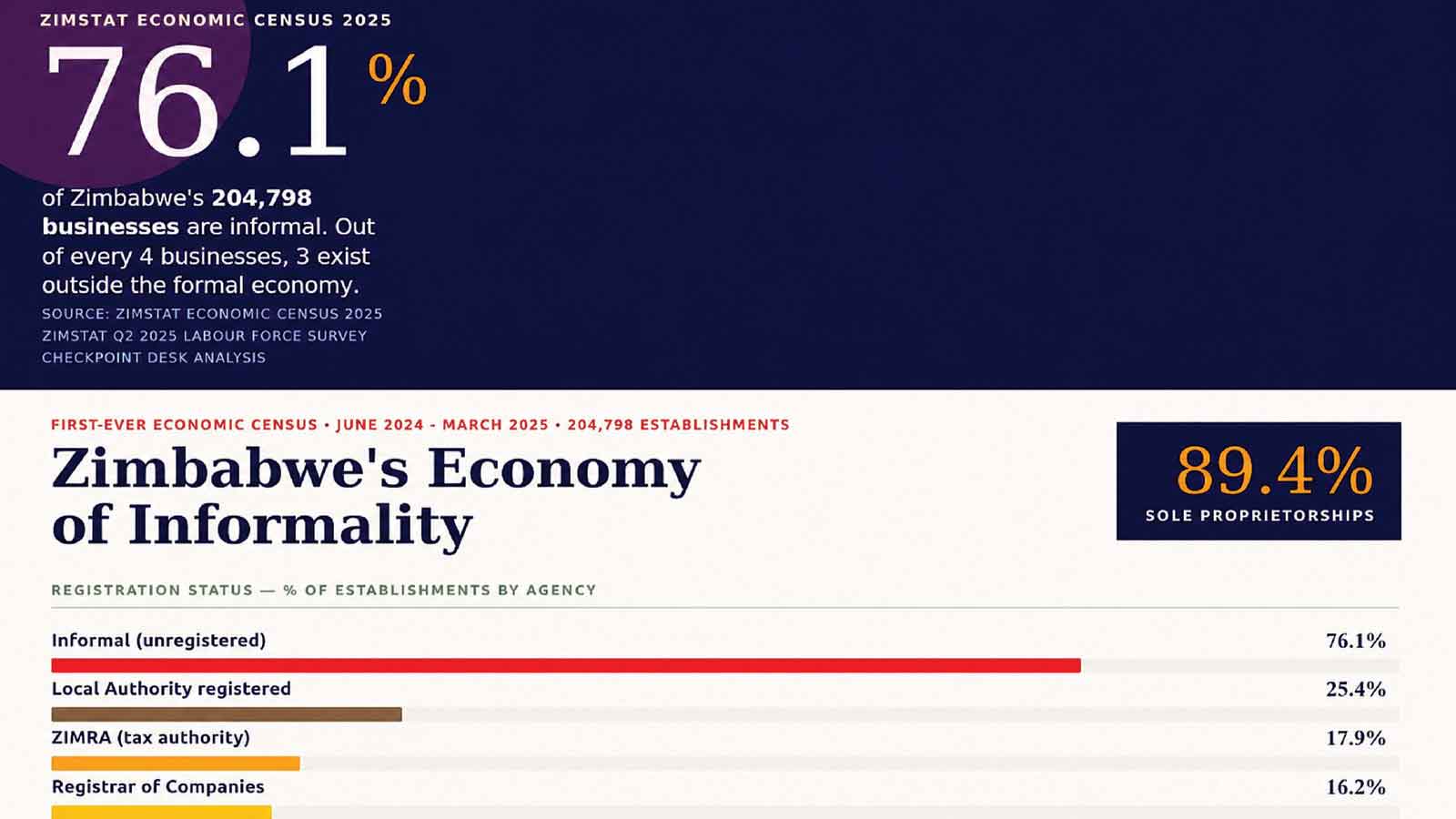
The Zimbabwe National Statistics Agency (ZimStat) completed its first-ever economic census last year, counting every operational business across the country.
According to the economic census, of the 204 798 establishments found to be operational, the majority — 76,1 percent — were informal.
In other words, out of every four Zimbabwean businesses, three exist entirely outside the systems that the new policies are designed to strengthen.
The survivalist structure of Zimbabwe’s MSME sector
The micro-enterprise picture is even starker.
Overall, the largest proportion of establishments, 87,9 percent, were micro — tiny one-person or family operations scattered across urban markets and roadside stalls.
Of the 204 798 establishments at national level, 89,4 percent were sole proprietorships.
These are not budding entrepreneurs waiting for regulatory reform; most are survival businesses, operating in the grey zone between subsistence and enterprise.
But the deeper structure of this informal economy becomes clearer when viewed through FinScope’s national MSME (micro, small, and medium enterprises) survey.
The country has an estimated 1,6 million business owners and about 1,95 million MSMEs, employing about 1,7 million people and generating roughly US$8,6 billion in value added.
The scale is foundational.
Within that base, over 81 percent are individual entrepreneurs, effectively one-person operations with limited capacity to absorb labour or scale.
Formalisation policy is, therefore, not targeting firms on the cusp of growth, but a vast population of low-productivity, low-income operators.
The registration gap — the distance between where businesses are and where the formalisation strategy wants them to be — is enormous.
Nationally, only 16,2 percent of establishments were registered with the Registrar of Companies and only 5,9 percent were registered with the National Social Security Authority (NSSA).
Data on the country’s workplace accidents highlight this gap.
ZimStat’s 2025 Second-Quarter Labour Force Survey recorded 33 785 employed persons reporting work-related injuries or illnesses during the survey period alone, a figure that, when annualised, suggests a far broader base of occupational harm than the roughly 4 000 cases captured annually by NSSA administrative data.
“The statistics are indeed a far cry from reality, owing to underreporting and non-reporting rampant in many developing countries. The statistics largely exclude the contribution from the informal sector,” said NSSA Occupational Safety and Health principal training officer Mr Norman Gwezuva during a media training workshop recently.
And FinScope data reinforces just how entrenched this gap is: only about 14 percent of MSMEs are formal — meaning licensed or registered — while as many as 94 percent remain unregistered with the Registrar of Companies.
Why formalisation remains elusive
Significantly, the barrier is not just resistance; it is structural.
The largest share of informal operators cite that their businesses are “too small” or lack the money to register, while others see no tangible benefit in formalisation.
At the same time, 71 percent say they would formalise if the process was cheaper, simpler or better explained.
The Government has, in recent years, moved to reduce the cost of doing business through measures such as scrapping or consolidating multiple local authority licences and lowering regulatory fees for SMEs, while rolling out one-stop investment and registration services.
It has also pushed digitalisation of company registration processes and eased compliance procedures in line with broader ease-of-doing-business reforms aimed at lowering barriers to entry.
So, informality is not just avoidance; it is, in many cases, rational economic behaviour.
The manufacturing sector, which contributes 15,3 percent of Zimbabwe’s gross domestic product (GDP), according to ZimStat’s revised 2023 GDP figures, tells a similar story.
Only 19 percent of the 16 877 establishments in the manufacturing sector were formal, and just 17,6 percent were registered with the Registrar of Companies.
This sector — with its potential for job density, export earnings and value addition — is largely operating off the books, with FinScope showing it contributes a relatively small share of MSMEs despite its strategic importance.
There is a geography to this problem, too.
About 87 percent of establishments were located in urban areas, whilst 13,3 percent were rural. However, FinScope indicates that 71 percent of MSMEs are rural-based, particularly concentrated in agriculture and informal trade.
This mismatch highlights a deeper measurement issue: Much of the rural economy remains thinly captured in formal datasets but dominates the lived reality of informal work.
Rural enterprises face compounding disadvantages: lower access to financial services, weaker infrastructure and limited proximity to registration systems.
The Government’s decentralisation and devolution agenda has sought to address these gaps through the devolution fund, which channels resources directly to provinces and districts for local infrastructure, market stalls and business spaces.
In parallel, the rollout of e-government services, mobile registration units and provincial one-stop investment services under agencies such as the Zimbabwe Investment and Development Agency (ZIDA) is intended to bring formalisation processes closer to rural enterprises.
Policy ambition meets economic reality
When one layers labour market data on top, a picture of the human dimension of this structural failure emerges.
According to ZimStat’s Q2 2025 Labour Force Survey, of the total employed population of 3 186 598, informal sector workers accounted for 58,5 percent, while formal employment represented just 35,8 percent.
The national unemployment rate stands at 20,7 percent, but that is the headline number.
The expanded unemployment rate rises to 37,1 percent.
More than one in three Zimbabweans who could be working are either unemployed or have given up looking for jobs. The youth pressure point is where the policy faces its most urgent test.
Youth unemployment among those aged 15 to 24 stood at 39,3 percent, rising to 58,2 percent on the expanded measure.
The NEET (Not in Education, Employment or Training) figures are even more sobering: 47,6 percent of those aged 15 to 24, and 49,2 percent of the broader 15 to 35 cohort, are outside employment, education or training.
Nearly half of Zimbabwe’s young people are economically adrift.
And yet the structure of the MSME sector suggests limited absorption capacity.
Most enterprises are not hiring firms — they are survival units.
FinScope shows that 68 percent of business owners rely solely on their enterprise for income, while average earnings remain low and unstable.
This is not a labour market that can easily scale to absorb millions of new entrants.
The income dimension adds another layer of difficulty. A significant share of MSME business owners earn less than US$200 per month.
Formalisation carries costs: registration fees, tax compliance, National Social Security Authority (NSSA) contributions and local authority levies.
For businesses operating on margins this thin, the mathematics of formalisation can quickly become unfavourable.
This tension is reinforced by financial behaviour.
While 95 percent of MSME owners are technically financially included, most of this inclusion is transactional; driven by mobile money and basic ban access to credit or investment capital.
Only a small fraction of businesses access formal credit, with 59 percent not borrowing at all, often due to lack of collateral or fear of debt.
In practice, this means most informal businesses lack the capital needed to grow into formal, tax-paying enterprises.
Critically, the ZimStat Economic Census also forces a revision of the underlying economic picture.
The 2023 GDP at current prices was revised upwards by 26,2 percent — from ZiG133,7 trillion to ZiG168,8 trillion — precisely because the census captured economic activity that was previously invisible.
Much of that activity is informal.
FinScope estimates that MSMEs alone generate billions in turnover and value addition, reinforcing a difficult truth: Zimbabwe’s economy is already deeply dependent on informality.
The 2010 National Employment Policy — which the new framework explicitly replaces — was itself a set of commitments that were largely unrealised.
There is no publicly accessible scorecard of delivery.
Without one, the credibility of the 2026-2030 commitments rests heavily on a monitoring framework that has yet to publish clear job creation targets or reductions in informality rates.
The comparison with peer economies offers both encouragement and caution.
Rwanda’s reforms reduced the time and cost of business registration but were backed by sustained institutional and digital investment.
Kenya’s financial inclusion push reached millions but has not resolved unemployment.
The lesson is consistent: Formalisation works, but only when it is paired with growth, finance and demand.
The success of Zimbabwe’s new frameworks will not be measured in NSSA registration numbers, in whether informal traders see value in formalisation and in whether young Zimbabweans have more viable economic pathways by 2030.
ZimStat captures the dilemma succinctly: The informal sector sustains millions but contributes little to formal revenue systems.
The FinScope Survey adds a crucial layer — most of these businesses are too small, too constrained and too financially fragile to transition without significant support.
Transforming this sector is not just about registration; it is about raising productivity, lowering the cost of compliance, expanding access to finance and creating demand for growth.
The informal economy is not a peripheral problem to be fixed; it is the core of the economy itself.