

 admin
admin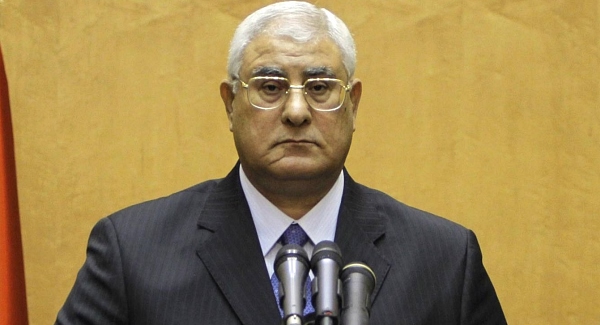

Top judge Adly Mansour has been sworn in as Egypt interim president, hours after Mohamed Morsi was overthrown in a military coup following huge protests against his one-year rule. Mansour took the oath of interim president yesterday as his democratically elected predecessor, Mohamed Morsi, was held in an unspecified military barracks along with senior aides.
Before the constitutional court, Mansour said: “I swear by God to uphold the Republican system and respect the constitution and law . . . and safeguard the people and protect the nation.”
“The revolutionaries of Egypt are everywhere and we salute them all, those who prove to the world that they are strong enough, the brave youth of Egypt, who were the leaders of this revolution.”
Separately, Mansour was made head of the supreme constitutional court — a position he was due to take on 30 June, when protests against Morsi’s one year in power began in earnest.
Morsi was overthrown by the military on Wednesday. According to a senior member of the Muslim Brotherhood, Morsi was being held in a military facility with top aides.
“Morsi and the entire presidential team are under house arrest in the Presidential Republican Guards Club,” Gehad El-Haddad, the son of a top Morsi aide, said yesterday. Haddad’s father, Essam El-Haddad, widely seen as Morsi’s right-hand man, was among those held, he added.
Less than an hour after Mansour was sworn in, Egyptian prosecutors issued arrest warrants for the Brotherhood’s top leader, Mohamed Badie, and his deputy, Khairat el-Shater, judicial and army sources told Reuters news agency.
Shater was the group’s first choice candidate to run in last year’s presidential election. He was disqualified from the race due to past convictions.
Hundreds of Muslim Brotherhood officials were also reported to have been arrested, with many senior leaders being held in the Torah prison in Cairo – the same prison holding Hosni Mubarak, who was himself deposed in the 2011 revolution.
In a televised broadcast, flanked by military leaders, religious authorities and political figures, General Abdel Fattah al-Sisi effectively declared the removal of Morsi.
Sisi called for presidential and parliamentary elections, a panel to review the constitution and a national reconciliation committee that would include youth movements. He said the roadmap had been agreed by a range of political groups.
Islamist supporters of Morsi who have gathered in a Cairo suburb reacted angrily to the announcement by the army.
Some broke up paving stones, forming piles of rocks. Muslim Brotherhood security guards in hard hats and holding sticks formed a cordon around the encampment, close to a mosque. Men and women wept and chanted.
Denouncing military chief Sisi, some shouted: “Sisi is void! Islam is coming! We will not leave!”
At least 14 people were killed when opponents and supporters of Morsi clashed after the army announced his removal, officials said. Eight of those died in the northern city of Marsa Matrouh, including two members of the security fources.
Three people were killed and at least 50 wounded in Alexandria, state news agency MENA reported; a woman stabbed in the stomach, and two men killed by birdshot.
Three people were also killed and 14 wounded in the southern city of Minya, including two police, MENA said.
Speaking shortly after Sisi’s announcement, liberal opposition leader Mohamed ElBaradei said the “2011 revolution was re-launched” and that the roadmap meets the demand of the protesters.
Egypt’s leading Muslim and Christian clerics also backed the army-sponsored roadmap.
Pope Tawadros, the head of the Coptic Church, said the plan offered a political vision and would ensure security for all Egyptians, about 10 percent of whom are Christian. Egypt’s second largest Islamist group, the Nour party, said in a statement that it agreed to the army roadmap in order to avoid further conflict.
Morsi, Egypt’s first freely elected president, came under huge pressure in the run-up to Sunday’s anniversary of his maiden year in office, with his opponents accusing him of failing the 2011 revolution by concentrating power in Islamist hands.
The embattled 62-year-old proposed a “consensus government” as a way out of the crisis. That was not enough for the army, and Mansour, a previously little known judge, was installed as the country’s interim leader.
Meanwhile, the Egyptian army’s suspension of the constitution and removal of Morsi has drawn mixed responses from world leaders:
The EU has called for a rapid return to democracy in Egypt.
EU foreign policy chief Catherine Ashton said: “I urge all sides to rapidly return to the democratic process, including the holding of free and fair presidential and parliamentary elections and the approval of a constitution, to be done in a fully inclusive manner, so as to permit the country to resume and complete its democratic transition.
“I strongly condemn all violent acts, offer my condolences to the families of the victims, and urge the security forces to do everything in their power to protect the lives and well-being of Egyptian citizens.”
Saudi King Abdullah sent a message of congratulations to Adly Mansour ahead of his appointment as interim president.
“In the name of the people of Saudi Arabia and on my behalf, we congratulate your leadership of Egypt in this critical period of its history. We pray for God to help you bear the responsibility laid upon you to achieve the ambitions of our brotherly people of Egypt,” the message said.
Bashar al-Assad on Wednesday praised Egypt’s protests against their leader and said his overthrow by the military means the end of “political Islam”.
Assad, who is seeking to crush a revolt against his own rule, said Egyptians have discovered the “lies” of the Muslim Brotherhood.
He spoke in an interview with the state-run Al-Thawra newspaper.
“What is happening in Egypt is the fall of so-called political Islam,” Assad said. “This is the fate of anyone in the world who tries to use religion for political or factional interests.”
The UAE welcomed the change in Egypt, according to state news agency WAM, and praised the Egyptian armed forces.
“His Highness Abdullah bin Zayed al-Nahayan, the foreign minister of the UAE, expressed his full confidence that the great people of Egypt are able to cross these difficult moments that Egypt is going through,” WAM said in a statement.
“Sheikh Abdullah said that the great Egyptian army was able to prove again that they are the fence of Egypt and that they are the protector and strong shield that guarantee Egypt will remain a state of institutions and law,” it added.
The UK urged for calm in Egypt, but stopped short of calling the military intervention a coup.
“The situation is clearly dangerous and we call on all sides to show restraint and avoid violence,” said Foreign Secretary William Hague. “The United Kingdom does not support military intervention as a way to resolve disputes in a democratic system.”
The UK called on all parties to move forward and “show the leadership and vision needed to restore and renew Egypt’s democratic transition”.
The US State Department expressed concern over the military intervention.
The US ordered the mandatory evacuation of its embassy in Cairo, just hours after the army deposed Morsi. A later travel advisory confirmed that “the Department of State ordered the departure of non-emergency US government personnel and family members from Egypt due to the ongoing political and social unrest.”
Germany Foreign Minister Guido Westerwelle said the military intervention was “a major setback for democracy in Egypt” and called for “dialogue and political compromise”.
“This is a major setback for democracy in Egypt,” Westerwelle said during a visit to Athens. “It is urgent that Egypt return as quickly as possible to the constitutional order… there is a real danger that the democratic transition in Egypt will be seriously damaged.”— Al Jazeera.


 Online Reporter
 derick.khumalo