admin
admin
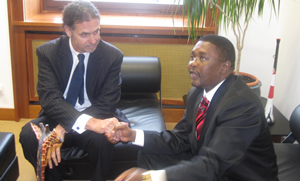
Tourism and Hospitality Industry Minister Walter Mzembi (WM) was in Beijing, China, for the First World Conference on Tourism for Development from May 18 to 21, whose theme was: “Tourism for Peace and Development”. Our News Editor Lovemore Chikova (LC), who is in China, spoke to the minister on the conference, the role tourism plays in bringing peace in Zimbabwe and the way forward for the sector.
LC: Tell us about this conference, the first of its kind, which you have just attended.
WM: The conference was organised by the UN World Tourism Organisation (UNWTO) and the government of the People’s Republic of China and running under the theme: “Tourism for Peace and Development”.
This was the first high-level meeting to address how tourism can contribute to the implementation of the 2030 Agenda for Sustainable Development and its 17 universal goals.
It brought together more than 1 000 public and private representatives from over 107 countries to discuss tourism’s role in advancing the Sustainable Development Goals (SDGs), with a particular focus on tourism’s capacity to fight poverty and build peaceful societies.
The conference had two sessions on the role of tourism in poverty alleviation and the development agenda and on tourism and peace.
I was invited in my capacity as the current chairperson of the UNWTO Commission for Africa and I was a panellist on the session on tourism and peace.
The session discussed linkages between tourism and peace and explored ways to make the sector more peace sensitive. It further discussed opportunities and the way forward to ensure that tourism can play an effective role in building a culture of peace.
LC: What role can tourism play to bring global peace at a time the world seems to be grappling with several security issues?
WM: Tourism has a natural patent to soft power and it should be deployed in public and people-to-people diplomacy. It is not hard power alone that will defeat terrorism; it is complementary action from soft power that will ultimately win because terrorism is conceived and transported in the mind.
It is an ideological mindset and the citizen diplomacy will overwhelm terror because you cannot ask seven billion people to stay at home — 1,2 billion people are already part of the travelling revolution.
These numbers will increase exponentially in the next decade considering that in 1950 there were just 25 million international travellers.
The sheer force and economic impact of this industry and the mere prospect of deleting $7 trillion from the global balance sheet brought through tourism will compel unity of purpose and engagement to this threat.
LC: Do you think governments and other stakeholders in the tourism industry are awake to this point?
WM: We have not, as global tourism leadership, sufficiently unpacked the economic argument for protecting this sector. It is still viewed as an attack on some elitist lifestyles.
The United Nations Year on Tourism is, therefore, an opportunity to pitch safe, secure and seamless travel at the highest inter-governmental level.
None of us is safe from the scourge of terror and, therefore, an attack on humankind, no matter how geographically remote or distant, is an attack on us all.
The terror problem is rampant and requires global solutions. It also should not just deal with outcomes and symptoms, but go to the causes of what really causes terror.
We must look critically at current sources of terror — that it is not a coincidence that they appear to be from collapsed states, arising out of interventions in internal matters of targeted regimes.
There is a link also with the emerging current refugee crisis in Europe.
LC: Let’s look at the tourism sector in Zimbabwe; it nearly collapsed due to confrontation between the country and Western countries over land reform policies.
WM: Yes, it is public knowledge that the decade leading up to 2009, Zimbabwe virtually ex-communicated itself from the UNWTO due to non-payment of membership subscription as a result of economic meltdown arising after the fallout with the international community over its agrarian reform.
Inflation last recorded in December 2008 was in excess of 240 million percent. The Zimbabwe dollar was in quadrillions to the US$ and the international media onslaught had virtually collapsed the Zimbabwe brand.
In February 2009, I was part of the Unity Government that was prescribed to the country by the region. I was immediately drafted into the international re-engagement team and deployed to the debate on state diplomacy.
I immediately recognised the people-to-people diplomatic potential of the tourism sector and how it would underwrite inter-state diplomacy going forward.
LC: What did you do after realising you were being faced by such a situation?
WM: The first task was regularisation of our internal membership to tourism organisations, principally the UNWTO, World Travel and Tourism Council and Regional Tourism Organisation of Southern Africa (Retosa).
Second, was an exercise to rebrand tourism that resulted in a clean bill of travel health by June 2009 and Germany was the first country to lift travel advisories followed by Europe and later on the United States and Japan.
Third, was the integration of Zimbabwean, global and regional tourism agenda setting which saw us elected to the executive council of the UNWTO 2009 to 2013 and successive chairmanship of Retosa, two time president of the African Travel Association and now second time chairperson of the UNWTO Commission for Africa.
The ultimate destination of this journey in rebranding of tourism was our own decision backed by the conviction of a man whom we shall remain permanently indebted to — Mr Talib Refai — the current secretary general of the UNWTO.
This was when the UNWTO unanimously decided that the 20th session of the General Assembly of the UNWTO should be a joint hosting between Zimbabwe and Zambia at the Victoria Falls. That became the highest global endorsement of brand Zimbabwe and the rest is history.
LC: Having said all this minister, where are we now in tourism?
WM: Tourism has recovered to a point where it is the leading sector ahead of agriculture, mining and manufacturing in terms of sectoral growth. In fact, it is cross subsidising the Zimbabwean economy and Gross Domestic Product. Its contribution now stands at 11 percent.
Going forward, it is paying the bills for Government functions. Meanwhile the world has significantly softened stance towards Zimbabwe, with European Union sanctions partially dropped and there is intense business reconnaissance missions into Zimbabwe and China would attest to this.
So, tourism has been the most significant rapprochement and re-engagement tool for the Republic of Zimbabwe and it is now an acknowledged unifying force and a tool for public diplomacy and the economy has largely been stabilised by its receipts income, securing peace in the process.
LC: The session you participated in as a panellist at the First World Conference on Tourism for Development was on tourism and peace. How did tourism manage to secure peace for Zimbabwe?
WM: The last bullet fired by Zimbabwe in a war situation was in 1979. In Rhodesia, there was no substantial tourism to talk about because of the war and conditions that prevailed.
Unfortunately, following the inception of our land and agrarian reform, the response of a section of the international community created near similar conditions to those that prevailed pre-1980 for tourism — similar to war conditions.
The response in itself by the section of the international community was a failure of diplomacy.
When State diplomacy fails, even without guns being fired at times, it can invent conditions equivalent to those of a war zone. And usually traditional diplomacy fails because of ego.
It fails because of reciprocity; because traditional diplomacy sometimes invokes an eye for an eye. But an eye for an eye leaves the world blind. Traditional diplomacy is also sometimes characterised by retaliation. It fails because it is characterised by those three elements.
We must never allow a situation where after traditional diplomacy fails it precipitates war before we invoke the inherent diplomatic characteristics of tourism. Tourism must come to the rescue and not itself to be a victim of collateral damage arising out of the failure of State diplomacy.
Tourism has become a public diplomacy tool and that type of diplomacy actually works. In tourism, we should patent soft power, the ability to embrace the diversity that comes from tourism. Tourism is public diplomacy which is characterised by wealth creation.
When people arrive in destinations, they are agents of goodwill. Usually they bring an olive branch, so today’s 1,2 billion global arrivals can easily be turned into peace ambassadors of this world. The expenditure that they generate in destinations creates tourism economies.
LC: How did you apply this soft power diplomacy of tourism in Zimbabwe and were the results favourable?
WM: In the very early stages of my deployment, I realised that tourism was a force for the good and we leveraged on it to transform a $2,94 million economy in 2009 to just over a billion in 2015.
Because I inherited (as Minister of Tourism and Hospitality Industry) so much adversity arising out of sanctions, disengagement and isolation of a destination, I turned this negative stock that I inherited into an opportunity.
The first thing is that I looked at the flip side of the negative publicity and concluded that there was nobody in the world who did not know Zimbabwe because it was in the press daily for one reason or another.
CNN, BBC, Sky News and all the major print media abroad covered the country for one reason or another almost on a daily basis. I said: “How do I proceed with this negative stock?”
The first thing is, I said notwithstanding the negativity, there was a starting point and that starting point was that no person in the world could claim that they didn’t know Zimbabwe and where it was.
The next thing was to rebrand, which meant basically turning that negative stereotype into an opportunity. How did I proceed with it? — through re-engagement.
Tourism ministers did not impose travel warnings on each other and they are normally very good nurtured people. Travel advisories are imposed on nation States by foreign offices. It was important, therefore, for tourism ministers to engage the right audience.
LC: The re-engagement seemed a very difficult task considering that the people you were targeting already held their own views on Zimbabwe. What strategies did you use to win their hearts?
WM: I said we must develop very close working relationships with the security sectors and the ministries of Foreign Affairs. And even as we go out to engage, these are the same agents that we must possibly engage in those countries up to including Heads of States and Governments because that’s where conceptions about destinations and countries are derived from.
That’s why this International Year of Sustainable Tourism Development becomes a very clear opportunity for us to be heard by the right people. It will ultimately result in an audience for us by the Heads of State and Government at the UNWTO general assembly in 2017 here in China.
We want to get there when our act is together on what we want to sell and be understood on. Create a better understanding profile for tourism to function better.
There is hardly any Head of State in the world or a level higher than me that I have not engaged to plead for Zimbabwe’s case to be understood and it resulted in what we now claim as the clean travel bill of rights as far back as June 2009 because we pitched our message to the right people.
I met Hillary Clinton (then the United States Secretary of State), Angela Merkel (the Germany Chancellor), Gordon Brown (former British Prime Minister) – virtually most of the leadership of the world – to explain that notwithstanding our state of fallout, we should never allow this people-to-people bridge to be collapsed.
That was my message to the world of re-engagement and rapprochement to the world leadership.
It does not matter how much of a fallout nations States have, tourism is a peace sector. It’s a public diplomacy tool, which should not be collapsed.
LC: Now that the tourism sector seems to be on its way to full recovery, what will guarantee its survival in the future?
WM: Anything in a Government that is economically significant is enabled, facilitated and protected. We advanced tourism in Zimbabwe to a point where it is now a recognised economic pillar. That we were able to advance to that point of recognition means that the whole government works for its advancement.
It starts with the security sector guaranteeing peace because peace is a critical success factor. First and foremost as Zimbabwe, our first product is peace. It does not matter how attractive a destination is, if it is situated in a conflict situation it doesn’t sell. Tourism cannot sell conflict.
We are even confident to a point where we have crafted a 5-5-15-2020 vision. Interpreted to mean towards a $5 billion tourism growth from five million arrivals contributing 15 percent to GDP by year 2020.



 Online Reporter