admin
admin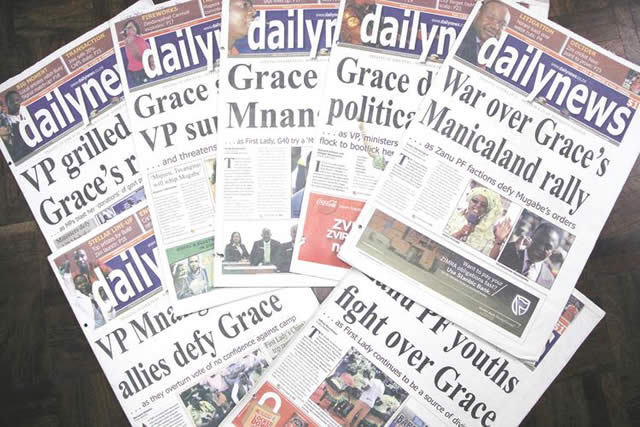
Alexander Rusero Correspondent
A MEANINGFUL and informative narrative on bad journalism in Zimbabwe which has taken centre-stage of the current public discourse on the declining standards of journalism should firstly make reference on the infamous Brandina Tadyanemhandu’s case. The story was one published by The Daily News on April 23, 2002 on a Tuesday. The lead of that story read: “Two young girls, aged ten and 17, watched in horror as their mother was murdered brutally by having her head chopped off at the neck. Brandina Tadyanemhandu, 53, was butchered inside her hut in Magunje on Sunday by about 20 youths, who were suspected to be Zanu-PF supporters.”
Ironically, the presiding editor of that story was none other than Geoffrey Nyarota, often described in contemporary media circles as a veteran journalist.
Whatever the conviction by the then editor to publish such a fictitious story, it later came out that contrary to the vivid portrayal of the barbaric murder appearing as if his reporter was a witness when the incident took place, it later turned out that they went on to publish, based on someone’s narrative, no evidence, no police confirmation or undergoing basic verification necessary to publish despite the serious gravity of the story — involvement of a murder case!
The retraction Mr Nyarota posted read: “Until Tadyanemhandu’s grave is located and positively identified, we are left with no option but to . . . tender our most profound apology to Zanu-PF, whose image was tarnished by the report in question.” In other words, he was still convinced that the incident was after all true only that the paper could not produce sufficient evidence to substantiate their report.
Later Nyarota would still live in denial that he slept on the job when he wrote in his memoir Against the Grain: Memoirs of a Zimbabwean Newsman that “Subsequent events and developments lent weight to my growing suspicion that Tadyanemhandu was part of an elaborate CIO sting operation.” [Page 280].
But was the CIO instrumental in the editor’s judgment and discretion to publish the story before verification? It was such kind of journalism that warranted the legislation like the Access to Information and Protection of Privacy Act (AIPPA) whose purpose was to regulate and ensure ethical compliance, but in his book, Nyarota thought otherwise:
“From the outset, it was obvious that while AIPPA was couched in general terms to suppress Zimbabwe’s vibrant privately-owned press, its specific target was the Daily News. The paper had grown into the largest selling daily in little over one year of existence. It posed an ominous political threat to a ruling party and government whose popularity and entrenched position were closely on the decline.”
He harshly retorted that: “Under the new media legislation, masterminded with singular determination by (Professor Jonathan) Moyo, no company could run a newspaper, radio or television station unless registered by the MIC (Media Information Commission — the predecessor of ZMC), whose members were hand-picked by the minister. Journalists were not allowed to practise unless accredited by the same commission, which was chaired by Dr Tafataona Mahoso, an eccentric academic and zealous Zanu-PF apologist.” [Page 276]
Nyarota later went on a self-imposed exile close to a decade until his return recently when he tried his luck in opposition politics without much success after being defeated in the Nyanga North Constituency primaries of the MDC-T.
He later became the chair of the Information and Media Panel of Inquiry (IMPI) whose review Indaba is scheduled soon, according to the Ministry of Information, Media and Broadcasting Services secretary George Charamba.
The rest is now history, but in trying to root out bad journalism which has taken precedence in the media of the day, it is also crucial to be genuine and indulge in self introspection, if citizens are to take us seriously.
The political economic infrastructure of Zimbabwe with the coming of the new millennium was one characterised by a retrogressive façade of politics of hate and politics of demonisation and the media has been instrumental in fuelling such.
At the international scene, the demonisation of Zimbabwe by global media following a diplomatic stand-off with Britain over the latter’s denial to fund the land reform, became one whose detrimental effects the country is still facing to this day.
But at the local scene, the private media whose flagship was Nyarota’s Daily News also did its damaging part. It is this dark episode of Zimbabwe’s media history that should be the nadir of bad journalism precedence we are all crying foul today.
It was through this same period where we learnt that institutional criticism was inseparable from personalities. Nyarota in his book even once described President Robert Mugabe as “a candidate long overdue for admission to an old age home presided over the disintegration of their once prosperous homeland.” [Page 276]
The private media from that day denied economic sanctions ever existed and instead shouldered all the blame on Zanu-PF. Binary media characterisation started. You were either Zanu-PF or MDC. You either read The Herald or The Daily News. Everything associated with Zanu-PF in the eyes of the private media was evil and baseless. Equally the Zimpapers fought in Zanu-PF’s corner. Everything associated with the opposition was a charade of neo-imperialism and neo-colonialism on the verge.
On that narrative I totally agree with Brother Geoff in his recent Herald opinion that: Throughout the years, the partisan handling of issues to do with the MDC-T by newspapers owned by the Zimpapers stable, on the one hand, to compete with the equally prejudiced coverage of news concerning the ruling Zanu-PF party on the part of the privately-owned newspapers, on the other hand, have become legendary.
But in the interest of fairness, it would not be absolutely accurate to blame the resource-constrained Zimbabwe Media Commission (ZMC) as well as the Voluntary Media Council of Zimbabwe (VMCZ) of ‘sleeping on the job’ resulting in the escalating declining standards of ethical journalism.
Recently I was with ZMC’s research manager Academy Chinamhora in Beijing. He passionately expressed grief over the declining levels of ethical journalism but explained how his organisation is in near paralysis due to insufficient budgetary support. I have known VMCZ’s executive director Loughty Dube for long and his personal and professional devotion on media ethics is unparalleled.
There is need to exorcise the era of 2000 ghost, where journalism lost respect to a lot of things such as respect of the memory and narrative of the liberation struggle, personality and character of the President, human rights, citizens participation and diversity of views.
President Mugabe, his wife Amai Grace Mugabe and fellow colleagues in the political fray are news characters by virtue of their status. But when you have a systematic trend of them occupying page one stories on a daily basis, it ceases to be news, it becomes an orchestration. Orchestrations by their nature are meant to demonise, ridicule and denigrate. We need to revisit the pre-millennium era and locate the virtues of journalism that once engulfed our nation.
In that era we will all bask in the glory of the much revered Willowgate Scandal whose architecture was Geoffrey Nyarota himself.
Alexander Rusero is a political analyst and media critic based in Harare. He can be reached [email protected]


 Online Reporter