admin
admin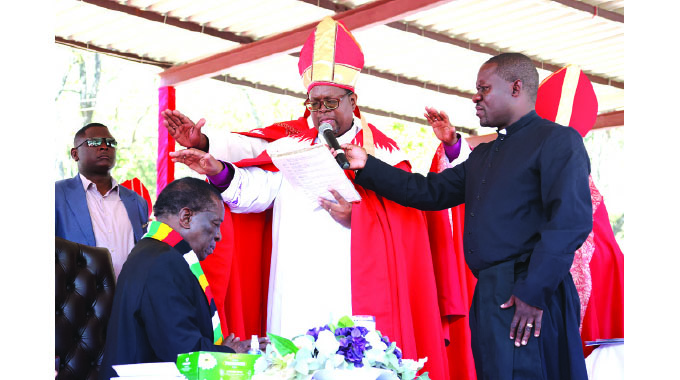
Ranga Mataire-Group Political Editor
On June 17, President Mnangagwa was a guest of honour at the Bernard Mizeki annual pilgrimage attended by thousands of Anglican Church parishioners just outside Marondera town.
The President was accompanied by Vice President Constantino Chiwenga and the Minister of Defence and War Veterans Affairs, who is also the governing Zanu PF party’s national chairman, Oppah Muchinguri.
The mere presence of these high ranking officials signified the importance attached to the church as a critical institution in nation-building.
Mizeki was an African missionary who died in 1896.
It is said that in June 1896, Mizeki was fatally stabbed by a spear outside his hut. His wife and a helper went to get help and upon their return, Mizeki’s body was no longer where they had left it.
Instead, they saw from a distance a blinding light in the hillside where he had been living and heard a rushing sound as though of many wings.
It is at this place of Mizeki’s demise that has since become the focus of great devotion for Anglicans and other Christians.
Realising the importance of Mizeki in the lives of Anglican parishioners in particular and Christians in general, President Mnangagwa had to accede to the invitation extended to him by the Anglican Church.
Unbeknown to some, while there were early tensions between the church and indigenous people during the First Chimurenga, the church later became an integral part of the quest for the independence of Zimbabwe.
The church’s role can be assessed in two phases.
First, although early white missionaries were catalysts in the eventual colonial occupation of the country, their stance and attitude towards the indigenous people later changed as they established missionary schools across the country.
The establishment of educational facilities by the church resulted in a number of Africans accessing education and some of the early nationalists were products of these schools.
Educational progression in government schools at the time was very stunted and most indigenous people trooped to missionary schools.
Resultantly, early African nationalists and advocates of majority rule were schooled in the missionary schools.
It was, therefore, not a coincidence that early African nationalists like Robert Mugabe, Ndabaningi Sithole, Enos Nkala, Edgar Tekere, Cephas Msipa, Joshua Nkomo, Joseph Msika and Herbert Chitepo all passed through some missionary schools.
Missionary education had a dual consequence for black Zimbabweans.
First it gave them skills with which to articulate their demands and question the legitimacy of colonial authorities.
Second, education turned out to be a powerful medium of African acculturation of Western Christian (and political) values- values that they ingeniously and niftily incorporated into the political debate over their struggles for freedom.
As the liberation struggle gathered momentum around the late 1960s, many Christian leaders felt obliged to actively participate by either providing material and financial support or encouraging the young students to join the liberation struggle.
Some mission schools became recruiting resource bases for young cadres voluntarily joining the war.
Some of the church leaders who played some role in the fight for majority rule included Bishop Ralph Edward Dodge — an outspoken advocate for racial justice and the last white bishop of the United Methodist Church of Zimbabwe (Rhodesia) during the colonial era.
Bishop Dodge’s 1956 election as a Methodist bishop for central and southern Africa was the only time that an American Methodist missionary was elected bishop by the denomination in the then colonial territories of Angola, Mozambique, Rhodesia and Zaire.
He led the church for eight years before being expelled in 1964 for advocating for an inclusive church and representative rule. He was however re-elected in exile and served another four years.
In his own words, in a 1997 story by the United Methodist News Service, Bishop Dodge said: “The reason I was expelled was that I had written a book that criticised the church on racial matters and said the church should be preparing to take over or train indigenous people to take over responsibilities. The assumption was that if the church could prepare people to take over, then why could the government not do the same thing? There was the assumption that the time had come for a transfer of authority…and the government did not like this.”
Besides Bishop Dodge, there was also Reverend Canaan Banana (British Methodist), Reverend Paul Borough (Anglican), Reverend Christopher Chikasha (Anglican Reformed) and Bishop Donal Raymond Lamont of Roman Catholic Church (27 July-14 August 2003), who was of Irish origins and is known for fighting against white minority rule.
When Ian Smith declared Unilateral Independence from Britain in 1964, Bishop Lamont was one of those from the Salisbury Council of Churches who insisted that Africans did not recognise the Smith regime as a legal authority in the country. His sterling involvement in the liberation nationalist project is well documented.
African Apostolic churches whose freedom of worship was somewhat restricted were also instrumental in leading defiance acts against the minority white colonial regime.
Fast forward to the post-liberation era, the church has continued to play a critical role as a nation-builder especially in the education sector.
It is precisely because of the recognition that the church plays that saw the President attending the Anglican Church of the Province of Central Africa’s 56th Pilgrimage celebrating the life and ministry of Bernard Mizeki at the Bernard Mizeki Shrine just outside Marondera.
The President’s call at the shrine for Zimbabweans to remain united and peaceful as the country gears itself for this year’s elections, is made out of the recognition of the pivotal role played by the church in cementing unity and harmonious co-existence of citizens in the country.
It is a call that recognises that Zimbabweans are largely a religious people whose moral and social fabric is moulded and shaped by the church.
It is also not a coincidence that in the post-colonial Zimbabwe the majority of churches have a special bond or affinity with the revolutionary Zanu PF and Government because of the party’s pro-poor and pro-majority ideological base.
The historical fraternal bonds of affinity emanate from the ideological convergence of the revolutionary party’s policies with the aspirations of the church anchored on freedom, justice, sovereignty and peace.
In short, there is an interconnectedness between religion and the nationalist liberation project and there is no point in guessing on whose side the church will be on come 23rd of August.


 Online Reporter