admin
admin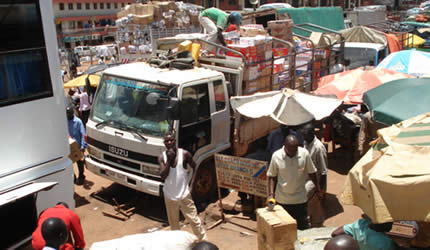
world than with itself.
Regional fragmentation could become even more costly for the continent with new World Bank forecasts suggesting that economic slowdown in the eurozone could shave Africa’s growth by up to 1,3 percent this year.
The World Bank in its report noted that uncertainty still surrounds the global economy and stagnation is likely to continue in traditional markets in Europe and North America, enormous opportunities for cross-border trade within Africa in food products, basic manufactures and services remain unexploited.
The reports says this situation deprives the continent of new sources of economic growth, new jobs and sharply falling poverty, factors which accompanied significant trade integration in East Asia and other regions.
The cross-border production networks that have spurred economic dynamism in other regions, especially East Asia, have yet to materialise in Africa.
It is clear that Africa is not reaching its potential for regional trade, despite the fact that its benefits are enormous – they create larger markets, help countries diversify their economies, reduce costs, improve productivity and help reduce poverty.
Yet trade and non-trade barriers remain significant and fall most heavily and disproportionately on poor traders, most of whom are women. African leaders must now back aspiration with action and work together to align the policies, institutions and investments needed to unblock these barriers and to create a dynamic regional market on a scale worthy of Africa’s one billion people and its roughly US$2 trillion economy.
In a special World Bank report, women traders on the border with the Democratic Republic of Congo and neighbouring countries in the Great Lakes region describe how they routinely encounter violence, threats, demands for bribes and sexual harassment, at the hands of the large numbers of customs and other government officials at the border.
As one egg and sugar trader from Goma says on the video: “I buy my eggs in Rwanda; as soon as I cross to Congo I give one egg to every official who asks me. Some days I give away more than 30 eggs!”
Barriers blunt trade in goods as well as services
Until the onset of the financial crisis, most sub-Saharan African countries grew rapidly and often at much higher rates than the world average. Economic growth in these countries was robust and driven by the boom in commodity prices, which led to very high growth in export values, especially for minerals, to new fast-growing markets such as India and China.
While exports have grown strongly over the last decade, and the region’s trade has recovered well from the global crisis, the impact on unemployment and poverty has been disappointing in many countries.
Unemployment remains around 24 percent in South Africa. In Tanzania, extreme income-poverty appears to have remained broadly constant at around 35 percent of the population.
This shows that export growth has typically been fuelled by a small number of mineral and primary products with limited impacts on the wider economy and that formal sectors remain small in many countries.
As a result, Africa will have to diversify its exports from depending solely on precious metals and other commodities and encourage more people to trade goods and professional services in accounting, law, education, and healthcare, among others. The region’s large number of young people also calls for significant numbers of new jobs, intensive trade and growth.
Changes are needed in three areas
To escape the current straitjacket of trade fragmentation, African leaders need to pursue changes in three key areas.
1. Improving cross-border trade, especially by small poor traders, many of whom are women, by simplifying border procedures, limiting the number of agencies at the border and increasing the professionalism of officials, supporting traders associations, improving the flow of information on market opportunities, and assisting in the spread of new technologies such as cross-border mobile banking that improve access to finance.
2. Removing a range of non-tariff barriers to trade, such as restrictive rules of origin, import and export bans, and onerous and costly import and export licensing procedures.
3. Reforming regulations and immigration rules that limit the substantial potential for cross-border trade and investment in services.
One classical example is how the South African supermarket chain Shoprite spends US$20 000 a week on import permits to distribute meat, milk, and plant-based goods to its stores in Zambia alone.
For all countries it operates in, approximately 100 (single entry) import permits are applied for every week; this can rise up to 300 per week in peak periods. As a result of these and other requirements, there can be up to 1 600 documents accompanying each truck Shoprite sends with a load that crosses a border in the region.
Lack of co-ordination across government ministries and regulatory authorities also causes significant delays, particularly in authorising trade for new products. Another South African retailer took three years to get permission to export processed beef and pork from South Africa to Zambia.
Gift Mugano is an author and expert in Trade Policies Research and Analysis (ACP-EU, Comesa & Sadc) and PhD candidate (Economics) and a lecturer of International Trade and Finance at Nelson Mandela Metropolitan University. He is based in Port Elizabeth, South Africa. Email: [email protected], mobile: +27 780 174 112.



 Online Reporter