Online Reporter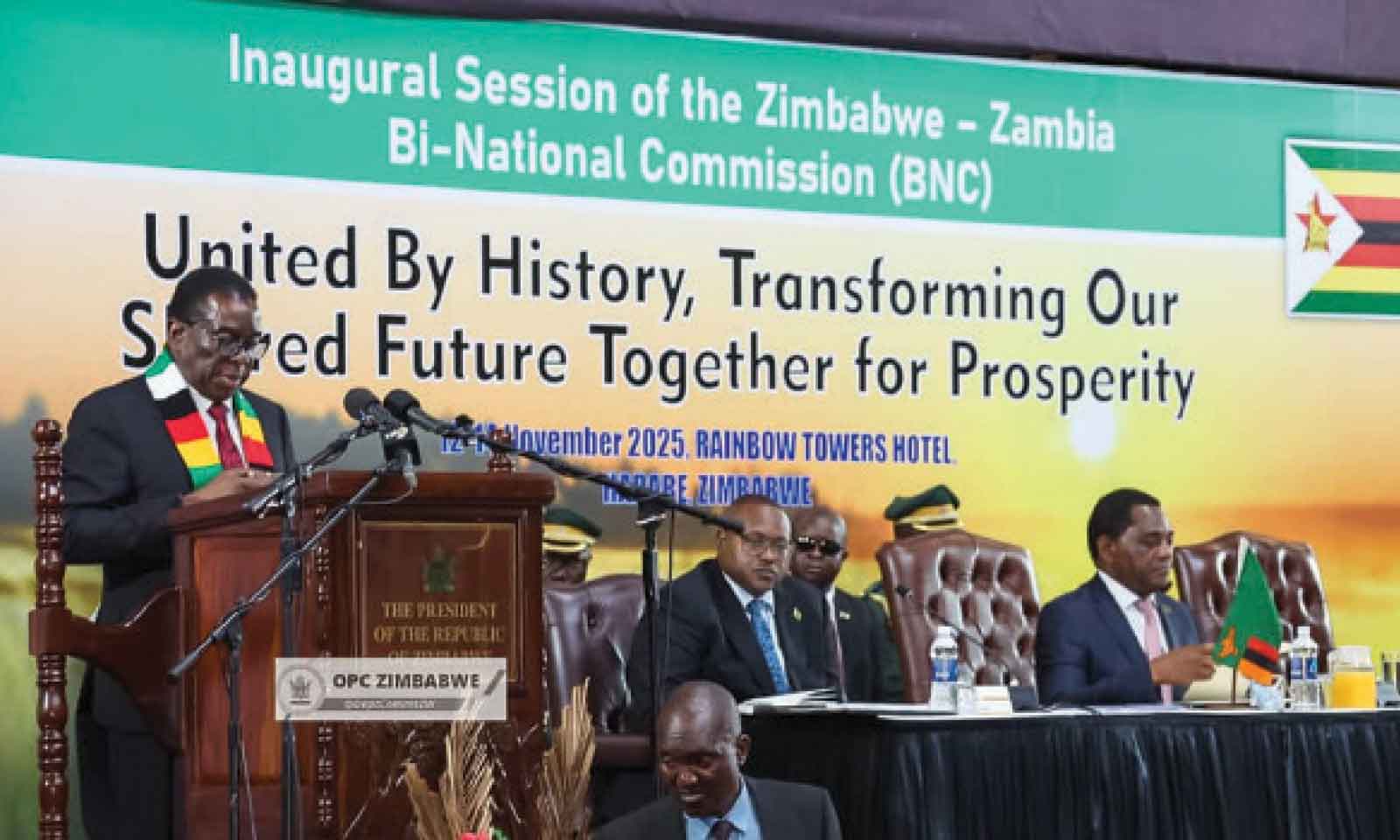
Sunday Mail Reporter
TRADE between Zimbabwe and Zambia is set to increase following the inaugural session of the Bi-National Commission (BNC) for the two countries in Harare on Friday, which agreed to remove all trade barriers.
The removal of the barriers is set to be finalised by March next year, giving effect to free movement of goods between the two nations.
According to a joint communiqué issued after the inaugural meeting, the two states committed to finalising a trade and economic cooperation framework agreement to guide future engagements.
Zimbabwe further agreed to support Zambia’s electricity imports from the region, with Harare set to increase the limit on power transfer capacity to facilitate the arrangement.
The inaugural session was attended by President Mnangagwa and President Hakainde Hichilema of Zambia, alongside senior Government officials from both countries.
The two countries signed six memoranda of understanding (MoUs) covering Diplomatic Training; Cooperation in Labour and Employment; Youth Affairs; Immigration and Technical Cooperation; Agriculture; and the Signing of Agreed Minutes.
“The Parties recalled the decision of September 2025 to remove all barriers that affect trade,” the communiqué reads in part.
“To that effect, Zimbabwe informed the Meeting that its Cabinet had passed a decision to scrap transit duties on petroleum products in particular, and measures on other barriers were factored into the country’s 2026 National Budget, which will come into effect on November 27, 2025. Both sides further agreed that technical-level discussions on the matter will continue on a quarterly basis, with finalisation by March 31, 2026.
“The Parties agreed to finalise the bilateral Trade and Economic Cooperation Framework Agreement, anchored on five existing regional and continental instruments, to guide structured engagement and deepen economic ties. Progress under the Simplified Trade Regime (STR) was acknowledged, with both Parties reaffirming their commitment to its full implementation to facilitate small-scale cross-border trade.
“The Parties welcomed the arrangement to support electricity imports by Zambia from the region through Zimbabwe and for Zimbabwe to progressively increase the limit on power transfer capacity.”
The communiqué also stated that the two countries agreed to implement 24-hour operations at the Chirundu and Victoria Falls one-stop border posts by the end of this year.
They underscored the importance of enhancing transport connectivity, noting that improved infrastructure is crucial for promoting trade and investment.
Zimbabwe and Zambia further highlighted the need for continued collaboration to ensure that shared assets are commercially viable and fully utilised for the benefit of their communities.
Additionally, both countries agreed to maintain regular engagements and dialogue on bilateral, regional and global matters.
“The Parties agreed to maintain regular engagements and intensify collaboration across existing and emerging areas of mutual interest,” the communiqué further reads.
“They further underscored the importance of sustained dialogue on bilateral, regional, continental and global developments, with a view to advancing shared positions and strengthening strategic alignment.
“The Parties welcomed the proposal to hold the Second Session of the Bi-National Commission and agreed to convene it by November 2027 in Lusaka, Zambia.
“Zambia pledged to continue advocating for the removal of illegal and unilateral sanctions imposed on Zimbabwe, as they are hindering developmental efforts.”
Zimbabwe and Zambia also reaffirmed their commitment to strengthening peace and security cooperation at bilateral, regional and global levels.
They commended the progress made by their surveyors-general on the boundary reaffirmation exercise and encouraged continued reconnaissance along the shared border from Victoria Falls to Kazungula.
The two countries also agreed to instal floating buoys on Lake Kariba to clearly mark and improve monitoring of the boundary.
The two parties agreed to have the second session of the Bi-National Commission by November 2027 in Lusaka, Zambia.
“It is important that we continuously work and track progress as we implement the agreements and MoUs that we have signed,” President Mnangagwa said while addressing the session.
“Let us adopt an honest and positive work ethic in the discharge of our various mandates within the context of the BNC.”
As Heads of State, President Mnangagwa said both himself and President Hichilema had an inevitable duty to ensure that Zimbabwe and Zambia leverage each other’s comparative advantages and natural resource endowments.
This, he said, would enable Harare and Lusaka to accelerate development, modernisation and industrialisation.
“We share a very long border, which was arbitrarily drawn by the former colonial power, separating families and communities,” he said. “Your visit (President Hichilema) affords us the opportunity to give impetus to ongoing efforts aimed at scaling up multi-pronged and mutually beneficial cooperation between our two countries.”
President Hichilema said he “loved” the development and order he had witnessed in Zimbabwe.
This was his first visit to Zimbabwe since assuming the Zambian presidency.
He emphasised the need to deepen relations between Harare and Lusaka, stating “what we want to see now is to do many things that are yet to be done in developing our assets”
“What we want to see now, ministers of Finance of Zambia, Zimbabwe and your counterparts in Investment, Trade, Commerce, in culture, and in many areas; what we urge you is to get on with the job, to do many things that are yet to be done in developing our assets,” he said.
“The Batoka Gorge project; we are tired of talking about it, we want to see steps taken to commence works on that asset,” he said.
He also announced that a team from the mining sector in Zambia was in Zimbabwe to tap into the country’s lithium mining expertise.
He called for the removal of tariffs between the two countries to enhance trade and increase investments from one country to the other.
President Hichilema conveyed Zambia’s solidarity with Zimbabwe in calling for the unequivocal removal of Western-imposed unilateral coercive measures.