

 admin
admin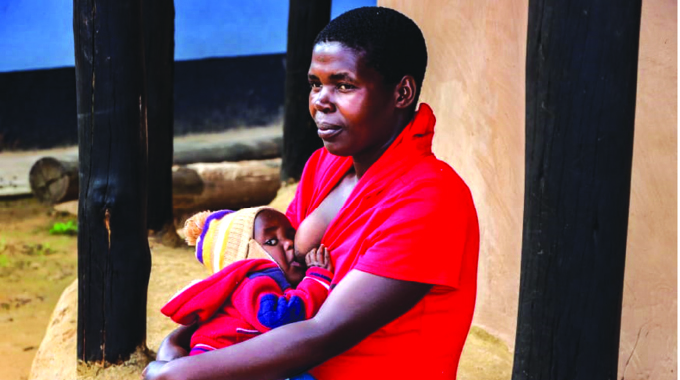
Rumbidzayi Zinyuke Senior Reporter
Can you imagine speaking about men and breastfeeding in one sentence?
Definitely not in many African settings.
Issues to do with breastfeeding are about women and are usually left for the females to discuss.
But in Chipinge district, Manicaland, a community where men are traditionally the unflinching custodians of culture; where men are used to making all the decisions for their families, traditional leaders have changed the norm and are now championing breastfeeding.
For years, the district had one of the highest rates of maternal deaths, a high infant mortality rate as well as high malnutrition rates.
After village health workers noticed the worryingly high number of these cases, they approached the traditional leaders to come up with a solution.
Chief Mapungwana, along with his village heads, health workers and other partners in his area, joined forces to change the trend.
A new law was put in place to penalise any family where a home delivery happens, or the mother falls pregnant while still breastfeeding, or fails to take a child under the age of five for their regular health checks.
Parting with a cow, a goat, a hen and a cockerel can leave one poorer in this part of the country.
Hence for the past six years since the rule was introduced, very few of these cases have been recorded in the area.
“As a community, we have set fines for all couples who stop breastfeeding their babies before the recommended times. If your case is reported to the headman, you pay a goat and if it is reported to the chief, you pay a cow,” said Chief Mapungwana.
“Since we started the issue of fines about six years ago, malnutrition cases have drastically gone down, which is a good development, even maternal deaths have gone down because we also fine mothers who deliver at home.”
And because these fines are paid by the husband, it has ensured the buy in of all men in the area.
Mr Richard Makwinimizi from Chagonda Village said men now appreciated the value of breastfeeding for the prescribed times, as well as visiting health facilities.
“We now appreciate that we were losing our women during child birth because most of them were giving birth at home,” he said. “We also lost many babies due to malnutrition.
“Men failed to take into consideration that a woman who is still breastfeeding can fall pregnant and they were not willing to use contraceptives so this resulted in pregnancy. Once the woman falls pregnant, they stopped breastfeeding and this caused the child to suffer from malnutrition.
“As men, we are now supporting our women and we have seen the benefits. And paying a fine is also not an option because men value their livestock.”
The women are happy that they now have their men’s support.
“We have always been encouraged to breastfeed for two years because it helps to maintain the child’s good health,” said Mrs Sibongile Mayengeni. “We are happy that the men have become supportive, they now realise that fewer children are dying due to consequences of early weaning and less women are dying while trying to hide that they fell pregnant while breastfeeding.”
All this has been possible through the rigorous programmes initiated by the Village Health Worker programme being implemented by the Ministry of Health and Child Care in partnership with the World Health Organisation and Unicef under the Health Development Fund (HDF).
Mr Titos Makuyana, a community based health worker in Chagonda village, said men were a key player in reducing cases of malnutrition and infant mortality rates.
He said before engaging traditional leaders, the situation was dire.
“I have been a village health worker for 12 years and before the traditional leaders intervened, I would see at least half of all children below two years suffer from malnutrition,” said Mr Makuyana. “Mostly, this was a result of women weaning their children early because they would have fallen pregnant.
“When we did our home visits, we would find the children sick, but upon enquiries, the mothers would not open up. Most of these children were not taken to hospital hence many of them died.
“The women would also not want to go for antenatal visits because they were afraid they would be rebuked for getting pregnant while another child was still too young so they were giving birth at home.
“Because the problem was big, we decided we could not succeed in curbing it alone and we approached the traditional leaders to assist us. People respect the traditional leaders and they would open up once in their courts.”
Continuous engagements between the male VHWs and the men has helped to open up discussion around available family planning methods and also increased awareness among the men on the importance of breastfeeding and providing nutritious food for the family.
The WHO and Unicef recommend that breastfeeding be initiated within the first hour of birth and that children be exclusively breastfed for the first six months.
Breastfeeding acts as a baby’s first vaccine, protecting them from common childhood illnesses.
It also guarantees a safe, nutritious and accessible food source for babies and young children while protecting them from all forms of child malnutrition, including wasting.
However, there are some misconceptions that are still proving a barrier against the total elimination of malnutrition.
According to custom, the milk of a woman who falls pregnant while still breastfeeding is contaminated, hence the child cannot continue taking it.
In Chagonda, once the mother is pregnant, they believe that the milk she produces is no longer for the breastfeeding child, but for the one growing inside the mother.
But Chipinge district nutritionist Mrs Samukeliso Masikati says that is not true. She says a child can continue breastfeeding until the mother goes into labour.
“Families believe in stopping breastfeeding when the mother gets pregnant so there is abrupt weaning of the child,” said Mrs Masikati.
“And in such cases, we find that the children will suffer from malnutrition because once they are weaned they are not given enough food to keep them healthy.
“The mother is now concentrating on the new pregnancy and the young child then suffers in most cases.”
Mrs Masikati said most cases of malnutrition recorded in Chipinge were of children who would have been weaned earlier than the recommended time of two years.
She said the introduction of a fine in Chief Mapungwana’s area was working and called for continued engagement between communities and health workers to maintain the results of the initiative.
Mrs Masikati said Chipinge district had approximately 65 000 children under the age of five years, and of these, 2 percent were affected by malnutrition.
The district’s Global Acute Malnutrition (GAM) rate stands at 9 percent, while the Severe Acute Malnutrition rate is at 4,5 percent and the Moderate Acute Malnutrition rate at 4,5 percent.
“After the occurrence of cyclone Idai, we recorded a spike in malnutrition rates and because it was followed by droughts, we still have residual impact of these on our children,” said Mrs Masikati.



 Online Reporter