

 admin
admin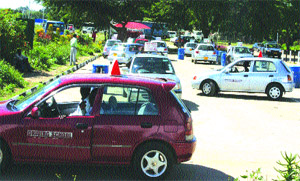
Such schools have since courted the ire of administrators who are threatening to take the owners to court if they do not formalise their operations.
Cases of corruption have also been reported as driving instructors allegedly connive with some Vehicle Inspection Department officials to issue licences to incompetent drivers.
The illegal driving schools have contributed to the “already huge numbers” of registered ones, spoiling prospective drivers with a wider choice.
But the problem is that it is difficult for learner drivers to distinguish between the genuine and the fake.
Though they could not provide figures, Traffic Safety Council of Zimbabwe officials said they were concerned with the increase in fake driving schools.
The officials also said they were dealing with limiting the numbers of the registered driving schools, which they feel was now excessive.
“We will take those who are operating illegally to court according to the law that guides us,” said the operating, research and marketing director for the Traffic Safety Council of Zimbabwe, Mr Proctor Utete.
“The number of driving schools has increased in the city and we are aware of the situation. While we have that in mind, we are considering putting them on hold and closely monitoring the ones we have registered.”
Mr Utete said owners of driving schools operating illegally were contravening Section 3 subsection 1 of Statutory Instrument 309 of 1985, which enjoins them to register.
The sprouting of driving schools has been attributed to taxi owners who are converting their cars for driving lessons.
Harare was flooded with taxis in the run-up to the Fifa World Cup held in South Africa last year.
Some people imported large fleets, hoping to cash in on tourists that were expected to visit because of the World Cup.
There was a duty-free dispensation on the importation of vehicles for that purpose. But many found themselves stuck with the vehicles after the World Cup and were also disappointed after realising that very few tourists visited Zimbabwe.
Zimbabwe Driving Schools Association chairman Mr Kudakwashe Mudzengi confirmed the unprecedented increase in the number of driving schools.
He said the increase was due to the fact that the Traffic Safety Council of Zimbabwe did not limit the number of such schools being registered.
But he said some of the driving school owners did not bother to register.
Mr Mudzengi said like any other business, there are some people who operate illegally, but it is the role of the Traffic Safety Council to monitor the number of driving schools.
“The schools have increased since there is no limit to the number of schools to be licensed, as long as they meet the statutory requirements, they get into the business,” he said.
“We urge those in the driving school sector to operate with proper documents.
“Most people own the driving schools, but they do not have the necessary resources which are required for the learners to get professional training.”
Mr Mudzengi said those who did not have licences were not members of the association.
Traditional driving schools are slowly being overtaken by new ones that are “putting sleek vehicles” on the roads.
And the new ones come in different names specially designed to give hope and courage to would-be drivers.
Names such as Flash, Target, Kuyedza, Kushinga, Tsungai and Exodus are now common on the city’s roads.
There is always a hive of activity at open spaces where the driving schools hold the lessons.
When The Sunday Mail In-Depth visited the open space adjacent to the Rainbow Towers last week, drivers of at least 25 vehicles were competing for the limited area to hold lessons.
The limited space has prompted the driving school owners to call for the expansion of infrastructure to accommodate them.
Platinum Driving School owner Mrs Shiriyedengwe said there was increased competition among the driving schools.
She said the City Health Department should play a part in monitoring the driving schools and controlling the environment in which they operate.
Mrs Shiriyedengwe admitted that there were some fake operators in the industry.
“The question now is: Are we going to produce good drivers?” she asked.
“This might be business, but we are talking about life. The intention of many who get into driving school business is to make quick money.
“The regulatory authorities should come up with a strategy on how they can make a follow-up. For example, they can monitor 10 schools per day.”
Some have noted that establishing a driving school is now one of the easiest ways of making money.
One does not need to have a big fleet as two small cars can be adequate for one to start operating.
But some of the driving schools have become breeding grounds for corruption.
A driving student, Ms Rumbidzo Mutanhi of Harare, said she attended 30 lessons at a local driving school.
When it was time to go for the road test, she was clearly told by her instructor that she would not pass the test unless she forked out US$150.
“I don’t even know which driving school to enrol at as they all tell you to prepare something to give the instructors when you go for the road test,” said Ms Mutanhi. “After paying US$150 for my first road test, I failed but I was not compensated. From that time, I gave up.”
The Traffic Safety Council of Zimbabwe trains instructors for the registered driving schools, with courses such as principles of effective learning and practical skills evaluation being undertaken. In order to obtain a driving school operating licence, one has to pay an application fee of US$100, insurance, registration fee of US$100, vehicle logo fee of US$50, premises logo fee of US$40, have a Zimra clearance certificate and an office to operate from.
There are at least 139 driving schools registered in Harare alone.
The driving schools charge between US$3 and US$10 for a single lesson of 30 minutes.
The learner driver would also have to pay US$15 for a copy of the Highway Code, US$20 to sit for a provisional test and US$15 for a book that contains more road and vehicle features. Booking a car for a road test costs US$20, with the road test itself costing the same amount. Such amounts have scared many prospective learner drivers as they are deemed exorbitant.-The Sunday Mail


 Online Reporter