admin
admin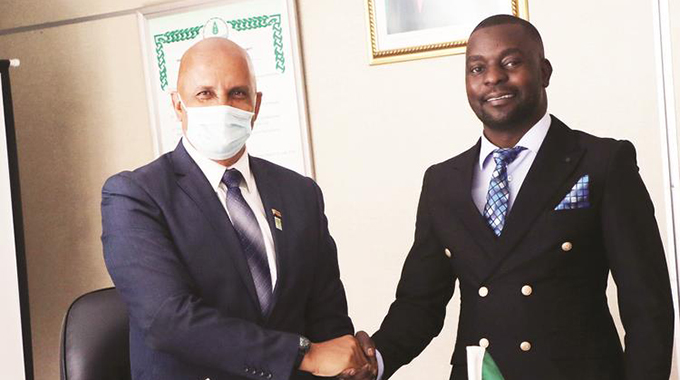
Lovemore Chikova
Development Dialogue
Two major developments that are expected to kick-off the process of restoring the Agricultural and Rural Development Authority (ARDA) to its yesteryear glory happened in the last few months.
The first was the appointment of the board led by Zimbabwe Agriculture Society chairman and agricultural expert, Mr Ivan Craig.
This was followed by the appointment of agronomist Mr Tinotenda Mhiko as the substantive chief executive of the authority.
What gives optimism that ARDA is set for a huge transformation is the appointment of agricultural experts to the key positions to lead the authority.
Mr Craig is a well-known agricultural expert who has worked at different levels in organisations and companies dealing with farming, gaining a lot of experience and expertise in the field.
His board is expected to give policy directions to the ARDA management, which will be led by Mr Mhiko.
Mr Mhiko is an agronomist who has the right qualifications for the job and has experience in modern agriculture.
He is a holder of Bachelor of Technology (Honours) Degree in Post-Harvest Technology from the Chinhoyi University of Technology.
Mr Mhiko also holds a Master of Science Degree in Agronomy Specialising in the Management of Technologies of Production, Processing and Regulation of Agricultural Products from the Peoples’ Friendship University of Russia.
He is studying for a Doctor of Agricultural Technology Degree (PhD) and his research entails prediction of crop growth, development and adaptation to abiotic and biotic environmental stresses using artificial intelligence and machine learning algorithms.
Being at the helm of an organisation like ARDA will give Mr Mhiko a chance to put in practice what he has gained in education and experience to help move the country’s agriculture forward.
This is because the ultimate goals being set by ARDA would require someone highly qualified for the job like Mr Mhiko to push the agenda forward.
An organisation that puts the rightfully qualified people in positions of leadership is likely to achieve its transformation and realise its goals much quicker.
And ARDA has been crying out for such talent to be at the helm.
For the ARDA board, the other members are Mr Lance Jena, who is the deputy chairperson, Dr Darlington Zeza, Mr Brian Henry Oldrieve, Advocate Thembinkosi Magwaliba, Ms Philomina Mandaza, Mr Willard Mbona and Dr Conrad Zawe.
A lot has been happening at ARDA aimed at re-aligning the institution with its original mandate of spearheading the advancement of agricultural production and rural development.
It is expected that now as the new board is in place, as well as a substantive chief executive, ARDA can chart its course going forward and play its rightful role in economic development.
ARDA is working on intensifying its rural development mandate as it seeks to uplift the livelihoods of communities in remote areas, enabling them to contribute immensely to the growth of the country’s economy.
This entails reviving productivity at its agricultural enterprises and transfer the requisite skills to transform farming in surrounding rural communities.
This means that apart from pursuing the commercial side of business, the rural development mandate should be at the forefront for ARDA in line with the country’s vision of transforming the marginalised areas.
ARDA is now expected to become a centre of excellence, with its estates strewn across the country acting as agricultural demonstration centres that impart knowledge and technology to rural farmers.
It is crucial that the newly-installed officials are already envisaging creating value addition centres for agricultural produce from both ARDA and the rural areas.
Value addition is the way to go as it can help with creating processing industries in the rural areas where people, especially the youths and women, can be employed.
Another priority for ARDA should be establishment of irrigation schemes in the rural areas and the availing of technology to power them.
Many irrigation schemes in various parts of the country are lying idle, but their revival will benefit the rural communities with food security.
This will enhance agricultural production and assist in developing rural areas, and in the end help reduce poverty levels.
Communal farmers have been facing various challenges that inhibit them from developing agribusiness.
These challenges include lack of skills and knowledge to improve production efficiency, financing for start-up or expansion and new technology.
These problems affect the capacity of rural farmers to both diversify into new markets for higher-value products, or add value to existing products through improved quality.
In this case, ARDA has to come in with support systems, market intelligence and information to assist the farmers realise their goals.
This calls for a model that supports and strengthens smallholder farmers’ activities.
ARDA’s plans should feed into the broader Vision 2030, which envisages the transformation of rural areas to aid the achievement of an upper middle income economy.
In fact, with swathes of land in many areas of the country, ARDA is capable of contributing significantly to the production of food.
What is important is that the authority has presence in all the eight rural provinces, and this means that no area will be left behind in development and benefiting from the expertise of ARDA.
This dovetails with the devolution development concept being pursued by Government to develop marginalised areas so that they come at par with others.
Unveiling the board in December last year, Lands, Agriculture, Fisheries, Water and Rural Resettlement Minister Dr Anxious Masuka said ARDA was expected to push the attainment of Vision 2030 to achieve an upper middle income society.
He outlined the mandate as follows:
Transform ARDA into an entity that maximises land utilisation of all the 88 000 hectares of potential arable land out of the 142 000 hectares it possesses instead of the present 13 000 hectares, within the next three years.
Produce food for the national strategic grain reserve.
Adopt best farming practices with a view to increase production and productivity on all its estates.
Ensure ARDA transitions from administering farming to leading by farming.
Transform rural development in line with Vision 2030.
Establish transformative linkages for sustainable funding and marketing of commodities produced on ARDA estates and irrigation schemes.
Establish new agricultural and rural development projects.
Become a vehicle for national food feed and fibre security.
After the board was unveiled, it then announced Mr Mhiko as the substantive chief executive.
The board emphasised that Mr Mhiko’s mandate was to “transform ARDA to achieve food, feed and fibre security”.
According to the board, special attention should be directed to:
Transform ARDA so that the entire 88 000 hectares it owns are fully utilised
– Ensure that ARDA adopts better farming practices with a view to increasing production and productivity
Ensure that ARDA ceases to only administer farming, but now lead by farming
Transform rural development in line with Vision 2030.
Establish transformative linkages for sustainable funding, marketing of commodities produced on ARDA estates and rural irrigation schemes.
These mandates as outlined by Dr Masuka and the ARDA board signify the new dispensation that is taking shape at ARDA to restore the institutions to its original mandate.
With the right people now in place to steer the ship, ARDA is destined for a success through the achievement of its mandate.



 Online Reporter