
Chief Justice Elizabeth Gwaunza
FOR many people, access to a court still involves travelling considerable distances, paying transport costs and taking time away from work, family responsibilities or the pursuit of a livelihood.
These burdens can be particularly difficult for people with limited means, older persons and persons with disabilities.
For some, attending court requires arrangements they can scarcely afford.
Bringing judicial services closer to communities helps to reduce these barriers and makes the right of access to justice more meaningful.
Addressing these barriers is not merely a matter of convenience.
It is a constitutional obligation.
Section 162 of the Constitution of Zimbabwe declares that judicial authority derives from the people of Zimbabwe.
Section 69 guarantees every person access to the courts and a hearing within a reasonable time.
Section 164 requires the State to assist and protect the courts so as to ensure their accessibility and effectiveness.
Section 165 reminds us that justice must be done to all irrespective of status, and that justice must not be delayed.
Section 190 charges the Judicial Service Commission with promoting efficient, effective and transparent administration of justice.
A court that people cannot reach cannot fully serve them.
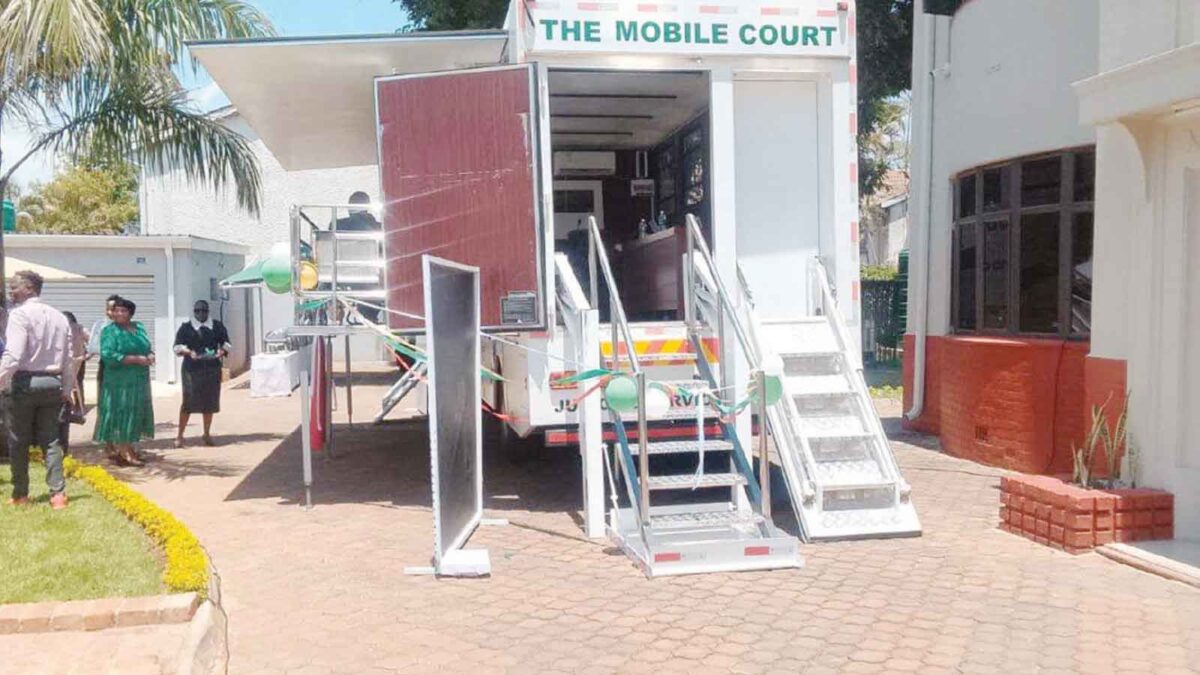
The mobile arrangement takes the court to the people, rather than requiring the people always to come to the court.
This initiative advances the commission’s strategic priority of improving access to justice under its Strategic Plan for 2026-2030.
It gives concrete expression to the theme of this legal year, which calls for quality, inclusive and sustainable judicial service.
It is intended to serve remote and underserved communities and to ease pressure on busy urban courts.
The initiative is equally aligned with our national aspirations.
Vision 2030 seeks a prosperous and empowered upper middle-income society, and the second National Development Strategy places good governance among its key priorities.
Development depends on the rule of law.
Disputes must be resolved and rights enforced without undue delay or cost.
Every hour that a trader, a farmer or a worker no longer spends travelling to court, or waiting for an adjourned matter, is an hour returned to productive life.
At its heart, the mobile court is an efficiency measure.
Its benefits can be seen at three levels.
Firstly, transport costs for court users, and limits time lost from work.
Witnesses who live near the court are more likely to attend.
Fewer missed appearances mean fewer postponements.
This also means that public confidence will be strengthened by the efficient and effective administration of justice by the courts.
Secondly, for the justice system, it allows matters to be heard close to where they arise.
For instance, police officers spend less time conveying dockets and accused persons to Mbare.
For the Mbare Magistrates’ Court, it can now attend more promptly to the matters that remain properly before it.
Thirdly, for the Judicial Service Commission, it makes better use of public resources.
An equipped truck, supported by a dedicated team, can be deployed according to identified need and redeployed as that need changes.
It extends our reach without the cost and time required to build a permanent court in every locality.
The mobile court will initially operate in the Harare South area.
It will cater for matters originating from Glen Norah, Glen View, Budiriro and Southlea Park, with the objective of reducing the caseload and pressure on the Mbare Magistrates’ Court.
To ensure that the service reaches all the intended communities, the mobile court will operate on a rotational basis, visiting the police stations in Glen Norah, Budiriro, Glen View and Southlea Park.
Each station will be visited once a week.
This arrangement is intended to bring judicial services closer to the communities, improve access to justice and reduce the need for litigants and other court users to travel to the Mbare Magistrates’ Court for the resolution of matters that can conveniently be dealt with within their localities.
The mobile court provides the physical facility.
The magistrates, prosecutors, court staff and other officers who serve in it will give the service its effectiveness.
Those officers must approach this responsibility with diligence and institutional pride.
For many people, their encounter with the officers will shape their understanding of the Judiciary.
The successful implementation of this initiative will, however, require the collective efforts of all key institutions in the justice delivery system.
The Judicial Service Commission will work closely with the National Prosecuting Authority of Zimbabwe, the Zimbabwe Republic Police and the Zimbabwe Prisons and Correctional Service.
Effective coordination and cooperation among these institutions will be essential to the smooth operation and overall success of the mobile court.
No single institution can achieve the objectives of this initiative in isolation.
The legal profession is an essential partner in this endeavour.
Through the Law Society of Zimbabwe, I invite legal practitioners to support the mobile court by providing legal advice and representation to the communities it will serve.
Bringing the court closer to the people must be accompanied by helping them understand its processes and participate effectively in proceedings.
We must also learn from this pilot mobile court.
Its performance will show whether we are reaching the intended communities and easing pressure on existing courts.
I encourage candid reporting of operational challenges and constructive feedback from court users and our partners.
The Secretary of the Judicial Service Commission will also report periodically on the progress and performance of the pilot mobile court.
The implementation plan for this initiative envisages each province having a mobile court by 2030.
Lessons learnt from this initial implementation will inform the selection of subsequent locations as the programme is progressively rolled out across the country.
This will enable us to extend access to justice to communities throughout Zimbabwe, particularly those facing geographical and other barriers to accessing conventional courts.
It must also be emphasised that the drive for efficiency must never compromise the principles of justice.
A court that moves quickly but unfairly does not serve justice.
Wherever the mobile court sits, judicial independence, impartiality and procedural fairness must guide its work.
It must treat every person appearing before it with dignity and give them a fair opportunity to be heard
In conclusion, our vision of a Zimbabwe in which world-class justice prevails must be felt in the everyday experience of the people who use our courts.
Elizabeth Gwaunza is the Chief Justice of Zimbabwe.