Online Reporter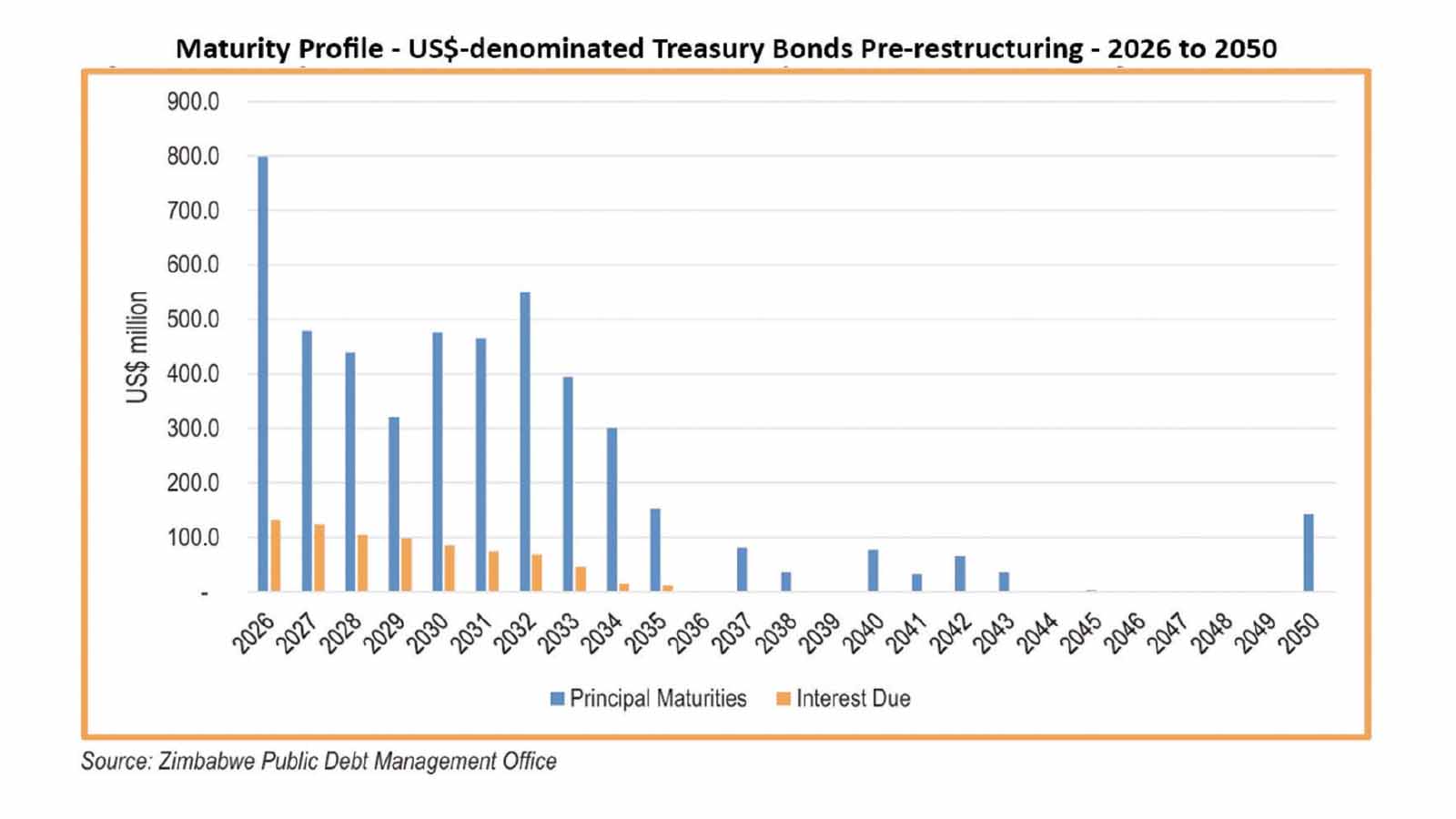
Tapiwanashe Mangwiro
Senior Business Reporter
The Government’s decision to restructure part of its domestic debt portfolio is expected to ease pressure on public finances over the coming years, creating additional fiscal space for development spending while reducing the risks associated with large debt repayments falling due within a short period.
The move forms part of a broader debt management strategy being implemented this year, as Treasury seeks to strengthen fiscal sustainability, deepen the domestic capital market and improve investor confidence.
According to the 2025 Annual Public Debt Bulletin, the Government undertook a significant reprofiling exercise that restructured Treasury securities with an outstanding value of about US$1,2 billion, extending maturities and smoothing the country’s repayment profile.
Prior to the restructuring exercise, Treasury faced a steep repayment schedule, with domestic debt obligations heavily concentrated in the short term.
The bulletin shows that debt service requirements for 2026 would have exceeded US$931 million, placing considerable strain on Government cash flows.
Following the restructuring, the repayment profile has been spread over a longer period, substantially reducing near-term refinancing pressures.
The revised maturity profile is expected to improve the Government’s ability to finance essential public services and infrastructure, while avoiding the need for costly short-term borrowing to meet maturing obligations.
Treasury said the exercise was undertaken to promote prudent debt management by reducing refinancing risks and improving the sustainability of domestic public debt.
Economist Gladys Shumbambiri-Mutsopotsi said debt restructuring was a widely used public finance tool that enabled governments to better align debt repayments with expected revenue flows.
“A debt reprofiling exercise should not be viewed negatively. It is a recognised debt management strategy aimed at reducing repayment pressures and avoiding situations where large volumes of debt mature simultaneously,” she said.
“In Zimbabwe’s case, smoothing the maturity profile provides Treasury with greater flexibility in managing public finances while supporting macroeconomic stability.”
She said the benefits of the exercise would ultimately depend on the Government maintaining prudent borrowing practices and ensuring that new debt financed productive sectors capable of supporting long-term economic growth.
“Restructuring debt provides breathing space, but that space must be used wisely. The objective should always be to improve the quality of public expenditure while maintaining fiscal discipline.”
The debt restructuring forms part of wider reforms outlined in the bulletin, which include developing a more active domestic securities market, reintroducing
Treasury Bill auctions, issuing longer-dated instruments and increasing the use of ZiG-denominated securities.
Authorities believe these measures will diversify the Government’s funding sources while reducing refinancing risks associated with shorter-term debt.
Ms Shumbambiri-Mutsopotsi said successful implementation of the broader debt strategy would require consistency in fiscal policy and continued transparency in public debt reporting.
“Investors value predictability. Publishing regular debt information, maintaining transparent borrowing practices and adhering to a clearly defined debt management strategy all contribute to building confidence in Government securities.”
She added that developing a deeper domestic capital market would ultimately provide the Government with a more reliable source of long-term financing, while supporting broader financial sector development.
Economic analyst Namatai Maeresera said the restructuring represented an important step towards modernising Zimbabwe’s domestic debt market.
“One of the biggest risks for any sovereign borrower is a concentration of debt maturities within a short period. When large repayments become due simultaneously, governments often have to refinance under unfavourable market conditions or divert budgetary resources away from development spending,” he said.
“Extending maturities reduces these risks and improves fiscal planning, because repayments become more predictable.”
Mr Maeresera said a more balanced repayment schedule could also strengthen investor confidence by demonstrating the Government’s commitment to active debt management, rather than reactive borrowing.
The bulletin indicates that domestic debt remains an important component of Zimbabwe’s overall debt portfolio, accounting for nearly half of total public and publicly guaranteed debt. Treasury is therefore placing greater emphasis on improving the efficiency and resilience of the domestic debt market.
Among the reforms being pursued is the gradual shift towards market-based issuance of Government securities, allowing Treasury to better determine investor demand while improving price discovery in the domestic bond market. The Government also plans to expand its investor base by encouraging greater participation from pension funds, insurance companies, banks and other institutional investors.
Treasury further intends to broaden financing options through innovative instruments such as diaspora bonds, asset recycling and public-private partnerships, to reduce pressure on conventional borrowing.
These initiatives are expected to complement ongoing efforts under the Arrears Clearance and Debt Resolution Roadmap, which seeks to normalise Zimbabwe’s relations with international creditors and eventually restore access to concessional financing.
Economists say that while debt restructuring does not reduce the overall stock of public debt, it significantly improves its management by lowering refinancing risks and allowing Treasury to spread repayments over a longer period.
Combined with ongoing fiscal reforms and efforts to deepen domestic financial markets, the strategy is expected to strengthen the country’s debt sustainability and improve the Government’s capacity to finance economic development without creating excessive pressure on the national budget.