

 Online Reporter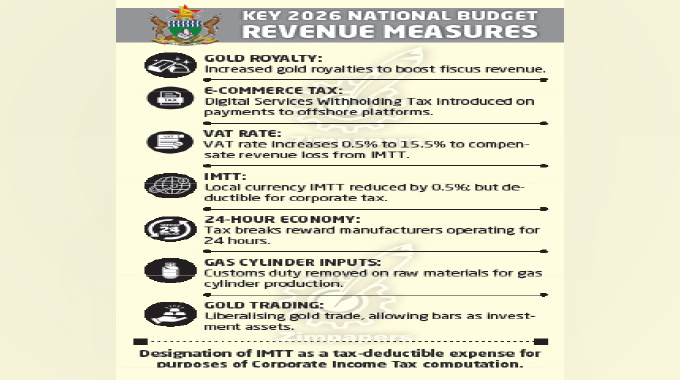
Golden Sibanda, Harare Bureau
ZIMBABWE’S economy is forecast to maintain a solid growth trajectory of at least 5 percent in 2026, anchored by the key sectors of electricity generation, agriculture, mining, manufacturing, wholesale and retail trade, Finance, Economic Development and Investment Promotion Minister Professor Mthuli Ncube has said.

The rapidly stabilising macroeconomic conditions, with year-on-year inflation expected to moderate to about 12,1 percent by the end of 2026, will also support the prevailing strong economic growth trajectory.
The Treasury expects the ZiG annual inflation rate to further decline to single-digit levels by the fall of 2026, reflecting anchored inflation expectations, currency and exchange rate stability, as well as strengthened monetary-fiscal policy coordination.
The 2026 national budget broadly reflects the Government’s policy thrust under the National Development Strategy 2 (NDS2), Zimbabwe’s next medium-term policy blueprint, which broadly seeks to consolidate the gains of NDS1, including the plunge in inflation, supported by the now largely stable exchange rate.
NDS2 is Zimbabwe’s comprehensive blueprint to accelerate the economic transformation towards the realisation of Vision 2030, which is to elevate the country into a prosperous and empowered upper-middle-income Society by 2030.
Presenting a US$9,5 billion 2026 national expenditure plan at the New Parliament Building yesterday, Minister Ncube said favourable weather conditions were expected to bolster agricultural production, while higher investment in the manufacturing sector was expected to drive industrial output.
He said the 2026 National Budget was anchored on the 10 national priorities of NDS2 (2026-2030), which include macroeconomic stability and financial sector deepening, inclusive economic growth and structural transformation, infrastructure and housing development, agriculture, national food security, climate and environment and science, technology, digitalisation, innovation and human capital development.
In addition, the budget will also prioritise job creation, youth entrepreneurship and development, creative industry and culture, social development, gender and social protection, regional development and inclusivity through devolution and decentralisation, image building, international relations and trade and good governance, institution building, peace and security.
“In 2026, the mining sector is expected to be the largest contributor to GDP growth, accounting for 0,9 percent of the projected 5,0 percent growth. This will be followed by financial and insurance activities at 0,7 percent, while agriculture and manufacturing are each projected to contribute 0,6 percent,” Minister Ncube said.
The economy is projected to grow by 6,6 percent this year, after a 8,8 percent expansion in the first half.
The overall projected revenue envelope for 2026, coupled with the Government’s borrowing capacity, provides for an overall expenditure amount of ZiG290,9 billion (US$9,5 billion), which translates to 17 percent of GDP.
However, during the national budget consultations stage, ministries, departments and agencies submitted bids over ZiG828,5 billion, way above the available capacity of ZiG253 billion (3,3 times).
“Government will continue to align expenditure outlays with available resources, thus ensuring that fiscal policy supports macro-economic stability and the broader objectives of sustainable economic growth and transformation.
“This is critical to contain inflationary pressures, preserve exchange rate stability and minimise the accumulation of public debt,” he said.
“The 2026 National Budget revenue measures seek to consolidate the gains achieved under the National Development Strategy 1 (NDS1) and lay the foundation for the transition to NDS2.
Minister Ncube said one critical milestone achieved during the NDS1 (2020-2025) period was the introduction of the local currency (ZiG) in April 2024, which has restored price and macroeconomic stability.
“The proposed revenue measures are targeted at supporting productive sectors, providing relief to taxpayers, and minimising avoidance and evasion, whilst ensuring fairness, efficiency, and simplicity in the tax system,” the minister said.
Other economic policy support measures include the proposal to harmonise and review the royalty structure for all gold producers as follows: 0 to 1,200 oz, 3 percent; 1,201 oz to 2,500 oz, 5 percent; 2,501 oz and above, 10 percent.
The minister also proposed to hike the intermediated money transfer tax (IMTT) from 2 percent to 1,5 percent, to promote the use of local currency and lower transaction costs.
However, the Treasury chief maintained the IMTT rate on foreign currency transactions at 2 percent while designating IMTT as a tax-deductible expense for purposes of Corporate Income Tax computation.
The Treasury also expanded the definition of financial institution for purposes of the IMTT tax to include microfinance entities.
“As a quid pro quo to the above concession and to partially compensate for the revenue forgone arising from the IMTT rate reduction and deductibility measures, I propose to increase the Value Added Tax rate by 0,5 percent to 15,5 percent, effective 1 January 2026,” Minister Ncube said.
The minister noted that the emerging sector continued to account for a substantial share of economic activity, with the foreign currency dominating over 90 percent of physical cash transactions across both the formal and informal markets.
This widespread reliance on physical cash undermines transparency, the minister said, reducing traceability of transactions and significantly limiting the effectiveness of tax administration and revenue collection.
“On average, ATM withdrawals amounted to approximately US$265,8 million per month between April 2024 and June 2025, of which over 90 percent were in United States dollars,” the minister said.
The minister pointed out that banks now keep over US$1 billion in nostros to meet the cash demand.

The continued increase in cash withdrawals, Minister Ncube stressed, which reached US$353 million in June 2025, heightened risks of informality, tax evasion, corruption and administrative inefficiencies.
To discourage the US dollar cash withdrawals, the minister has proposed a levy of 2 percent for transactions valued at US$500 to US$1001 for individuals and US$5001 to US$10,000 for corporates.
The US dollar cash withdrawal levy has been set at 3 percent for transactions above US$1 000 for individuals, and withdrawals above US$10 000 for companies.
And support the economy’s transition towards a 24-hour production economy, the minister proposed to introduce targeted tax incentives for firms operating extended production or service hours in the manufacturing sector, where such operators demonstrate incremental production and revenue thereof.
“Discussions are ongoing with relevant stakeholders on the modalities of the proposed framework targeting, among others, the following incentives: additional tax deductions on selected expenditure incurred during extended operational hours; accelerated wear-and-tear allowances on plant and equipment used in round-the-clock production cycles and priority access to import duty concessions for firms that demonstrate capacity for expansion or productivity improvements under the 24-hour model.”
To facilitate mobilisation and retention of bank deposits, Minister Ncube proposed to allow as a tax-deductible expenditure, interest expenses payable on such deposits made with financial institutions, subject to appropriate safeguards to prevent abuse, including transfer pricing rules, thin capitalisation principles, and anti–base erosion measures.
To modernise the gold trade legal framework and support the use of gold as an alternative investment asset, the minister proposed to expand the categories of persons who may lawfully possess or deal in gold, to include authorised dealers, the national gold refinery, and individuals in possession of certified gold bars acquired from these entities.
“Furthermore, I propose that holders of certified gold bars, subject to the Exchange Control Act, be allowed to pledge, exchange, sell, barter, or otherwise transact in these bars. This reform will facilitate the introduction of regulated, traceable investment-grade gold products, thereby offering citizens a secure store of value,” the minister said.
The minister said to reduce the cost of producing gas cylinders and stimulate local production, levelling the playing field between imported and locally manufactured products, the Treasury would remove customs duty on selected imported raw materials that include steel coils and plates.


 Bongani Ndlovu