Chronicle Editor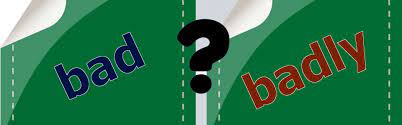
BAD, badly — bad is an adjective and modifies a noun. Badly is an adverb and modifies a verb, an adjective, or another adverb. The teacher is in a bad mood today.
She felt bad that her team had lost the match. However, she agreed that overall, the team played badly. Farther, further – Farther refers to physical distance. Further refers to time or degree. You have to travel farther than the next shop. We have to discuss this a little further.
Maybe before going far, we can provide explanations to words like adjectives.
An adjective is a word that modifies a noun or pronoun. An adjective may answer one of these questions: What kind? Which one? How many? How much? Many adjectives have different forms to indicate degree of comparison. (tall, taller, tallest).
The comparative degree compares two persons, places, things or ideas (worse, sadder). The superlative degree compares more than two persons, places, things, or ideas. (worst, saddest).
Good, well – Good is often used as an adjective. Well may be used as an adverb of manner, telling how ably something is done, or as an adjective meaning “in good health”.
All the contracted farmers had a good season. The whole class performed well. After feeling sick last week, the baby is well now. In, into – In means “inside”. Into indicates a movement from outside toward the inside. They were seated in the house. A snake slithered into the house.
Lay, lie – Lay means “to place”. Lie means to recline. The builder instructed the trainee how to lay the bricks. You have to lie in bed if you are unwell. Loose, lose – Loose means “not firmly attached”. Lose means “to misplace” or “fail to win”.
The rope got loose and he fell to the ground. Did you lose your pen along the way? He predicted that they would lose the game by a huge score line. Set, sit – Set means to place” or “to put”. Sit means to place oneself in a seated position.
Please set the table for dinner. There is no place in the hall to sit down.
Whose, who’s – whose is the possessive form of who.
Who’s is the contraction of who is.
Whose car is this? Who is going to take me home?
Among, between – Use among for three or more people, things, or groups.
Use between for two people, things, or groups.
They found her among the crowd of people at the market. She walked between the two boys.
All right, alright – The expression all right should be written as two words.
Some dictionaries do list the single word alright but not as a preferred spelling. He felt all right again after taking some tablets.
Amount, number – Use amount with nouns that cannot be counted. Use number with nouns that can be counted.
She added the wrong amount of salt o the relish. There was a large number of uninvited guests at her party.
Raise, rise – Raise means to “cause to move up”. Rise means “to move upward.” Farmers raise different crops depending on climatic regions. Dust will rise when you start sweeping and affect guests. Who, whom – Who is the subject pronoun. Whom is an object pronoun. Who has dug this pit? This is the lady to whom we should report our problems.
We also have trouble areas where as learners you need to recognise and then correct the common writing errors. For example, sentence fragment.
A sentence fragment does not express a complete thought. It may lack a subject or verb or both. You can address this through identifying problems and offering solutions. For example: the lion paced the floor of the cage. Looked hungry.
Solution: Ad a subject to the fragment to make a complete sentence. The lion paced the floor of the cage. He looked hungry.
How much do you know about nouns? There are various types of nouns. Here is a list of some of them and their functions. Abstract noun – names an idea, a quality, or a characteristic.
Examples, beauty, love. Collective noun – names a group of people or things – class, team, troop, and audience.
Common noun names a general, not a particular, name of a person, place, thing or idea- pen, fear, city, boy, pig.
Compound noun is made up of two or more words – hairbrush. Concrete noun names a thing that you can see or touch – water.
Possessive noun shows possession, ownership, or the relationship between two nouns – Jacob’s ladder. Predicate noun follows a linking verb and gives information about the subject – the story is a comedy. Proper noun names a particular person, place, thing or idea – Bulawayo, Jeremiah.
Learn personal pronouns, their singular and plural forms and use in sentences. Singular pronouns: I, you, she, he, it. Plural – we, you, they. They are used as a subject. (me, you, her, him, it – us, you, them)
These can be used as a direct object, indirect object, or object of a preposition. (my, your, her, his, its – our, your, their. These possessives are used before nouns (our home). (mine, yours, hers, its- ours, yours, theirs possessive used alone. The book is yours.
Learn the suggested language structures for improved performances. For views link with [email protected] or sms to 0772113207.



 Online Reporter