Chronicle Editor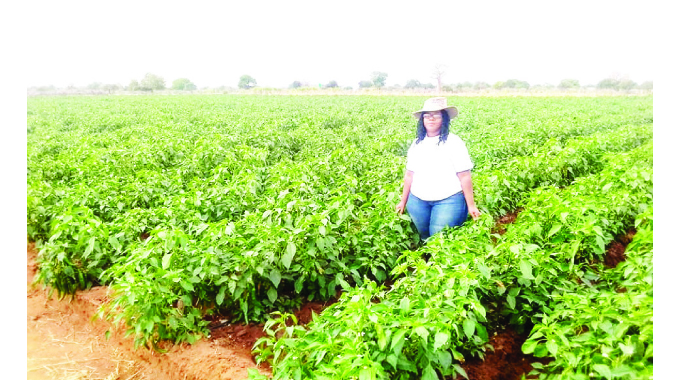
Mashudu Netsianda, Senior Reporter
AN enterprising cross-border truck driver, Mr Edzisani Muleya (55) has transformed a dry area, largely characterised by low rainfall and recurrent droughts into an oasis of hope for his community in Tshapfutshe Village in Beitbridge district, Matabeleland South.
Despite the geographical location, Mr Muleya, who has no formal qualifications in agriculture, has managed to turn his dream of becoming a successful commercial farmer into reality.
He has transformed a 4-hectare piece of land, previously lying idle, into a flourishing horticulture project, which has generated employment for 20 families in his locality, among them widows and orphans.

A self-taught farmer who started his horticulture project two years ago, Mr Muleya is already eyeing export markets in Italy and neighbouring South Africa for a variety of spices which include paprika, saffron, fennel, fenugreek, coriander and cumin.
Mr Muleya relies heavily on technical advice from agronomists, extension officers and other experts in the field.
Through his efforts, he is defining the success farming story, contributing significantly to food security for the nation in line with the Agriculture and Food System Transformation Strategy (2020-2025) whose thrust is to see Zimbabwe achieving a US$8,2 billion agriculture economy by 2025.
The strategy, which was launched by President Mnangagwa in August 2020, is underpinned by growing the economy and ensuring Zimbabwe grows its own food and ensures the majority of rural families move from poverty to affluence.
“When I started this project, my intention was to produce food and be able to feed my family upon retirement.
I started by growing maize for household consumption using flood irrigation,” he said.
“I then discovered that there was a huge gap in the market in terms of tomatoes and vegetables hence I decided to venture into commercial horticulture farming.”
Using a drip irrigation system, Mr Muleya grows up to 10 000 tomato plants for the local market, which he is failing to satisfy.
“I started with 2 500 plants of tomatoes, but due to demand, I increased to 5 000 then eventually got to 10 000 and the demand keeps growing,” he said.
His enviable farming project attracted the attention of Cesvi, an Italian non-governmental organisation that has partnered Government in supporting rural communities in transforming into commercial agriculture through modernisation of infrastructure, market approach and new management systems.
Cesvi is working with smallholder farmers across the country to revive the exports of oranges and paprika and exploring the niche of saffron.
According to online reports, saffron which Mr Muleya is growing is the most expensive spice in the world with 450 grams costing between US$500 and US$5 000.
The reason for its high price is its labour-intensive harvesting method, which makes its production costly.
Saffron is harvested by hand from the Crocus sativus flower, commonly known as the saffron crocus.
According to studies, saffron contains an impressive variety of plant compounds.
These act as antioxidants — molecules that protect human cells against free radicals and oxidative stress.
Free radical damage has been linked to chronic diseases such as cancer.
The spice is revered for its medicinal properties.
People would eat saffron to enhance libido, boost mood and improve memory.
Mr Muleya said when Cesvi officials visited his plot, they were impressed by his project and offered to partner him in securing an export market for paprika, which he has just introduced.
“I am now part of the Cesvi programme to promote export crops in Beitbridge district.
I have planted two hectares of paprika including other spices such as saffron, fennel, fenugreek, coriander and cumin.
I am currently working on these export crops using drip irrigation, which saves water by 35 percent.”
Mr Muleya said since Beitbridge falls under a dry region, they are trying hard to conserve the little water that is available.
“I have one borehole, which uses electricity to pump water.
There is also a reservoir which has a holding capacity of 10 000 litres of water,” he said.
The paprika is destined for South Africa while saffron is going to Italy.
Mr Muleya said he also started preparing land to plant garlic.
Due to the nature of his job, Mr Muleya works with his younger brother, Obert and niece, Ms Progress Muleya who help monitor and manage the project during his absence.
“Although most of the time, I will be at the plot, I have my younger brother and niece who manage the project in my absence.
The Cesvi people are also helping me to monitor the export crops under their programme,” he said.
Mr Muleya’s project has generated direct employment for at least 20 families, including widows and orphans from the local area.
“My ultimate goal is to get into farming full time upon retirement.
My niece who studied agriculture is assisting me in terms of technical advice.
This project has transformed the face of our area and there is now a lot of economic activity,” he said.
“In addition to employing locals, I also assist vulnerable groups such as the elderly.
Farming is good because it creates employment and boosts the country’s food security and helps in terms of economic growth.” – @mashnets.



 Online Reporter