Chronicle Editor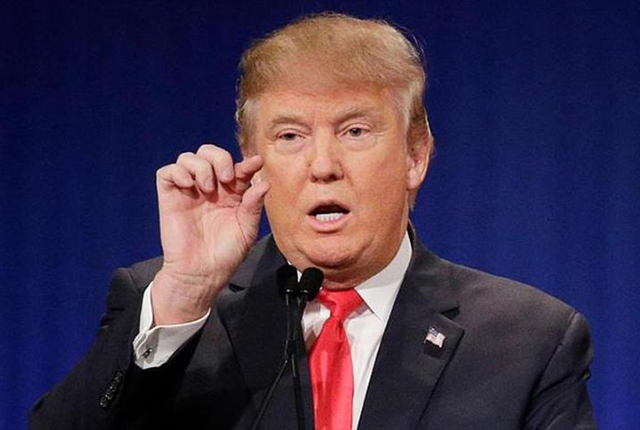
Jeffrey Gogo: Climate Story
IT is now a matter of public record: Donald Trump’s victory shocked many people as much as it pleased several others. He was largely expected to lose, even by those in his Republican party. Or at least they hoped so. But the US president in waiting is now causing consternation in climate change discourse, where his loss would have been met with loud cheers.A known climate change denialist who believes the dangerous science is a trick, Mr Trump has in the past threatened to rip the landmark Paris Agreement apart, if he became president. The Agreement came into force on November 4, much earlier than the original 2020 effective date.
It aims to keep global temperature rise “well below two degrees Celsius” in this century, and to pursue efforts to achieve a 1,5 degrees Celsius warming cap, as well as help African nations adapt.
World governments and environmentalists are currently meeting in the Moroccan resort of Marrakech for the annual UN climate talks where they expect to put the Paris Agreement into motion.
Now that he is president-elect, will Mr Trump make good on his promise and pull the US, the world’s second largest emitter behind China, out of the treaty, achieved after decades of painful negotiations?
“He is an actor,” said a Zimbabwean climate expert, of Mr Trump.
“So, anything can happen but he will not (pull out of the Paris Agreement),” said the expert who cannot be named for professional reasons, as negotiations on how to make the agreement work enter their second and final week, this week in Morocco.
During his campaign, Mr Trump made several promises on how he intends to change America once he became president, with some promises eliciting derision and others outright condemnation. This includes his infamous plan of stemming the flow of immigrants by building a wall along the US-Mexican border. Mr Trump’s election promise could not have been more serious.
His plan for job creation follows numerous paths, but the bigger threat comes from the ambition to do this by expanding fossil fuels production and use, the number one source of climate changing greenhouse gases like carbon dioxide. Being the “actor” that he is, it is difficult to know for certain whether Mr Trump will fulfil his pre-election promise and withdraw the US from the world’s first inclusive, legally binding treaty, agreed by 195 countries last December. And neither can we dismiss his antics as political banter, at this stage.
How would the world react to such an action by just one man, a man convinced climate change is one of China’s tricks to rule the world through an expansion of renewable energy at the expense of fossil fuels, that he aims to champion?
Environmentalists may be losing sleep over Mr Trump’s threats, but not for long. The world has to move on, with or without the incoming US president. The US wasn’t party to the Kyoto Protocol, but those that were reported some progress in lowering emissions, however inadequate.
Crucially, nations aren’t actioning on climate change to please the US; it’s a question of domestic interest, they are doing it for themselves. Extreme climate-related events such as drought, floods, cyclones have bashed countries relentless in recent decades, leaving a trail of destruction that has cost live and livelihoods.
So, by addressing climate change, countries are as a matter of fact addressing a major development issue that is already curtailing social and economic growth. Governments understand this perfectly well.
Canada, which accounts for 1,6 percent of global emissions, has for the first time joined the party, showing some commitment. Combined with higher emission cuts from the 27-member European Union, which makes up 10 percent of world emissions, Canada can help fill in the void left by the US. It may not be much, but it will count for something. Further, Mr Trump risks isolating the US if he proceeds with his ill-thought withdrawal plan.
“If President Trump decides not to honour America’s commitments under the Paris Agreement, he will quickly learn that this negatively impacts his ability to get support from other countries’ leaders on trade, terrorism, and other issues important to him,” said Linh Do of ECO, a commentary to the environmental negotiations process produced since 1972.
“Climate change has become a geopolitical issue of the top order, and any country perceived as not doing its fair share to confront the climate threat will suffer consequences for its standing in the world.”
Why is it important that the US remains in the Paris Agreement?
Together with China, the US accounts for 45 percent of the global emissions total. A Trump pull out is a pull out of about a sixth of world emissions from the Paris Agreement. It means the US will be freed from fulfilling its commitments of cutting emissions by between 26 and 28 percent by 2025, compared to 2005 levels.
According to the Obama administration, most of the reductions were to be achieved by tightening existing laws in the energy industry, targeting power plants, oil and gas production as well as in the transport and construction sectors.
A US withdrawal, if at all it happens, will be most damaging to the global effort on climate change. It could set the world back several decades at a time scientists at the UN expert panel on climate change are agreed action remains woefully inadequate.
Even if the Paris Agreement was fully implemented, with America participating, the world was firmly on course for an unsustainable above 3 degrees Celsius warming by 2100, they say.
The pull-out may spell doom for Africa and the rest of the developing world who expect to benefit from the obligatory financial interventions by rich countries. So far, the US has pledged $3 billion to the Green Climate Fund, which aims to help poor nations in Africa and elsewhere adapt. But the prospects of those funds being released under a Mr Trump presidency remain hazy.
“There may be limited future resources for climate action from public funds but the private is already in it and supporting clean technologies so the momentum can continue,” said an optimistic Mrs Veronica Gundu, deputy climate change director in the Ministry of Environment, Water and Climate, by text message.
ECO’s Linh Do said he was hopeful that “the coalition of US development, faith, environmental, and business groups” will make “Trump and his team understand” the reality that financial “assistance is not charity or a hand-out, but rather a smart investment with economic, environmental, and security benefits to Americans.”
How long will it take for the US to completely withdraw from the treaty?
Some experts have argued the pull-out process might take up to four years, the equivalent of Mr Trump’s term of office.
So, Mr Trump will likely have to spend his entire time in the White House trying to prevent America from becoming a responsible nation, climate-wise. He may not succeed on this front. Mr Trump will not repeat his shock election win on climate change.
After all, what are the odds he will be elected for a second-term in office?
God is faithful.



 Online Reporter