


 Online Reporter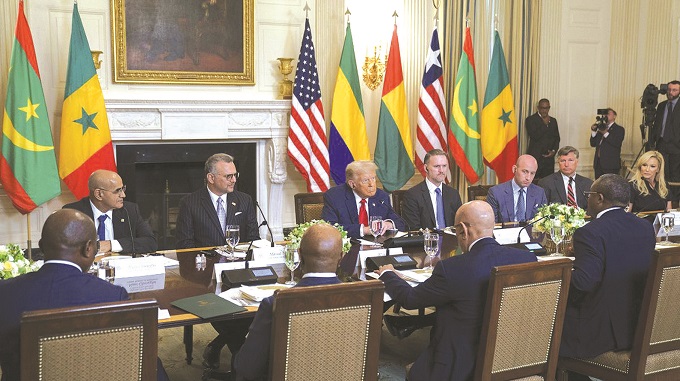
Moussa Ibrahim
On July 9, 2025, the White House hosted a high-profile gathering framed as a new beginning for United States-Africa relations.
Five presidents from West and Central Africa (Gabon, Guinea-Bissau, Liberia, Mauritania and Senegal) joined US President Donald Trump for what was described as a working lunch to discuss trade, investment, democracy and development.
On the surface, the meeting appeared to offer hope — a pivot away from charity-based aid and towards “win-win”economic cooperation. But beneath the photo ops and carefully worded press releases lies an old script, imperialism rewritten for a new era, colonial logic in a business suit.
The most immediate red flag was the selective nature of the invitation. These five leaders were chosen not because they represent the African continent or a regional consensus, but precisely because they do not. They were selected for their compliance, not their vision. Revolutionary governments such as those in Mali, Niger, Burkina Faso or Guinea were deliberately excluded.
The African Union was sidelined.
The Economic Community of West African States (ECOWAS) was ignored.
This was not diplomacy; it was a strategic manoeuvre to fracture African solidarity and reward obedience, while isolating defiant sovereigntist forces in the Sahel.
Trump used the occasion to showcase his shift in policy from foreign aid to direct trade and private investment.
This coincides with the dismantling of USAID and broader gutting of US foreign assistance programmes.
While Trump presents this as cutting waste and promoting self-reliance, the numbers tell a different story. Liberia alone stands to lose aid worth more than 2,5 percent of its gross national income. A recent Lancet study forecasts up to 14 million deaths globally by 2030 as a consequence of cascading aid cuts in health, nutrition and infrastructure.
The narrative of aid fatigue obscures a more violent reality: The imposition of austerity and the prioritisation of corporate capital over human lives. The logic behind this pivot is not benevolence; it is extraction.
Trump openly praised Africa’s “very valuable land, great minerals, great oil deposits”, and announced US support for Gabon’s Banio potash mine through the US Development Finance Corporation.
This is not development.
It is raw material dependency dressed in the language of opportunity.
These so-called partnerships do not include technology transfers, sovereign control of value chains or long-term industrial strategies. African nations remain trapped in structures where they export what they do not consume and import what they do not produce. It is the same colonial dynamic of wealth outflow, but with new branding.
Meanwhile, the travel bans that may affect the very countries represented at the summit underscore the contradiction at the heart of US foreign policy.
Even as Africa is courted for its resources, it is shut out of Western borders, stigmatised as a security risk and surveilled as a threat. The embrace of African leaders is tactical, not principled. It is not solidarity, but subjugation. The language of democracy and governance, repeatedly invoked at the summit, was deployed as a smokescreen.
No one questioned the democratic legitimacy of US-backed regimes, nor did anyone raise the violence of sanctions, the repression of dissent or the consequences of economic strangulation. Democracy, here, is not a goal but a weapon, used to discipline, coerce and justify intervention. The summit was silent on colonialism, on reparations, on stolen wealth, on looted artefacts and on the structural violence that underdeveloped Africa for centuries.
We must see this summit not as a new beginning, but as a continuation of a permanent economic war against Africa.
From structural adjustment programmes to exploitative trade agreements, from the CFA franc to the World Trade Organisation, Africa has been systematically disempowered. The use of debt, sanctions and aid conditionalities have turned economic tools into instruments of domination.
The radical response should be to reject these colonial structures entirely.
We must also recognise that the US is not a development partner; it is a global military empire. With over 29 bases in Africa under AFRICOM, US drone operations in Niger and covert CIA programmes across the Sahel, Washington operates not as a friend of Africa but as a garrisoning force.
These military installations are not for peace, but for control.
Trump’s so-called economic shock therapy is nothing new. It is part of a larger strategy of controlled collapse: Destroy weak states, flood markets with foreign goods, privatise essential services and turn public wealth into private profit. To replace aid with investment is not inherently bad, but when that investment comes from the same forces that destroyed public systems in the first place, it becomes a cruel joke.
Africa should fund its own development through progressive taxation, state-owned enterprises, repatriation of looted wealth and the creation of sovereign wealth funds built on nationalised resources.
The people of Africa should look beyond them and build grassroots power: Pan-African assemblies, community councils, people’s defence networks and economic forums that reflect the will of the masses, not the preferences of Washington.
And let us stop pretending that development can happen without justice.
Africa is owed reparations, for slavery, for colonial plunder, for structural adjustment and for environmental destruction.
Africa loses US$777 billion annually in illicit financial flows. It pays more in debt servicing than it receives in aid.
These are not accidents; they are systemic theft. We must demand reverse conditionality: No cooperation without restitution.
No deals without asset return.
No handshakes without apology.
Culturally, too, Africa is under siege.
The US and its allies export not just goods but ideologies, individualism, consumerism, depoliticised entrepreneurship and liberal technocracy.
These are not neutral.
They are tools of erasure, designed to uproot revolutionary consciousness.
We must fight back with radical education, liberation art and African-centred philosophy. We need a renaissance of resistance rooted in history, language, memory and vision. The ultimate goal is not a better version of the current system. It is a different system altogether. A people’s economy built on public ownership, cooperative agriculture, food sovereignty and democratic control of resources. A trade system not based on extractive exports but on intra-African barter, solidarity and reciprocity. A union of African nations that looks south, to Latin America, to Asia, to other colonised peoples, for alliance, not northward for approval.
We must consider organising a continental debt strike, led by the African Union and rooted in the legitimacy of popular resistance. Africa must collectively refuse to pay illegitimate debts, and redirect those funds towards healthcare, housing, infrastructure and education. The White House summit also sought to isolate Africa from its revolutionary allies.
There was no mention of Venezuela, of Cuba, of Palestine, of Iran, of the BRICS alliance. These are not coincidental omissions.
They are calculated.
The US fears a multipolar world where Africa chooses its own friends.
That is why we must build an Afro-Global South Alliance — a collective of liberation movements, radical governments and grassroots struggles across continents committed to self-determination, anti-imperialism and global justice. And finally, we must reclaim revolutionary memory.
The names of Nkrumah, Sankara, Gaddafi, Cabral and Nyerere are not museum pieces.
They are maps. They are weapons.
They are the blueprints for what must come next. The young generation must know what was done, what was dreamed and what remains unfinished.
Let us build a Pan-African memorial archive to preserve their legacies and to teach the next generation not how to negotiate with empires, but how to defy them. What happened on July 9 in Washington was not a new beginning.
It was a recycling of the old, an imperial pageant masquerading as diplomacy. But Africa does not belong to summits. It belongs to its people.
And the people are rising.
From Ouagadougou to Bamako, from Khartoum to Kinshasa, the cry is the same: We are not your quarry. We are not your market. We are not your experiment.
We are a continent in rebellion.
And history, as always, is being written not by those who dine with empires, but by those who dare to resist them.— rt.com
Moussa Ibrahim is the executive secretary of the African Legacy Foundation in Johannesburg.


 Online Reporter