Chronicle Editor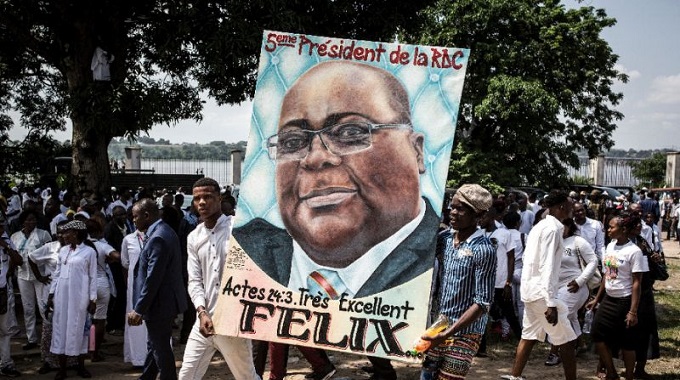
Democratic Republic of Congo (DRC)’s new president, Felix Tshisekedi, turned the spotlight on human rights on Friday, on his first full day in office after succeeding Joseph Kabila, in power for 18 years.
“I have already scheduled a meeting of the Senior Security Council, to which I will attach agencies such as the ANR,” Tshisekedi told journalists, using the French acronym for the powerful National Intelligence Agency.
Closing down illegal prisons – which the ANR is regularly accused by rights watchdogs of having – will be “one of my first decisions,” Tshisekedi added.
The 55-year-old took the helm of sub-Saharan Africa’s biggest country on Thursday after gruelling elections.
There were fears that notoriously unstable DRC would be plunged into bloodshed once more.
But polling on December 30 took place relatively quietly, leading to the country’s first-ever peaceful transition of power despite angry claims of a fix by runner-up Martin Fayulu.
In his inaugural speech on Thursday, Tshisekedi vowed to release all political prisoners swiftly and offered words of reconciliation for Fayulu and third-placed candidate Emmanuel Ramazani Shadary.
Kabila handed over his office to Tshisekedi on Friday after the pair spent more than two hours closeted together.
They walked down a flight of stairs and shook hands.
Tshisekedi’s campaign chief and political ally, Vital Kamerhe, has been appointed his chief of staff.
The new president will have to share power with Kabila supporters who wield an overwhelming majority in the National Assembly.
Parliament reconvenes today, when the new president is likely to start building his new government and choosing a prime minister.
Fayulu’s coalition confirmed on Friday that it will take up its seats in the National Assembly while continuing its quest for “the truth” of the December election outcome.
The DRC is a vast, mineral-rich but impoverished country the size of continental western Europe.
The country has been chronically unstable since it gained independence from Belgium in 1960.
It lived through two regional wars in 1996-97 and 1998-2003 that claimed millions of lives and sucked in armies from around the region.
Presidential elections in 2006 and 2011 – both won by Kabila – were marred by bloodshed.
Dozens died in a crackdown on protests after Kabila chose to remain in office in 2016 at the end of his constitutionally-limited second term in office.
Meanwhile, a United Nations rights group has unearthed more than 50 mass graves in the western DRC after a spate of killings were reported in the region last month.
Abdoul Aziz Thioye, the director of the UN Joint Human Rights Office (UNJHRO), said on Saturday that “more than 50 mass graves, as well as common and individual graves that we have identified,” were uncovered in the town of Yumbi in the DRC’s western province of Mai-Ndombe.
“This suggests that the number [of deaths] is quite high because a communal grave depending on size may contain five, ten bodies” or even “100 bodies or four times more,” Thioye said following a joint fact-finding mission with local authorities.
General Fall Sikabwe, the army chief in western DRC, said that an investigation had begun.
“They have killed soldiers and policemen, taking their weapons to slaughter with,” he said, giving no further details about the killings.
Earlier this month, the UN said at least 890 people were killed during three days of inter-communal clashes in the region.
UN High Commissioner for Human Rights Michelle Bachelet, said in a statement on January 16 that the UN office had been informed by “credible sources” that the people were killed between December 16 and 18 in four villages in Yumbi.
The violence appears to have been rooted in a long-standing rivalry between the Banunu and Batende ethnic groups, sparked when Banunu tribespeople buried a traditional chief on Batende land on the night of December 13.
– AFP


 derick.khumalo