

 Chronicle Editor
Leonard Ncube, [email protected]
TSHOLOTSHO District in Matabeleland North is turning the page in development following the opening of an agricultural training centre whose vision is to equip youth with skills to become job creators.
Initiated by Wilderness Safaris’ Children in the Wilderness (CITW) in partnership with the International Union for Conservation Nature (IUCN), the centre is called Ngamo Livestock Farm and Agricultural Training Centre.
It is located in Ngamo Village in Ward Three where a group of 40 pioneer students started classes early this month.
The initial goal of the training centre is to benefit the local Ngamo and Gezi communities covering nine villages namely Ngamo, Nganyana, Vozheka, Zikwakweni, Sitambali, Zandile, Ziga, Siwela and Mbizo which are all under Chief Matupula.
The training centre came after a needs-based assessment by Wilderness Safaris and the community showed desire for conservation and farming projects as they are prone to human-wildlife conflict due to proximity to Hwange National Park.
A one-square kilometre farm was identified and has demo plots for vegetables, tomatoes, butternuts, cucumbers and carrots.
The farm will be expanded gradually into a fully-fledged eco-friendly and climate smart intensive crop farm while four cattle have been put on site for livestock farming.
The school will have a cattle breeding project to improve local cattle genetics through artificial insemination. An abattoir will be established for the farm and whole community as part of the project.
All students are accommodated on site after construction of boys and girls’ hostels. There are offices, two solar powered boreholes, a cattle boma pen, fowl runs, a green house, kitchen and lecture rooms.
The students will work on the farm as part of their practicals, which contributes to the completion of the course. Produce from the farm will be used to feed the students and surplus will be sold to the community and Wilderness Safaris camps.
Various stakeholders are involved in the project and these include CITW, IUCN, Zimbabwe Parks and Wildlife Management Authority, Sadc, Kavango-Zambezi Transfrontier Conservation Area, Tsholotsho Rural District Council and a number of funding partners.
The project is the first of its kind in the province.
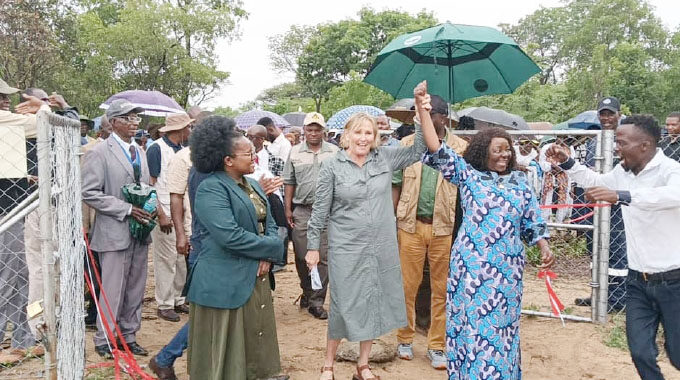
Environment, Climate and Wildlife Minister, Dr Sithembiso Nyoni, officially opened the training centre on Friday.
She said the project aligns with President Mnangagwa’s Vision 2030 for an upper-middle-income society.
“I am grateful that today we are launching Ngamo Livestock Farm and Agricultural Training Project, which will empower youths to venture into livestock and crop production.
“We are doing this to reduce the trek to neighbouring countries,” she said.
“We have agreed that this should be expanded into a provincial training centre and each district should be given two slots so that no one and no place is left behind as we capacitate youths with skills to be able to create jobs and be self-sustaining,” said Dr Nyoni.
She said learners should be taught smart climate-proofed farming while some courses should be tailor made to address local challenges such as food insecurity, human-wildlife conflict, rural-urban migration and others.
Dr Nyoni said Vision 2030 cannot be attained without empowered youths and noted that Tsholotsho has vast natural resources that can benefit youths.
“This college should change the mindset by producing graduates that create employment and find solutions to communities’ challenges. We want education with production for our youths so that when they leave here they can help to uplift the livelihoods of their families,” she said.
Dr Nyoni said communities should take the forest as an economic asset and conserve the environment as part of measures to address human-wildlife conflict.
“Let’s also introduce wire making and conservation as courses so that communities use wire fencing to protect their fields and homesteads,” she said.
Matabeleland North Provincial Affairs and Devolution Minister, Richard Moyo, said the project will address the critical challenges of food insecurity, human-wildlife conflict and climate change in Tsholotsho.
“This is in line with the Government agenda of improving the living standards of all citizens by 2030.
This is a shining example of a rural project that fulfils the mantra of leaving none and no place behind,” he said.
Minister Moyo said such projects promoted inclusive and sustainable development for citizens.
“By sharing knowledge and strategic development ideas from all of us, we can unleash the full potential of our local economy and work towards a brighter future for our province. I hope this project will trigger similar initiatives in other districts,” he said.
Wilderness Zambezi Impact Manager Ms Sue Goatley said the centre targets school-leavers aged between 17 and 25 who will attain HEXCO-certified certificates and diplomas after completing training.
“This initiative stands as a beacon of hope, resilience and empowerment for Ngamo community. The farm is not just about crop and livestock, it is about nurturing livelihoods, fostering resilience and building a brighter tomorrow,” she said.
Chief Matupula welcomed the project and urged his subjects to jealously guard the infrastructure. — @ncubeleon.



 Online Reporter