admin
admin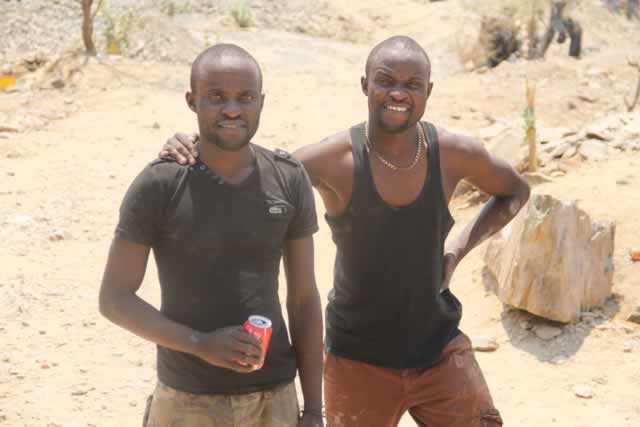
Roselyne Sachiti Deputy Features Editor
Their life story reads like a script from a television soapie or bestselling fiction novel as it is full of twists and turns.
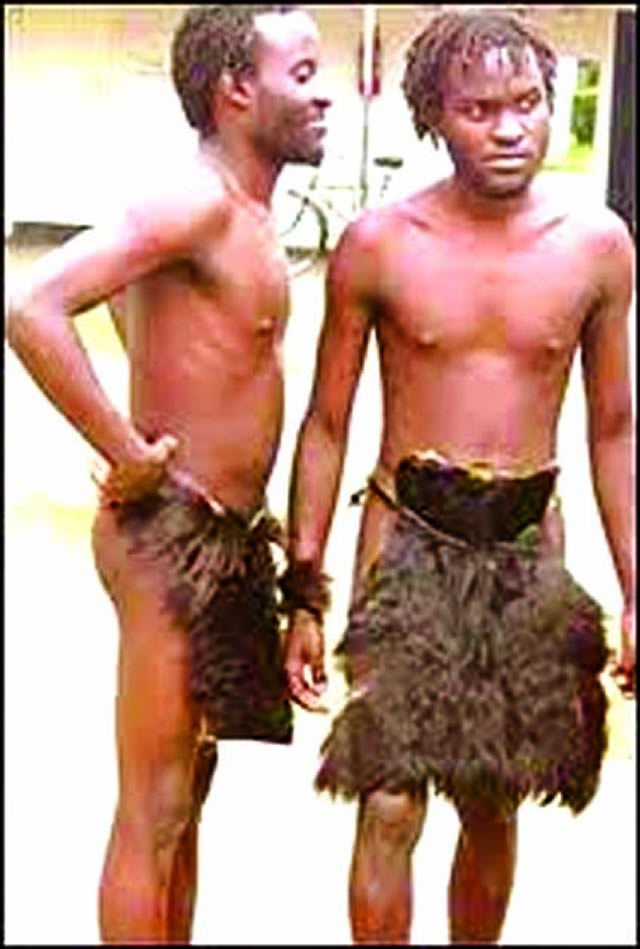
Known to many Zimbabweans as the “Terrible Twins”, the pair in 2006 walked Harare’s CBD and Mount Pleasant among other areas wearing goatskin kilts (nhembe) that only covered the essentials but left the buttocks exposed.
They were arrested, locked up in remand prison and released on condition they put on clothes.
They would appear and disappear from the public sphere and were at one time staying in Mhangura, Karoi and Banket where they were farming.
They also aided a traditional healer known as “Mbuya Nehanda” At one point the two also ventured into music.
When everyone thought their “characters” had been written off the “script”, the Fichani twins – Tafadzwanashe and Tapiwanashe – were at work, writing another chapter of their life story.
They are now proud “owners” of a mining claim in the Zenda area, Gokwe North.
The mine is registered under their father George Fichani’s name and the twins are in charge of its day-to-day operations.
They hire and fire people, buy gold, pay salaries, among other things, a job that requires utmost discipline and given their past one would doubt their credibility.
But they have proved all critics wrong as they are doing the job just fine. Their father is rarely there, putting his trust in his sons.
Over 2 000 people now pin their hopes on the pair as they offer temporary employment through daily shifts.
“We own about four blocks here. Around there are about 80 pits covering an area of about two football pitches. We are currently mining from only four pits,” said Tafadzwanashe, the more talkative of the two, as his twin walked by his side nodding in agreement.
Each day, he said, 400 job-seekers stand outside their claim hoping to be picked for shifts, which were created to give everyone an opportunity to work.
“When I came from England I intended to do mining and was doing it in Muzvezve.
“Sometime in 2006 just after whatever (referring to the kilt incident) our dad decided to buy this mining claim from Billy Rautenbach but we had problems here and there. In 2013, we embarked on mainstream mining. Tapiwanashe and I were in Banket and the old man (father) told us that he wanted us to be in charge,” he said.
Tafadzwanashe said they immediately took up the challenge but it was no stroll in the park.
“Rautenbach used excavators to extract minerals. We did not have excavators but had four compressors. To cope with the heavy load, we put people on contract basis.
“We cannot operate all pits because of financial constraints and the magnitude of the mine,” added Tafadzwanashe.
In an area which was hit by a severe drought and low cotton prices, the mining claims at Zenda come as a relief to many.
Most people received US$200 or less for two bales of cotton after working hard the whole season. In sharp contrast, they get over US$1 000 per month from working at Zenda.
In their short time in Zenda, Tafadzwanashe adds, many lives have been transformed.
Over 40 people have bought cars, built houses and can fend for their families, and also buy cattle. Others own shops, commuter omnibuses and supermarkets in their home towns.
He explained that the hired men use compressors and jack hammers when they go as deep as 60 metres.
“They drill holes and blast and take out the ore. We collect what we call mvolas and give each person two shovels for hand milling. At this stage women get heavily involved as they do most of the hand milling.
“The finished product is sold back to us and we take it to Fidelity. We also take the ore to Kadoma or Silobela.
“No outside buyers come to the area as the law does not permit them to do so.
“We are the main buyers here. Those who break the law are usually arrested by CID Minerals who have an office here,” he said.
Boasted Tafadzwanashe: “Most of our workers are getting over US$1 500 per month if they are lucky to get a shift per day. They live way above the Poverty Datum Line. We are the highest payer around. Children are in boarding school because of this.”
What they get per month varies.
It can be six to seven kilogrammes of gold per month.
Their pits have names. The one that makes a lot of money was named Pahasha because it had high concentration of gold and created all the spotlight. Then there is Julie’s stream also with high concentrations, Gudo and Peter.
But, they complain that they have not yet financially benefited from the Government-initiated indigenisation programmes.
“We are already enjoying the fruits of indigenisation because we own a claim something many blacks never dreamt of years back. We, however, are not benefiting from Government programmes financially and want them to help us. We have created employment for almost all the youths from Gokwe North constituency and beyond.
“Mining equipment is expensive. We support indigenisation and also want it to support us,” added Tafadzwanashe.
They are superstitious. Women are not allowed to go to the pits, it’s taboo.
“It’s just a superstition we inherited when we started mining here.
“It is also forbidden to wear certain colours like red at the claims.
“We do not completely shut out women but empower them by allowing them to do most of the hand milling. They get money that way,” clarified Tafadzwanashe.
Other companies, Four Brothers and Huni, also own mining claims and employ a sizeable number of people.
Loreen Madombi, who works at the Fichani claim, says she is living comfortably from the money she earns.
She handmills stones and earns US$200 per two weeks, but it is hard work.
“The steel grinder is heavy and weighs about 4kg. I always develop blisters on my hands,” said the mother of three.
All her children are all in school thanks to the mining claim.
She wants the Government to provide loans so that they buy wares for resale at the mining claims since they are not permitted in the pits.
“We will get more money this way,” she emphasised.
It has been three months since Raphael Jordan (22) started coming to Zenda. In the short space of time he has managed to pay fees for his siblings (who were always out of school because of non-payment of fees) and also take care of his parents.
He finished school in 2007 and has never worked anywhere.
A woman who only identified herself as Mrs Moyo from Nyarungwe area said she started hand milling this year.
She has paid school fees for her four children using wages from Zenda.
Tragit Moyo, a father of four, has been mining for 13 years. His life had greatly improved. He is now a proud owner of a house, a car, several cattle and supermarket and a shop in Chakari.
“Government should support mining initiatives by black people,” he said.
Mortion Wachekwa, who is the general manager of the Fichani claim, called for Government to remove duty on all mining equipment.
“We plead with Government to introduce free duty on mining equipment for small- scale miners because we are employing a lot of people benefiting the nation.
“We are also calling for higher gold prices,” he said.
A community leader, and Zanu-PF district chairperson Mr Edson Mafudza said mining operations at Zenda have helped locals greatly.
“Most people did not even own a single cow but now they now boast several. Some now have many goats and chickens, others have built beautiful houses and others bought cars. Most kids are in school because of such initiatives,” he said.
Shylet Hatina of Mutora in Nembudziya, who bakes bread and cooks sadza for resale, said she makes US$120 per week.
Her children live with her mother whenever she is in Zenda.
A member of the Zimbabwe Economic Empowerment Council, Hatina said women are getting money through difficult means. They have to work three times harder than their male counterparts.
Staying in their rural home does not help as they will starve.
As such she wants women interested in mining to be recognised through solid Government policies.
“Women in leadership like Vice President (Joice) Mujuru; Women Affairs, Gender and Community Development Minister Oppah Muchinguri; Higher and Tertiary Education, Science and Technology Minister Olivia Muchena among others should remember us. We are swimming in money but cannot access it because we are not allowed to go to the pits. Most women have developed chest problems because of hand milling,” she said.
Prisca Chigudu, who cooks sadza which sells to the miners, said she takes care of eight people using the money she gets from Zenda.
She is looking forward to opening a bar and shop at Tsungai Business Centre using her earnings She makes between US$48 and US$60 per day.
Alice Chindundundu said she is disappointed that women are not allowed to go into the pits where all the money is.
“We can only get money by selling wares. We also want to own pits. Even if we do not go underground men can do that for us and give us our gold.
“Sometimes I wish that I would turn into a man when I am here and transform to a woman when I go down,” she complained.
With 2 000 people at Zenda, the environment is clearly giving up.
A strong stench of human waste engulfs the air while paper, plastics, empty bottles and cans form a blanket in some sections.
There are only two Blair toilets – one within the Fichani claim – and another outside but they are not enough.
The roads to Zenda are extremely bad, rugged and damaged in some sections because of some illegal mining activities by some people, making some sections impassable.
The situation is worse during the rainy season as they become slippery and muddy.
But those determined to get money always find a way as even cars with low suspensions miraculously make it to Zenda.
Some people from as far as Harare, Kwekwe, Gweru, Kadoma among others are also making a bee line to Zenda either to work in claims or sell various wares.
A small “mining town” has been created.
Flea market stalls made from pole and grass welcome visitors to the main entertainment and business section known as the “Junction”.
The vendors – both men and women – sell from brand new clothes to second-hand ones, shoes, blankets, solar panels, radios, watches, jewellery and anything one can imagine. There is a hardware shop that specializes in all sorts of things.
Everything in Zenda comes at a cost; there are no freebies. There are no boreholes or other water sources to provide safe drinking water close by. Thus, a 20-litre bucket of water costs US$1, while a drum of water fetches US$8.
There are several canteens, my count ended at 20. Here women cook meals from breakfast, lunch and supper since everyone there has no time for that.
Breakfast prices depend on the meal you want and the type of bread, the dollar for two loaves or dollar for a loaf.
Lunch and dinner costs US$1 for a plate of sadza and beef or fish, US$2 for rice and chicken. Chicken feet, livers, gizzards, heads, and intestines are also served with sadza.
A live chicken costs US$6. A cow lasts a day if slaughtered.
“Supermarkets” strewn around the area have all luxuries for the comfort of the miners. From perfumes to mayonnaise, baked beans, tinned fish, pasta, the choice is yours.
There are plenty of bars at the Junction, too many to count. Men play snooker on brand new pool tables, others who have just received their pay cheques guzzle the day away while others shop in the flea markets.
“Here we drink Smirnoff like we drink water,” said a guzzler.
The pole and grass bars all have refrigerators and radios that play all music genres from sungura, R’nB, dancehall, etc.
Here ciders, lagers and opaque beers, cool drinks, freezits and mineral water are sold ice-cold and patrons get value for money.
Musaga, a bartender, said: “Business is brisk. We make US$400 a day.”
With such numbers and cash flowing come a number of societal challenges and risky behaviour. Most of the men at Zenda leave their wives at home as the environment there is not too conducive. This creates opportunities for ladies of the night who have found a ready market. Some are as young as 14 and prey on the men. A tryst costs US$10.
Shops there provide free condoms, both male and female.
There are plenty of used condoms strewn on the ground in the bushy areas.
There is a “clinic” at Zenda and it specializes in Chinese herbal products.
An apostolic faith sect also operates from there and those seeking divine intervention before going underground or on any other issues seek their services.
Harare has to come to them, they will not set foot there, they have everything they need.
Tafadzwanashe said most of the events that unfolded in their lives could be just a result of spiritual forces.
“You do something because of spiritual forces that work within people. Sometimes you have to refrain and say I do not want to do this or that.
“As time goes on you develop and have kids. You cannot just sit and pray, there is no manna these days, you have to work.”
Both Tafadzwanashe and Tapiwanashe also have two kids each.
Only time will tell whether the Fichani twins decide to add another chapter to their life script but for now they say they are content.
Feedback: [email protected] / [email protected]



 Online Reporter