admin
admin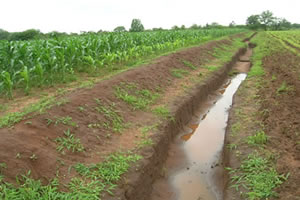
from Ward 17 in Gwanda District of Matabeleland South Province.
Ndlovu was referring to the effectiveness of the infield rainwater harvesting technology being promoted by development agencies in Gwanda, Matobo, Bullilima and Mangwe districts in this province.
‘’Without the involvement of the local people, projects are likely to fail,” said Ndlovu.
One of the project’s approaches is to enhance awareness and train local communities to have skills in the area of infield rainwater harvesting and management in this semi-arid province.
This involves the establishment of dead level contours, infiltration pits and low-cost rainwater storage facilities. The approach also shows that vulnerable rural communities in semi-arid areas can produce their own food and become less dependent on food handouts.
Rainwater harvesting technologies extended to 3 120 farming households have helped the smallholder farmers to improve on crop production and create livelihoods. This has enabled them to produce surplus food and generate income from their farming activities despite the unfavourable agricultural conditions in the area.
Farmer exchange visits were used to share and disseminate agricultural information.
‘’Contrary to common prejudice and belief, much of technology adaptation is done in the communities by commuties, and in some cases, new technologies and innovations are initiated there, ‘’says Ndlovu.
One such technology that has seen successful community level adaptation and improvement is the dead level contour concept in Gwanda, 180km north of Bulawayo, the country’s second largest city.
Dead level contours are an adaptation of the colonial times contour ridge, which was designed largely to divert run-off water from the field. Instead of channelling water away from the field, the purpose of dead level contours is to collect run-off water and store it. The water will then slowly percolate into the field on either side of the contour and provides vital moisture to the field over a period of time.
‘’The success of the dead level contour is dependent on its ability to hold on to moisture longer than the rest of the field,” says Phillip Maphosa, a lead farmer and ward development co-ordinator in Sizhubane Village, in Gwanda South.
This, however, presents a challenge in areas with sandy soils and where seepage is high. Soils in Gwanda South, for example, are not only sandy – the area falls largely into agro-ecological Regions Four and Five –
land suitable for semi-extensive livestock production. It is characterised by low and erratic rainfall, averaging 350mm annually. In every five years, drought occurs for at least three years. Poor and infertile soils area also prevalent.
Having carefully studied the characteristics of their soils, the people of Gwanda decided to introduce some innovation. They realised that not only did they have a challenge of low rainfall and poor soils, but also of very high temperatures.
As a response, they introduced the rammed earth concept to the construction of dead level contours. They introduced clay to the dead level contour which would ram to reduce water permeability. Instead of leaving the contour open as is conventional, they also decided to cover them to reduce moisture losses through evaporation.
This infield rainwater harvesting storage facility is also used as a compost digester during winter. The advantages of doing this is that the compost is prepared within the field, making it less labour intensive when spreading manure in the field.
With extra moisture available from the rainwater harvesting techniques employed by the communities, the smallholder farmers have diversified their crops from sorghum, the main crop grown by the farmers, to maize, groundnuts, pumpkins, beans, watermelons and cow peas.
Ndlovu, who is part of a 12-member group called ‘’Siyazama” (We are trying) has been involved in the scheme since 2006.
‘’As a result of the technology, during the 2006-2007 agricultural season, I managed to harvest 450kg of millet,350kg of sorghum and 300kg of groundnuts from my 4,5 hectare plot.”
The following seasons, the harvests trebled.
‘’We started rainwater harvesting to sustain our crops after receiving training from one of our development partners,” says Ndlovu.
With eight children to feed and school fees to pay, the Ndlovu family dependent on livestock to sell in times of crisis. When recurrent droughts devastated their livestock, they became more dependent on their crops for survival.
But, the land was dry and unproductive. The family recognised the need to improve and adapt their farming methods and techniques. They attended community workshops and learnt how to conserve water, and tried new varieties of drought tolerant crops.
Ndlovu added: ‘’Before, we could till the same hectarage, but because of poor rains, we frequently harvested very little, insufficient to last a year and we could only survive on buying food from the proceeds of selling livestock, and through remittances from relatives living in urban areas.”
Reckson Matengarufu, the Gwanda district facilitator for Practical Action, an international development organisation that is facilitating the uptake of this technology in the province, said that the water harvesting techniques act as an ‘’insurance policy” against the uncertainty of rain-fed agriculture in a harsh, changing climate.
He said: ”This demonstrates the positive impact of low-cost, but ‘appropriate’ technology on soil and water conservation, and food security among vulnerable smallholder farmers in semi-arid areas.”
A rural development expert who has worked with the smallholder farmers in Gwanda since 2002, Douglas Gumbo, said rainwater storage facilities are more important in semi-arid areas because they are useful in storing limited water supplies for agricultural purposes.
‘’In semi-arid regions such as Matabeleland South, where precipitation is low or infrequent during the dry season, it is necessary to store the maximum amount of rainwater during the wet season for use at a later stage, especially for agricultural supply.”
Meantime, the rainwater harvesting approach has enabled the smallholder farmers to experiment and be innovative in participatory technology development as they tried out new ideas, improved on them and gave feedback on their successes and challenges.
The initiative is enabling the 3 120 smallholder farming households to plan for, and cope with, natural disasters such as drought, and diversify strategies for sustainable livelihoods.
Formerly ‘’waste lands” are becoming productive fields giving smallholder farmers a worthwhile investment of their time and resources in dry land farming.
[email protected]



 Online Reporter