Online Reporter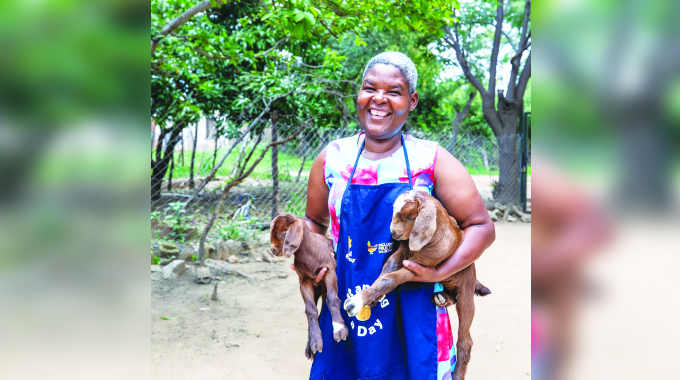
Sukulwenkosi Dube-Matutu
Matabeleland South Bureau Chief
JUST like a mother would care for her children, so does Umzingwane goat breeder, Ms Sikhumbulile Dube care for her herd of 185 goats which are a mixture of the Kalahari and Matabele breeds.
She has a deep connection with her goats which has seen her name each animal. Among them is “Brown”, a Kalahari buck that she purchased recently to improve her breed.
Ms Dube said she knows each goat by name and the animals respond to their names.
Ms Dube, who has experience in goat breeding, is a lead farmer for goat breeding farmer field school, Queens of Reds.
The group has 350 goats including those that belong to Ms Dube and her husband, Mr Elborn Ndlovu.
Ms Dube started off as a poultry farmer and used her profits to venture into goat breeding. She has maintained her herd by culling and selling poor performers.
Her goats leave the homestead in the morning to graze. She said she inspects each goat to ensure that it is in good health.
When the goats return in the evening, she examines each animal to ensure that they did not suffer any injuries. She said if she detects a problem with any animal, she immediately takes action.
Ms Dube said while the rest of her herd travels far to graze, her buck grazes nearby. She normally feeds her buck goat pellets and feed as it is a special breed.
“Every morning and evening I check on the goats while paying particular attention to how they will be walking. This way, I can detect if any of the animals has a problem so that I attend to it early. I have prepared proper shelter for the goats to ensure that they are not affected by rain. When it is raining, I keep the goats in their pens and only let them out when it has stopped raining,” she said.
Ms Dube said she also ensures that she invests in her animals’ health care. She said being a lead farmer has helped to motivate her to learn more about goat breeding and improve her operations as there are other people that look up to her.
“I make sure that I take my animals for dipping and I also vaccinate them in order to ensure that they are free from diseases. While I allow my goats to leave in the morning and return in the evening, I treat those that are pregnant and those that fall ill differently.
“I monitor the pregnant goats and when they are almost due, I create a ‘maternity ward’ for them. Those that are almost due spend the day in the pen and I feed them from there. I also nurse those which are ill and feed them from the kraal until they have recovered. I value each goat and losing one is a great loss for me,” she said.
Ms Dube said livestock farmers have to attach value to their animals as they are a valuable asset.
She was identified as a lead farmer under the Green Climate Fund project by virtue of being a thriving goat breeder.
Ms Dube received training in goat breeding and was tasked to establish a farmer field school.
She engaged farmers from her area who were already into goat production and they synchronised their operations.
The group started off in 2023 with 10 members and now has 34 as they have continued to engage more farmers under the farmer field school concept.
The farmers started off with Matabele goats and then introduced the Kalahari bucks in order to produce F1 crosses.
They cross the Matabele with the Kalahari breed with a target to produce pure stud breeds for export.
The farmers are also targeting to supply other farmers with F1 crosses from the Matabele and Kalahari
which will help improve the provincial herd.
The Kalahari breed has a big frame and weight while the Matabele has a high conception rate and is more resistant to harsh climatic conditions.
Ms Dube said crossing the Matabele and Kalahari has helped improve the conception rate and produce an improved breed.
“The experience I had in goat production coupled with the input of other farmers has seen our enterprise grow. There is knowledge that I had acquired on my own but the training has enhanced it. I was also trained on farmer field and in April we established our farmer field school.
“We network with other goat breeding groups, share knowledge, and sell our goats to them. Being part of the farmer field school has enriched us in a great way. This project doesn’t only benefit members of our group but we also host other farmers who visit us to learn,” she said.
Ms Dube said she is glad to be able to share her experience and knowledge in order to develop and enhance other goat breeders. She said her desire is to become a renowned stud breeder and to lead other farmers into exporting goats.
Her desire, she said, is to establish more farmer field schools in the area so as to share their knowledge with other farmers.
Matabeleland South provincial Agriculture Advisory and Rural Development Services (Aards) deputy director Mr Bhekilizwe Ncube said farmers like Ms Dube were playing a crucial role in imparting critical knowledge to other farmers in order to enhance production.
“As Government, one of our areas of focus has been equipping farmers with knowledge and skills as well as capacitating them. The farmer field school concept has helped ensure that farmers adopt best farming practices and are equipped. Farmers like Ms Dube play a crucial role in capacitating farmers.
“Ms Dube was identified because of her thriving goat project that she was running and she has displayed great improvement since she was incorporated into the GCF programme. She has shown great passion and commitment towards her project. We urge farmers to have such zeal and commitment so that we can transform the agricultural sector,” he said.
Goat breeding can be beneficial in many ways, including food production, income generation, and environmental sustainability.
Goats produce meat that is in high demand due to its nutritional quality. Goat milk can be used for human consumption while its fibre can be used for various purposes.
Goat farming requires less initial investment than other livestock farming and it can be a profitable occupation for farmers.
In terms of environmental sustainability, goats can improve grazing land and reduce bush encroachment while goat manure is a good source of nitrogen, potash, and potassium, and can be used to fertilise fields.
Goats can adapt to a variety of agro-climatic conditions, including arid, cold, and hot humid climates.
They have few housing and management requirements, and can share their homes with their owners.
Goats are less prone to diseases compared to other large animals, which makes them easier to manage. — @DubeMatutu