admin
admin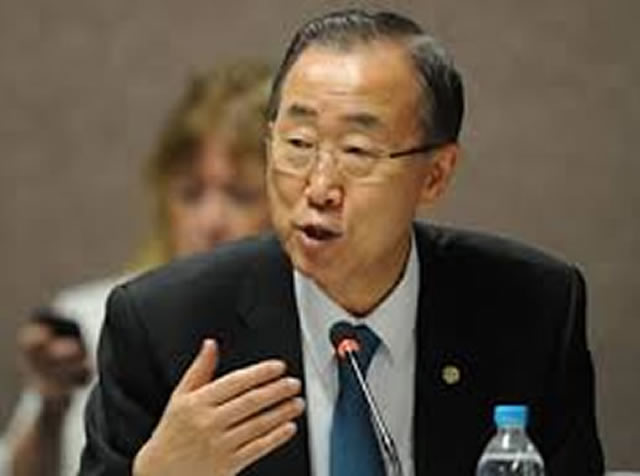

UN chief Ban Ki-moon has made an impassioned plea against military action in Syria, warning that it could spark further sectarian violence in a country already suffering from a humanitarian crisis “unprecedented” in recent history. Speaking at a humanitarian meeting hosted by Britain on the sidelines of the G20 summit yesterday, Ban called on world powers to put aside their differences over the Syrian conflict, and to take concerted action to get desperately needed aid to the population.
“I must warn that ill-considered military action could cause serious and tragic consequences, and with an increased threat of further sectarian violence,” Ban said.
About third of Syria’s pre-war 20,8 million population has fled abroad or have been forced from their homes during the popular uprising against President Bashar al-Assad’s regime which is now in its third year, UN refugee agency data showed.
“This is a humanitarian crisis of unprecedented proportions in recent history,” Ban said.
But “as as some flee the country, others dig in to fight,” Ban said, pointing to the need therefore to “avoid further militarisation of the conflict and revitalise the search for a political settlement instead.”
With a political solution proving elusive as world leaders dig in their heels over their entrenched positions, Ban called for unity in securing humanitarian aid for the population.
A funding shortage was also threatening to leave refugees in neighbouring countries with no food, he said, adding that stocks would run out within days in Lebanon and within two weeks in Jordan.
“The world must do everything within its powers to stop the suffering of the Syrian people. Let us use this united recognition of the problem as our starting point for focused and positive action,” he said. “Your support in exercising leverage on all parties to facilitate humanitarian access is critical.”
On Thursday, the UN refugee agency said that from October, it will have to cut food aid to more than a quarter of Syrian refugees in Lebanon.
From October, UNHCR will move to “targeted assistance,” as it struggles to assist a refugee population of at least 720 000 people in Lebanon.
“We will have to switch to targeted assistance and cut some of our direct funding in part because of the shortfall in funds,” UNHCR spokeswoman Roberta Russo said.
“Our campaign sought $1,7 billion for Lebanon, and that is only 27 percent funded,” she added, saying aid agencies were making “difficult decisions” every day about how to use limited aid money.
Russo said a transition from blanket assistance of all refugees to a focus on the most vulnerable was not unusual when dealing with such a crisis.
“At the beginning of the emergency it is normal to give blanket assistance,” she said.
“Then once you have a better knowledge of the population, as we do now, we are better able to distinguish between those who are able to survive without assistance and those who really cannot.”
But she acknowledged that the decision to cut food assistance, which will affect around 200 000 refugees, 28 percent of those in Lebanon, was also driven by the agency’s lack of funds.
“If we don’t have an increase in funding we will not be able to meet, in general, even the needs of population we have now, not to mention the additional population that could arrive if the fighting intensifies.”
Meanwhile, world leaders gathered at the G20 summit have failed to settle their differences over the US push for military action against Syria in the wake of alleged chemical attack. The first day of the summit on Thursday was overshadowed by the conflict, as President Barack Obama tried to garner international support for the military campaign amid Russian opposition.
“The G20 has just now finished the dinner session at which the divisions about Syria were confirmed,” Italian Prime Minister Enrico Letta, who attended the dinner, said in a comment on his official Twitter feed.
Russia, an ally of Syria, has led the opposition to US-led military action against the Syrian regime over a chemical attack on 21 August outside Damascus, which Washington says was perpetrated by the government forces.
In New York, the US Ambassador to the United Nations, Samantha Power, left no doubt that Washington had given up trying to work with the UN Security Council over the attack.
She said there was “no viable path forward in this Security Council” and accused Russia of holding it hostage. Beyond convincing Russia, Obama has a tough sell ahead elsewhere. China — another veto-wielding Security Council member — has already expressed its “grave concerns” over unilateral military strikes.
A political solution is the only way to end the Syria crisis, a senior Chinese official said on Thursday, warning world powers to be “highly prudent”.
“War cannot solve the problem in Syria,” Chinese delegation spokesman Qin Gang told reporters at the G20.
Pope Francis added his voice to the calls for a peaceful solution, warning against the “futile pursuit of a military solution”.
German Chancellor Angela Merkel has repeatedly ruled out her country’s participation in any US-led military strike against Assad’s regime, while the British parliament has also rejected the idea.
EU president Herman van Rompuy said while the Damascus chemical attack was “a crime against humanity” there was “no military solution to the Syrian conflict”.
However, France has said it was ready to support US intervention.
Obama blames forces loyal to Syrian President Bashar al-Assad for the 21 August poison gas attack in the Damascus suburbs that killed up to 1 400 people. Moscow says Obama has not proven that claim and says rebel forces may have carried it out.
Putin’s press secretary, Dmitry Peskov said earlier in the day that they cannot accept US proofs of chemical weapon used in Syria. “They are far from being convincing” he said.
Meanwhile, the British Prime Minister, David Cameron, said London had fresh evidence of chemical weapons use. In a new bid for a peaceful solution for Syria, the UN announced that its special envoy Lakhdar Brahimi would attend meetings at the two-day summit to push for peace talks.
Russia meanwhile, said Syria’s Foreign Minister Walid Muallem would travel to Moscow on Monday, as Obama seeks to convince US lawmakers to approve military action.
Western military action against Syria had looked imminent last week, but Obama deferred the move and is seeking backing from Congress after a Senate panel backed his plans. — AP


 Online Reporter