Online Reporter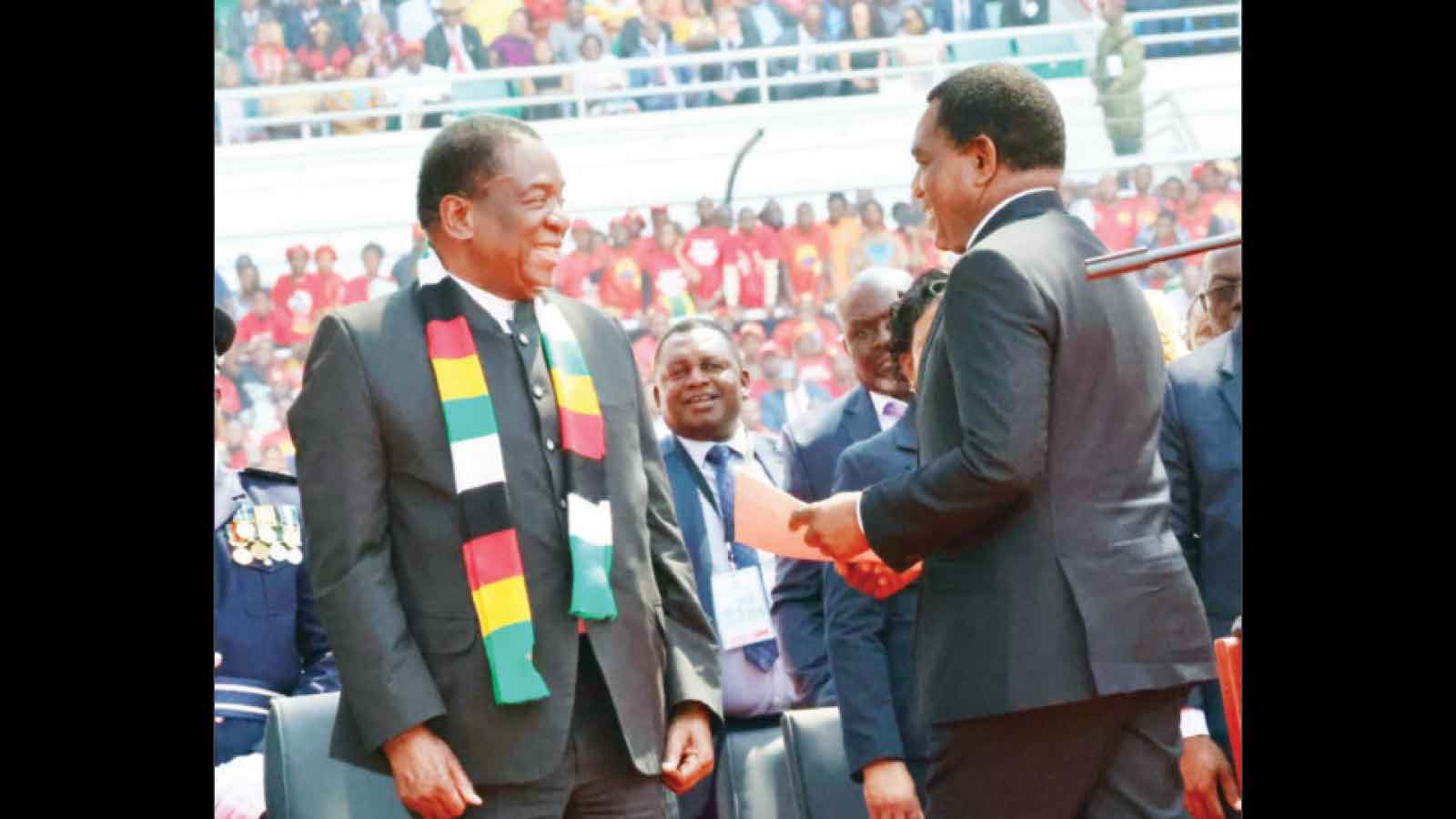
Richard Muponde-Zimpapers Politics Hub
PRESIDENT Hakainde Hichilema’s second-term inauguration gives Zimbabwe and Zambia an opportunity to consolidate a relationship defined by geography, history, liberation solidarity and economic interdependence.
President Mnangagwa’s presence in Lusaka was more than diplomatic courtesy. It symbolised the relationship between the Siamese Twins of Southern Africa, whose destinies intersect from liberation to industrialisation and prosperity.
President Hichilema won the August 13, 2026 presidential election with 2 965 326 votes, or 60,49 percent, against his main rival Brian Mundubile’s 1 856 217 votes, or 37,87 percent, a margin of 1 109 109 votes.
Reported constituency parliamentary results gave the governing UPND 136 of the 226 elected seats, while Mundubile’s NRPUP secured 60, the Republican Party five, Citizens First two, Zambia Must Prosper one and independents 20.
These results gave President Hichilema a renewed mandate and a platform for Harare and Lusaka to deepen strategic cooperation.
A Bond Forged By History And Sacrifice
Zimbabwe and Zambia are more than neighbouring states separated by an international boundary. Their relationship was forged in the difficult years of colonialism and the liberation struggle, when the peoples of the region shared sacrifices in pursuit of freedom.
Zambia provided vital political and logistical space to Zimbabwean liberation movements, while the victory of liberation struggles transformed the political geography of Southern Africa.
President Mnangagwa recalled this historical depth in his speech at the event on Tuesday, when he described the countries’ relations as being strengthened by “close historical, cultural and economic ties”.
That observation captures the essence of the Siamese relationship.
Families, communities, commerce and infrastructure connect the countries, while the Zambezi and Lake Kariba are shared strategic assets.
The elevation of the former Joint Permanent Commission on Cooperation into a Bi-National Commission represents recognition that ordinary diplomatic engagement is insufficient for a relationship of such depth. The BNC enables both Governments to coordinate priorities, resolve obstacles and convert friendship into development.
President Mnangagwa’s Message Of Unity
President Mnangagwa’s address at the inauguration contained a clear blueprint for the future of bilateral relations. His remarks declared that Zimbabwe and Zambia must approach the next chapter with stronger synergies and strategic focus.
“Our two countries enjoy excellent relations that are strengthened by close historical, cultural and economic ties,” President Mnangagwa said.
“I am confident that, under this new mandate entrusted to you by the great people of Zambia, we shall continue working together with stronger synergies and strategic focus.
“That historic visit was a confirmation of the long-standing ties and solidarity of our two countries, anchored on fraternal relations and mutually beneficial collaboration.
“Let us harness the opportunities presented to the Southern African region and the great continent of Africa. Let us never apologise for being a proud, sovereign and independent African people.”
These words connect cooperation to an African philosophy of sovereignty, self-reliance and development. President Mnangagwa’s invocation of Nyika Inovakwa Nevene Vayo/ Ilizwe Lakhiwa Ngabanikazi Balo underlines the principle that external partnerships must complement, rather than replace, African visions and priorities.
From Political Solidarity To Economic Integration
The inaugural Zimbabwe-Zambia BNC in Harare demonstrated how the historic relationship is being translated into practical cooperation.
A major outcome was agreement on 24-hour operations at Chirundu and Victoria Falls One Stop Border Posts. Faster border clearance has the potential to reduce congestion, lower transport costs and strengthen trade along critical regional corridors.
Zimbabwe’s decision to remove transit duties on petroleum products was another important trade facilitation measure. Both Governments also committed themselves to addressing non-tariff barriers and holding regular technical meetings to ensure outstanding issues are resolved.
Economic integration cannot thrive while traders and producers remain trapped by unnecessary barriers.
The Simplified Trade Regime further demonstrates that the relationship is not reserved for Governments and large corporations.
Small-scale cross-border traders, many of them women and young people, stand to benefit when Zimbabwe and Zambia create predictable and efficient trading conditions.
The strength of the Siamese relationship will be measured by benefits experienced by ordinary citizens.
Projects , Energy And Shared Infrastructure
Collaboration also extends to strategically important projects and infrastructure. The two Governments agreed on measures to improve boundary visibility along Lake Kariba through floating buoys and welcomed reconnaissance work from Victoria Falls towards Kazungula.
These initiatives manage shared geography through cooperation rather than competition.
Energy is equally central.
Zambia has arrangements to import electricity through Zimbabwe, while Harare has pledged to progressively increase transfer capacity. This illustrates regional complementarity amid changing climatic conditions and growing power demand.
Five memoranda of understanding covering diplomatic training, immigration and technical cooperation, labour and employment, agriculture and youth development provide further pillars for the partnership. The agreements create opportunities for skills development, food security, employment and future generations.
A Shared African And Global Voice
The relationship also carries diplomatic significance. Zambia supported Zimbabwe’s successful election to a non-permanent United Nations Security Council seat for the 2027–2028 period, while Lusaka has maintained advocacy for the removal of sanctions imposed on Zimbabwe. Such solidarity demonstrates a partnership beyond bilateral economics.
President Mnangagwa’s argument that partners should assist Africa according to African visions and priorities is particularly significant in an era of intense global competition for the continent’s resources and strategic influence. Zimbabwe and Zambia possess important mineral, agricultural and energy resources. Their strength increases when they negotiate from unity, sovereignty and clearly defined national interests.
The Siamese Twins March Forward
President Hichilema’s second term should, therefore, be viewed in Harare as an opportunity to consolidate continuity while accelerating implementation. The relationship has moved from rhetoric towards concrete agreements.
The task now is to ensure that memoranda become projects, commissions become delivery mechanisms and political goodwill produces tangible benefits.
The Siamese Twins of Southern Africa are bound by a past of shared struggle and a present of shared interests. Their future must now be defined by coordinated industrialisation, expanded trade, energy cooperation, efficient borders, youth empowerment and a common African voice.
As President Mnangagwa declared, a country is built, governed and prayed for by its own people. For Zimbabwe and Zambia, that philosophy can also guide a partnership in which two sovereign nations stand together, cooperate confidently and march forward towards a future built by Africans for Africans.