

 admin
admin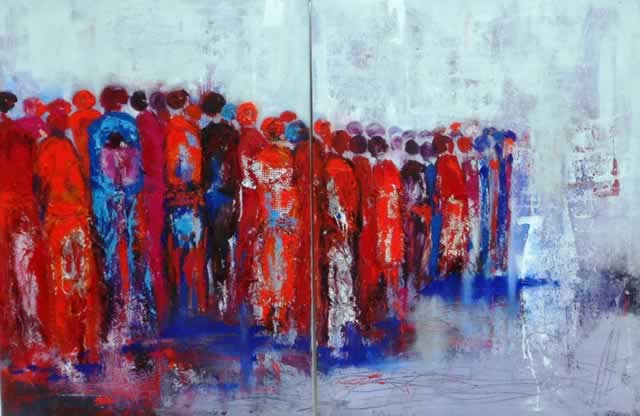
This year the National Gallery of Zimbabwe takes a step towards youth empowerment by staging the exhibition “Abatsha: Underneath it All” which runs throughout the month.
The show brings together young artists who execute their work in different media including stone sculpture, found object sculpture, weld art/ metal sculpture, painting, drawing, graphics, ceramics and prints.
The main purpose of the exhibition is to make known the creativity and proficiency that is present on our local art scene.
“Abatsha: Underneath it All” intends to examine the exact location of the contemporary Zimbabwe art scene by focusing on the present crop of artists who are under the age of 30. This will determine what direction art in Zimbabwe will move in on a global scale and would help these young artists to gauge their output in terms of marketability and retail ability of their artwork.
The banner Abatsha: Underneath it All emphasizes the new perspectives in the execution of artwork and pays particular attention in how ingenuity is applied in making the work, for instance Johnson Zuze’s assemblage of wire and other found objects entitled “Small Actions, Big Chances”.
The effect of the figure created by Zuze leaves much pleasure to the viewer, however it represents something greater in terms of what an Artist is and how the Artist stands in society.
There is an entrepreneurial tilt in most of the works on show at the Exhibition and the theme “Underneath it All” applies just how the show is to be presented to society. As seen in Zuze’s work there is great potential within the youth to be industrious and creative by recycling and reusing what is deemed waste and transferring this to society as a whole, this would create self-sustained industry which would make use of resources down to the last iota.
The Zimbabwean youth and the nation as a whole can learn a lesson from “Abatsha: Underneath it All” as the tactful execution of work falls in line with the progression towards indigenisation. The other works on show deal with subjects that are current and relevant to the situation on the ground.
Much of this context would be hard to decipher to a foreign audience as in Chido Nyatsuro’s painting “Ndangariro”, which is based on the subject matter’s reminiscence of the past (in Zimbabwean context this is largely socio-economic) which is also a subject Peter Musanhi presents in his series of queues entitled “Hold the Line” or Tandazani Dhlakama’s “Soko on a Wheelchair” deals with heritage and identity. These works present time specific subjects that present historical outlooks that serve as tenets of hope for the present and the future.
Other works such as Franklin Dzingai’s “Green Pipe” which addresses the intermittent water sanitation problems that haunt the nation whilst Webster Mubayirenyi’s “Tunnel to Cape Town” takes an observant insight on the dark side of migration and the brain drain that follows it while Mostaff Muchawaya’s “Coming Back of My Darling” speaks of that same journey motif and reunion between people which is often experienced locally and can appeal to an international audience.
Option Nyahunzvi’s painting “Pole Dancer” is a play on the title and represents different issues that have of late been widely conveyed through the media. Evans Mutenga’s collage “Kumafaro” echoes the same sentiment taken with a Pop Art approach à la Claes Oldenburg to project his representation of the current fad and fabric in society.
Gresham Nyaude’s The Lamp series represents idea and innovation and all the works point out to an attempt by the young Artists cross moral and social borders in the form of challenging the ‘norms’ that have long been set in stone. Privilege Garadi preserves the culture of stone sculpture with his “Mother and Child” bearing the same radiance in form as Royal Katiyo’s “Family of Birds”, which essentially shows the direction of Zimbabwean art being in capable hands as the artwork has the capacity to convey feelings to the audience in the same light as a mature artist’s work.
“Abatsha: Underneath it All” seeks to bring the audience into a space where they can find answers to numerous questions that will be answered through the work of young artists who have their finger on the pulse of what is happening now.
The young artists, most importantly the artist in general has through time been identified as one who thinks apart from ‘normal’ people and stands as a representative of time and place. In relation to creating impacting work that deals with the present generation’s greats, “Abatsha: Underneath it All” brings confidence to a fruitful and innovative art scene in the future.
There shall be a session of the Harare Conversations dedicated to “Abatsha: Underneath It All” on Monday the February 17. The topic of discussion will be “How Young Artists Represent Their Works to the Public In Order To Stimulate Discourse.” The Harare Conversations will feature the exhibition’s curator and the participating young artists. The Harare Conversations are open to the public and admission to these talks is free of charge.
“Abatsha: Underneath it All”, runs at the National Gallery of Zimbabwe until February 28. The exhibition is curated by Thomas Pasirayi.
Any comments would be greatly appreciated please leave them on our website – www.nationalgallery.co.zw or http://www.facebook.com/NationalGalleryofZim.



 Online Reporter