Chronicle Editor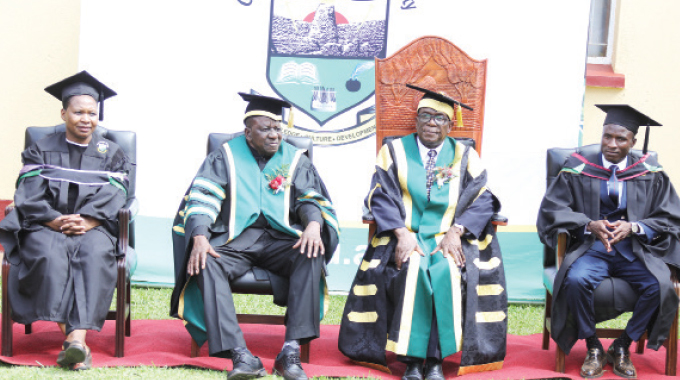
Zvamaida Murwira, Harare Bureau
State Universities in Zimbabwe have now become the anchor of social and economic transformation for communities through their innovation hubs and other life changing projects that have the potential to ensure that institutions of higher learning become financially independent.
Through the philosophy of the Second Republic led by President Mnangagwa of producing goods and services under Education 5.0, universities across the country have been walking the talk in complementing the Government efforts towards the attainment of Vision 2030.

Several universities have mapped their own future through innovation and research as they seek to play their part in making a difference and improving the country’s economy.
Yesterday, President Mnangagwa was in Masvingo at the Great Zimbabwe University, where he was briefed on the completion of the institution’s hospital in Mashava, which was upgraded and transformed into a university teaching institution.
In his address during GZU 18th graduation ceremony, Vice Chancellor Professor Rungano Zvobgo told delegates who included guest of honour President Mnangagwa who is also Chancellor of State universities that construction of the hospital was complete.
“The university has completed construction of the premier GZU Hospital, which will run as a strategic business unit for the university. We will request the honour of your presence to officially open this hospital before year-end. The hospital will contribute significantly to the nation’s attainment of universal health by 2030 in line with the World Health Organisation protocol,” said Prof Zvobgo.
The hospital would have health promotion and prevention services, a laboratory, X rays and imaging, rehabilitation and palliative care, and general practitioner and specialist medical health care services.
The hospital was expected to save people from travel costs to Harare and Bulawayo, where they would have to pay a fortune in transport and accommodation costs.
Bindura University Science of Science Education has also made its presence felt in terms of responsiveness to the aspirations and needs of communities.
A fortnight ago, President Mnangagwa commissioned the BUSE Optometry and Auditory School, which is the first-of-its-kind for a university in Africa, and a new students dining hall.
The Optometry and Auditory School houses nine lecture rooms, laboratories, and an eye lens production.
The expansion of the optometry department aims to facilitate the production of optical lenses.
Speaking to journalists after the commissioning, President Mnangagwa said it was encouraging to see tertiary institutions such as BUSE increasingly becoming action-oriented.
“We have seen the fruition of that vision that we have had a long time ago. BUSE Vice Chancellor Professor Eddie Mwenje has been talking about this for a long time. And I was looking for a day when what he talked about could be realised in reality,” he said.
President Mnangagwa then congratulated BUSE for a job well done and achieving the milestone.
He lauded BUSE proactive approach to the current industrial revolution, which is in line with Education 5.0.
The university’s innovation hub also has a diverse range of beauty products, and the masawu drink is being produced there.
He then toured the optometry department that is under expansion, the garment production factory, and the mouthwash production unit.
The fluoride-free mouthwash produced at the mouthwash unit, which is formulated with natural ingredients such as moringa and zumbani, aims to revolutionise dental care.
The ultimate objective of the innovation hubs is to free universities from their dependence on the national fiscus.
BUSE has also started holding training sessions on the use of the monitoring and evaluation dashboard that was designed by its innovation hub.
The monitoring and evaluation dashboard, known as Chiringa (meaning “look” in Shona), was presented to the Permanent Secretary in the Office of Vice-President Mohadi Dr Benson Martins Dube a month ago.
Not to be outdone, the Harare Institute of Technology unveiled a tram urban mass transport system proof of concept and research centre, reinforcing the country’s commitment to Education 5.0 and the National Development Strategy 1.
The innovation was commissioned by President Mnangagwa last month, where he capped students during a graduation ceremony.
He commended tertiary institutions for heeding the Second Republic’s philosophy that “nyika inovakwa nevene vayo”, thus contributing to the Government’s developmental efforts.
Once implemented, the transport system will complement already existing transportation initiatives.
“Long back, we would have sent people to go abroad and see how it’s done, then we buy from them. But now we are able to sell products to them,” he said.
President Mnangagwa said tertiary institutions such as HIT were proving that home-grown solutions were indeed the answer to the country’s problems.
Briefing journalists HIT Vice Chancellor Professor Quinton Kanhukamwe said competent personnel were behind the tram concept, and it would surely complement the already existing transport system in the country
“What we have here today is a proof of concept of our tram, which we hope will complement the mass transportation system.
“It is a system that we hope will complement the mass transportation system. The design, fabrication, and all the components have been done by our scientists here, engineers and technicians.
“A multiplicity of expertise spanning from electronic engineers, mechanical engineers, manufacturing engineers came together to come up with this concept,” said Prof Kanhukamwe.
On the other hand, the University of Zimbabwe unveiled a vehicle number plate plant that is able to meet local demand and supply other SADC countries, with negotiations already underway for the country to start exports
What was once a shell that housed mining equipment is now the university’s number plate manufacturing plant that produces 30 plates per minute, equating to at least 14 000 a day when there is demand for that number.
Previously, number plates for Zimbabwe’s vehicles were manufactured in Germany, and their shortage was a common feature, but since the coming in of the Second Republic, President Mnangagwa has called for home- grown solutions to the country’s needs and requirements.
UZ Vice Chancellor, Professor Paul Mapfumo, told The Herald recently that the Government had invested more than US$1 million in the plant, an investment that had saved the country’s foreign currency through import substitution.
“This (number plate manufacturing) is already at the commercial stage. The capacity for the plant means we are able to actually do it for the region.
“We can produce about 30 plates per minute. And that will give us probably an order of 14 000 per day if we work with our hours.
“And that means we can satisfy our local market and supply a far larger market if we produce like that, so I think we can respond to the region if that need arises,” he said.
With continued Government support and commitment, the sky will be the limit for universities as they journey towards modernisation and industrialisation in contributing to the development of the country in fulfilment of President Mnangagwa’s vision.


 Online Reporter