

 admin
admin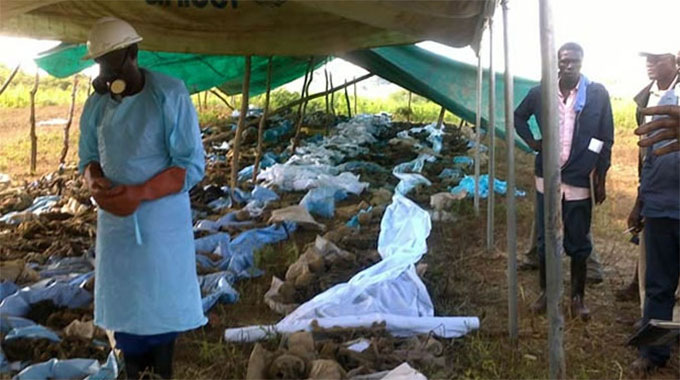
Dr Arthur Makanda–Correspondent
The Government is contemplating a national policy on identification, exhumations and reburial of human remains of those who fell during the liberation struggle and the conflict between the dissidents and Government, Gukurahundi.
While this is a noble idea, the bunching together of the two “conflicts” period is a misnomer, as the two conflicts were not informed by the same causes.
I will attempt to analyse the policy draft document in order to deal with the issues relating to the liberation struggle in the envisaged policy document.
The document’s background and introduction section does not capture properly the national mood that ought to be created by the policy owing to the juxtaposition of the two crises.
The situation or problem statement is centred on the uncoordinated and exclusion of the role of the spirit mediums during the struggle and that is still a central feature even in death as in African spirituality.
It is imperative that the centrality of the role played by the spirit mediums be brought to the fore.
The national grievances that caused the African resistance against colonialism must set the tone of the policy, as this was the pre-cursor to the killings and reprisals and the time frame must also be given.
This policy must lead to the claiming of reparations from the colonial masters.
During the periods of resistance right through to the independence of Zimbabwe spirit mediums played central and critical role which today the Policy seeks to dilute.
The problem statement or the situation must be premised among other things, on the social strife that is being caused by the failure to provide closure and finality to the families whose loved ones fell during the struggle and the spirit of those who fell — “The Fallen Heroes”.
Over the years, the country has witnessed a plethora of spiritual manifestations of the fallen heroes through the mediums of either their relatives or some other persons who either witnessed the war or some other who were not even born by the end of the struggle.
Some families are undergoing unexplained strife that maybe or are being caused by the quest of these fallen comrades of wanting to be properly laid to rest or to be united with their families.
The Fallen Heroes Trust of Zimbabwe has carried out identification, exhumation and properly reburied the fallen heroes with some being reunited with their families bringing about the much needed relief and closure.
Those who are carrying out public consultation are deliberately discrediting these exhumations by labelling the exhumation programmes as ‘uncoordinated’ in a bid to rubbish the work done by the trust.
The programmes have been done in a very systematic manner, where when a report is made or a spiritual manifestation occurs an identification process is done to establish whether the person concerned met his/her death as a result of the war, whether the person is a trained cadre or a civilian who was caught in the cross fire or killed by the Rhodesian security forces owing to his/her activities during the struggle.
After ascertaining the status of the person, relevant documentation is prepared and an application to the Minister of Home Affairs is made seeking authority to exhume the remains and subsequent reburial.
In some cases, authority is granted and where no response is received, a political solution is sought, where mass graves are identified, forensic scientists from the Ministry of Home Affairs are roped in, hence the citing of exhumations that were done at Chibondo in Mt Darwin, Butcher site in Rusape and many other sites by the drafters of the policy document.
The engagement has not been smooth as the forensic scientists felt that their western knowledge systems are being challenged, hence the concerted effort to discredit the Fallen Heroes Trust exhumation programme.
However, exhumation work has been done jointly and I will give a brief explanation on some of the work.
At Chibondo in Mt Darwin, the remains of a spirit medium who was killed and thrown into a mine shift were retrieved, and as I write the ancestral spirit is now manifesting in one of the family members and a traditional rite known as Kubata Musuo (authentication) has been performed and the exercise was successful.
In Rusape, there was a deadlock between the trust and some forensic scientists from Ministry of Home Affairs and on the procedures to be followed.
I broke the deadlock when I summoned the spirits of the fallen comrades and asked them to show the team where they ‘lay dead’. The team was shown and exhumations started and 16 comrades were exhumed and reburied.
At a mine in Odzi, remains of at least 300 fallen heroes and war victims were discovered and a report was made to the police who then attended the scene and took some samples from the mine shaft.
After preliminary investigation the trust was called in to assist and a process of identification was commenced.
The chief exhumer of the trust went into the mine shaft and immediately identified three bodies (at least told) in the spiritual realm and he came out with cellphone numbers of living relatives given by the spirit, asked the village head to contact the families who were in Mberengwa and Chipinge.
When the families were contacted, they confirmed that their children had joined the liberation struggle and did not return after independence.
Baffled with this, top officials from the Ministry of Home Affairs and Cultural Heritage came and chased away the members of the trust.
The forensic scientists remained and tried to continue with the exhumation, but they were met with strange happenings, which were spiritual as the spirits now guarded the bodies.
After they had left, the programme stalled until the trust was approached again and a ritual was conducted and the snake disappeared, paving way for the exhumation to commence.
And at least 300 bodies were exhumed.
There are so many incidents that the Trust can share, but the purpose of this disclosure is not to beat one’s drums, but to show the centrality of the role of spirit mediums.
The draft document talks about the National Peace and Reconciliation Commission that may be only ceased with the issues of Gukurahundi and seem not to be involved or concerned with the closures of those who fell during the liberation struggle.
The team that is carrying out the stakeholders consultation is emphasizing on the establishment of a DNA data bank and the bank will be created as exhumations are carried out and then maybe look for the families.
But there is an easy way of doing it, communities and war veterans can be engaged to supply the names and particulars of those who joined the liberation struggle, but did not return.
Samples can be obtained from parents and or relatives of those comrades who did not return from the war and a DNA standby bank can be created, once exhumations are done and samples collected then they can be matched with data already existing.
But in a bid to prove the fallen heroes trust wrong, the ministry is trying to ambush all exhumation to collect the data.
What the ministry is referring to as uncoordinated exhumation, but the ‘sprouting’ of spiritual manifestations and lack of closure, is the cause of the geographical spread of the problem.
In the draft document, the ministry stated: “Most of the disinterment and reburial done through some pressure groups do not adhere to professional standards”.
Indeed, all spiritual manifestation do not adhere to professional standards as may be required by forensic experts who may want to lead the process.
It is not correct that exhumations have been done unprocedurally and without documentation because letters of authority have been obtained from the Ministry of Home Affairs and other important stakeholders involved.
How uncultural? And, does not give dignity to deceased person is actually to remove parts of their bodies for examinations.
Traditionally, a body must be interred with all its parts intact, but it is only a compromise that traditions have been bend to accommodate other interests (scientific).
If officials in the ministry were fully utilising their department of cultural heritage they were going to be in the know and avoided raising unnecessary controversy. There is a deliberate omission of mentioning the Fallen Heroes Trust and conveniently bunching it as part of some pressure groups and yet the ministry takes pride in displaying in the museum work that was done by the trust.
If one was to ask the statistics of those fallen comrades who were exhumed by the ministry on its own using their forensic experts, the nation will be surprised if the number exceeds 10 and yet the trust has exhumed 1 341 to date.
Going through the rationale for the policy on exhumations, one will actually deduce that it is a biased approach, especially on bullet number two which reads: “To regulate the process of opening the graves or mass graves of victims of pre- and post independence violence and protect them against random exhumation and exploration”.
Coming up with the policy was never to bring closure to the social strife and rest the wondering spirits of the deceased comrades.
The policy is never aimed at allowing communities and government to claim for reparations from the colonial masters, it is never to help societies to get over the post traumatic disorders experienced by families whose loved ones fell in the struggle.
A well thought out rationale for the policy will help in the pacifying of these.
Some policy alternatives were given and basing on some argument on cultural beliefs and yet the victims of the post independents crises are being exhumed.
Whilst I am not a specialist in Ndebele culture, one may need to investigate the cultural perspective from the three tier system of the Ndebele cultures, which is amanguni enhla and amahole, and see whether the entire Ndebele culture prohibits that.
If that is the case, there has been talk of the beheaded ancestors whose heads are believed to be lodged in some British museum, and the policy document made reference to heroes of the First Chimurenga in its not so clear rationale.
“To facilitate the task of locating mass graves of the liberation struggle (1890-1979),’’ — it does not spell out what will culturally happen with those belonging to the Ndebele ancestors when located.
The question would be, will they be repatriated or be left in those museums? This is the only time the document talks inclusive of the heroes of the First Chimurenga.
A thorough research basing on the work done can present a clear picture on the extend of the problem and central issues at stake.
A wide coverage has been conducted and I believe ZBC still has got the clips as Forget Tsododo and Wadzanayi Mbombera captured the processes.
I want to suggest a team of researchers involving the Fallen Heroes Trust, war veterans, ministry officials, the police, traditional leaders and the army be commissioned to produce the policy document.
The resultant findings must lead to an Act of Parliament being enacted as I feel the issues at the stake are beyond the ministry’s conceptual view. Some universities that may form part of the desk research have produced doctoral thesis.
Hoping my contribution will help in the formulation of the policy document.
Dr APT Makanda is the chairman of the Fallen Heroes Trust of Zimbabwe


 Online Reporter