Online Reporter
Investigative Writers
IN the half-light of dawn, along the unfenced Zimbabwe-Botswana border, villagers from Maitengwe moved in small groups, scanning the scrubland for hoofprints.
They were not herding their cattle — they were trying to recover them.
“They hit five homesteads in one night,” said farmer, Richard Masunda from Maitengwe, a village on the Botswana side of the border with Zimbabwe. Our reporters encountered this group early one morning in March this year, while investigating how cattle theft cartels operate in these remote borderlands.
“We even know the thieves’ names: Godo, Mpume, Mgcini. But they’re still out there and they know the terrain better than we do. We’re out here every morning, trying to pick up signs of where they went.”
Across the border, frustration is just as palpable.
“We report. They’re caught. Then released,” said Headman Joe Tshuma from Madlambudzi village in Bulilima District, Zimbabwe.
“How do cattle get past police roadblocks at night? The law says you can’t move them after dark. So, how? Something’s not right.”
Their desperation highlights a growing regional crisis — one that has prompted a high-level response. Cattle rustling, a deeply entrenched historical issue in this region, has grown in scale and sophistication along the Zimbabwe-Botswana border, inflicting profound economic and social harm on affected communities. For generations, livestock has represented not just wealth, but a way of life.
“They steal our cattle and we’re left with nothing,” said Mr Tshuma.
“This is how we pay school fees. This is how we eat and survive.”
It’s a crisis that deeply affects both countries. In 2023 alone, Zimbabwe’s Anti-Stock Theft Unit recorded 11 313 cases of livestock theft, with cattle theft specifically increasing by 11 percent from the previous year. Botswana reported nearly 9 750 incidents.
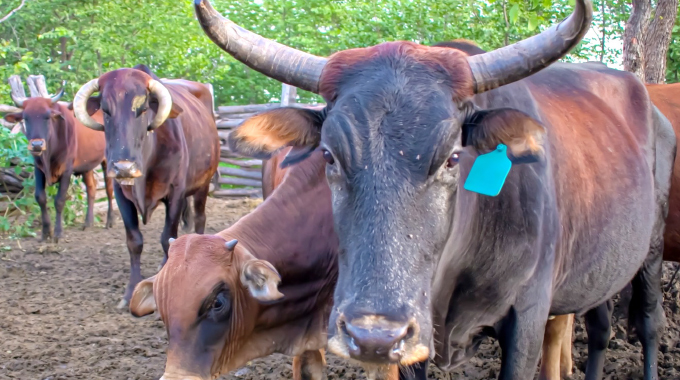
But the situation in the remote borderlands is especially punishing. Unlike general stock theft, which typically occurs within a single jurisdiction and allows for relatively straightforward police investigation and recovery, cross-border rustling traps victims in a jurisdictional grey zone. Once cattle are moved across the unfenced border, the chances of tracing or recovering them become almost non-existent.
Governments agree to curb cross-border smuggling
In response to the growing crisis, the Governments of Botswana and Zimbabwe signed a high-level Memorandum of Understanding (MoU) last year. It promised increased information sharing, joint enforcement operations and harmonised legal frameworks, to dismantle the syndicates smuggling cattle across the porous border.
But on the ground, village leaders like Mr Masunda and Mr Tshuma say little has changed. Despite diplomatic agreements, cattle continue to vanish and known rustlers remain free.
Now, an investigation supported by the Southern Africa Accountability Journalism Project (SA AJP) has uncovered that some members of the Zimbabwe Republic Police — specifically general duty officers, responsible for clearing livestock for movement — are themselves enabling the very smuggling networks they are meant to police, working in collusion with rustlers, to keep the trade alive.
The problem of police collusion with cattle rustlers is widespread across Zimbabwe. Yet the testimony of a former police officer — whose duties once spanned vast areas of Matabeleland South — suggests that if the governments are to curb these crimes where victims are most vulnerable, they must first tackle police complicity and corruption.
Rogue officers abusing their powers to help rustlers
At the heart of the problem lies Zimbabwe’s livestock clearance system — a paper-based process meant to prevent cattle theft and control the spread of disease. Before cattle can be moved by road within Zimbabwe, whether for sale, slaughter, or across provincial lines, ownership must first be confirmed by a village head or other trusted community witness. This is followed by a veterinary inspection to certify the animals as disease-free. Only then should the police issue the final movement permit.
But in practice, the system is routinely undermined. Police officers have been known to issue clearances without checking documents or requiring witnesses — often in exchange for bribes. The result is a clearance process that rustlers have learned to exploit. A mechanism designed to protect livestock owners has instead become one that enables their loss.
This reporting team gained rare access to Khami Maximum Security Prison in Bulawayo, with permission from the Zimbabwe Prisons and Correctional Services. There, they interviewed two convicted livestock rustlers — one of whom is a former police officer.
The officer agreed to speak only on condition of anonymity. He said he hopes to start a new life after his release and does not want to be identifiable as a convict.
At the time of his arrest in 2022, he was a constable stationed in Tshanyaugwe, one of Zimbabwe’s cross-border cattle rustling hotspots in Matabeleland South Province.
Now serving an 18-year sentence for stock theft and abuse of office, the former officer admitted to being systematically involved in the rustling trade, exploiting his position to operate with impunity. Cattle theft carries a mandatory minimum sentence of nine years.
“It was easy money,” he said. “There’s a process. The village head confirms ownership, the vet inspects the animals and then we, as police, issue final clearance. In some cases, we saw that the papers weren’t complete, the due process wasn’t followed — but we turned a blind eye. For a bribe, of course.”
He explained that syndicates were clever, gradually winning officers over with small favours and subtle manipulation.
“They’d offer us transport when we had no vehicles, to go to the next village to clear livestock. Sometimes they’d send someone new and clean to get the clearance — someone who wouldn’t raise eyebrows at the police station. Some of these guys had been at it for years; they know the tactics.”
He added that officers, who got involved were rarely criminals to begin with — they were slowly drawn in.
“They start small. First, it’s just a ride they offer you so you can go and clear the livestock. Then a little cash. Before you know it, you’re part of it.”
A racket spread across Zimbabwe, sometimes with rogue cops as kingpins
Another inmate, who agreed to speak was Jonathan Mahlangu. He was arrested and convicted for the theft of 14 donkeys in Lupane, Matabeleland North, and is serving time at Khami Maximum Security Prison.
Despite his imprisonment, Mahlangu maintains his innocence. According to his account, it was a police officer who deceived and implicated him — not the other way around.
“The officer told me I’d just be delivering animals,” he said. In Mahlangu’s case, he was hired to transport donkeys, not cattle.
“He cleared everything, signed and stamped the documents, which seemed genuine to me. My name was on the forms. I asked why and he explained the process. I believed him. I thought it was legal — this was a business being run by a police officer. I even collected some of the donkeys for resale at the police base where he worked. The documents looked genuine to me and to the local headman.”
Still, Mahlangu was arrested, while the officer behind the scheme walked free. He wept as he recounted his ordeal.
In a statement released in April, Zimbabwe’s National Prosecuting Authority confirmed that two other police officers had been convicted of stock theft — this time in the east of the country near the Mozambique border. They were each sentenced to nine years in prison.
In another case, the alleged kingpin of a cattle rustling gang, Zvishavane-based police officer Kudakwashe Chigwa, was arrested in 2023. He was found to have played a central role in manipulating the “clearance” of stolen cattle.
Confirmation from a vet and former cop
Dr Enat Mdlongwa, the provincial veterinary officer for Matabeleland South — a hotspot for cross-border rustling — confirmed that Zimbabwe’s livestock clearance process, over which police have significant influence, is highly vulnerable to corruption.
“We see cases where police have already issued clearance and then the buyer comes to us afterwards,” he said, noting that this is a clear red flag.
“That’s not how it works. First, the village head must confirm ownership. Then we inspect the cattle. Only after that should the police give their go-ahead. If you skip that, it’s mischief.”
Dr Mdlongwa acknowledged that even when the law is clearly being broken, enforcement often fails.
“Some buyers know they can bypass us,” he said.
A retired mid-ranking police officer, who spoke on condition of anonymity, confirmed that the clearance process is open to abuse.
“It’s still all paper. You get one form for ten cattle from the local vet, and these rustlers can re-use it five times if no one checks. They’re supposed to leave clearance forms at the abattoir when cattle are delivered for slaughter. They don’t.”
He highlighted the reliance on stamps and handwritten slips as a major loophole, fertile ground for forgery. Some forged documents even bore counterfeit or fraudulent police stamps.
“Some of those stamps… I don’t know if they were faked or just bought off someone, but they looked real. Some had the audacity to write on plain paper — not even the official clearance form — have it stamped and what puzzled us is that butchers or abattoir officials would accept such documents. And that’s the danger.”
Vigilante groups form in face of police inaction
According to Zimbabwe Republic Police spokesperson, Commissioner Paul Nyathi, the force is aware of the issue of officers colluding with rustlers.

“We’ve had officers not following procedures. Others, sadly, have worked hand in hand with rustling syndicates. Some have been prosecuted. The law will take its course,” he said.
Still, victims say few ever face justice — and the same names resurface time and again. The formation of the Maitengwe Anti-Crime Group in 2018, a citizen-led border patrol involving villagers from both Zimbabwe and Botswana, underscores the desperation. With flashlights and determination, they patrol the border at dawn and dusk.
“They have their own syndicate. They come at night, hit four or five homesteads,” said Mr Masunda, a villager from Maitengwe on the Botswana side.
“We’re left with nothing. No food, no school fees, no ploughing. Some villagers, who lose their cattle to rustlers can’t come to terms with the loss — it may even be why they die prematurely.”
The intergovernmental MoU signed in early 2024 was a first step toward tackling cattle rustling. It outlined intentions for cross-border co-operation on livestock movement. Months later, with cattle theft still rampant, both countries signalled their intention to expand the agreement into a more formal framework — one that would establish clear roles and enforcement mechanisms across borders.
As the two countries inch toward finalising the framework’s implementation, villagers like Headman Tshuma remain cautiously sceptical.
“We’ve heard the promises before,” he said. “They sign papers, shake hands, then we go back to losing everything.”
For families like that of Innocent Ngwenya in Nsubula village, Plumtree, the toll is devastating.
“Seven cattle, gone in one night,” he said.
“My eldest son had to leave school. No cows means no ploughing, no food, no future. The rustlers didn’t just take meat. They took our lifeline.”
In the end, whether the framework becomes a force for change — or just another forgotten paper trail — will depend not on summits or signatures, but on whether stolen cattle are recovered and corrupt officers held to account.
l This investigation was supported by the Southern Africa Accountability Journalism (SA/AJP), a project of the Henry Nxumalo Foundation funded by the European Union. The Article does not reflect the views of the European Union