


 malvernmugadzikwa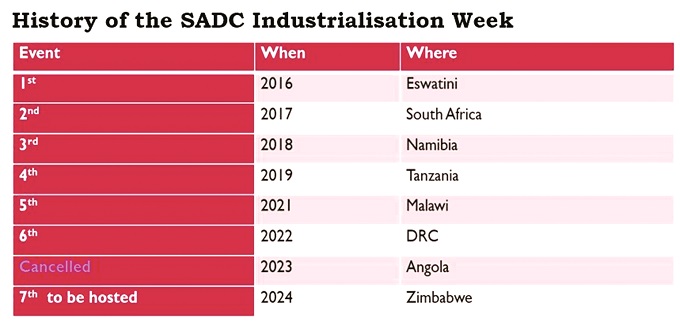
Zimpapers Politics Hub
Kuda Bwititi
AS Zimbabwe gears to assume the Southern African Development Community (SADC) chair in August, regional industrialisation is one of the issues expected to take centre stage at the summit.
This is evident in the hosting of the 7th SADC Industrialisation Week and Exhibition (SIWE), which usually precedes the main summit.
The industrialisation week and exhibition will take place from July 28 to August 2 at the Harare International Conference Centre.
The exhibition will have the same theme as the main summit — “Promoting Innovation to Unlock Opportunities for Sustainable Economic Growth and Development towards an Industrialised SADC”.
Background
Zimbabwe has played a crucial part in SADC’s industrialisation endeavours.
The SADC Industrialisation Strategy and Roadmap was adopted in April 2015, when Zimbabwe chaired the regional bloc.
This was a historic milestone that rallied the region to prioritise value addition and beneficiation of primary products.
In an interview with The Sunday Mail in April 2015, the then-SADC Executive Secretary, Dr Stergomena Tax (now Tanzania’s Defence and National Service minister), underscored the fundamental role that Zimbabwe played in championing the region’s industrialisation drive.
“When Zimbabwe took over, we started with the theme ‘Value Addition and Beneficiation’, and from this theme, Heads of State agreed that SADC should prepare an industrialisation strategy. And under the able leadership of Zimbabwe — not only the leadership, but the commitment as well — we achieved our mandate. That is really a big achievement,” she said.
Dr Tax said as the then-SADC chair, Zimbabwe had committed its entire machinery to come up with the transformative Industrialisation Strategy and Roadmap (2015-2063).
Zim’s industrial development under the Second Republic
Since the advent of the Second Republic, the manufacturing sector has been witnessing steady growth.
Capacity utilisation, which is real output measured against potential production capacity, has increased consistently from 2018 to date. In 2017, capacity utilisation stood at 34,3 percent. Last year, it ended at 53,2 percent, amid expectations that it will grow to over 60 percent this year.
Evidence of domestic industrial growth has been seen in the upsurge of locally manufactured products in supermarkets and other retail outlets.
About 80 percent of basic goods on supermarket shelves are locally produced, a significant shift from previous years when shops were flooded with imports.
Most recently, the Government adopted the National Industrial Development Policy (NIDP) 2024-2030. NIDP intends to facilitate growth, productivity, transformation and competitiveness through accelerating investment in the industrial sector.
Mechanics of the SIWE convention
SIWE is a public-private engagement platform that fosters new opportunities for intra-African trade, develops cross-border value chains and identifies investment opportunities in the SADC region.
In 2016, the SADC Council of Ministers endorsed a decision that the SIWE be convened annually on the margins of the SADC Summit of Heads of State and Government, specifically with the aim of popularising the strategy. As such, the host Government, through the ministry responsible for industry (in our case, the Ministry of Industry and Commerce); the SADC Business Council; and the SADC Secretariat host the business event.
Since 2016, six events have been held for the SIWE — in Eswatini (2016), South Africa (2017), Namibia (2018), Tanzania (2019), Malawi (2021) and the Democratic Republic of Congo (2022). In 2020, the event could not be conducted, as the summit was held virtually due to Covid-19.
According to a concept note provided by the Ministry of Industry and Commerce, the SIWE seeks to promote industrialisation, showcase investment opportunities across various value chains and facilitate networking among stakeholders in the industrial sector.
Other objectives include the need to popularise the SADC Industrialisation Strategy and Roadmap, as well as identify industrialisation projects that can be implemented jointly by the public and private sectors within member states. The SIWE serves not only as a platform for showcasing industrial advancements, but also as a crucial knowledge-dissemination initiative.
This strategic approach is aimed at bridging the gap among policymakers, industry leaders and the public, fostering a collective understanding and ownership of the SADC Industrialisation Strategy and Roadmap.
Also, the industrialisation week seeks to build coalitions to ensure understanding and cooperation among stakeholders on implementing the industrialisation strategy, including developing regional value chains for sectors such as pharmaceuticals, mineral beneficiation and agro-processing.
As such, the industrialisation week fosters inclusivity by targeting a broad audience.
This will ensure the industrialisation strategy does not function in a silo.
Widespread understanding is crucial for successful implementation because, when citizens grasp the potential benefits of industrialisation, such as job creation and economic growth, they are more likely to support Government policies and initiatives aligned with the strategy.
The programme for the SIWE will be confirmed in due course, but it is expected there will be a high-level investment conference.
Captains of industry will get an opportunity to interact and forge deals during the business-to-business (B2B) networking platform.
Plenary and parallel sessions will be held, in addition to factory visits to showcase Zimbabwe’s progress in manufacturing.
According to the Ministry of Industry and Commerce, the event targets hundreds of participants from the region’s 16 countries.
Exhibition stands will, thus, be available for both local and regional entities.
The ministry established an inter-ministerial committee and co-chairpersons with CZI for preparations to host the SIWE.
The committee comprises officials from Government ministries, the private sector and the academia, among other stakeholders.
A portal is being developed to allow online registration by participants before the event.
Expected outcomes
Hosting of the SIWE is expected to accelerate the implementation of the SADC Industrialisation Strategy and Roadmap (2015-2063) by SADC member states.
Furthermore, the event will provide an opportunity to show the investment opportunities within the region’s trade corridors, which are key anchors for industrialisation.
The success of Zimbabwe’s chairmanship and SADC’s industrialisation drive will hinge on the collective effort of member states.
Addressing infrastructure gaps, fostering skills development and attracting investment will be critical. With focus and regional cooperation, SADC can unlock its vast industrial potential and create shared prosperity for people in the region.



 Bongani Ndlovu
 Online Reporter