


 Online Reporter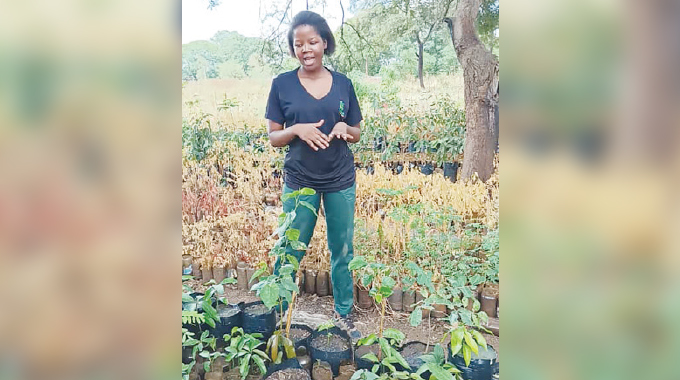
Vincent Gono, Day Editor
IN a world where environmental conservation often takes a backseat to economic development, urban expansion and other pressing socio-physical needs, one young girl is quietly but passionately making a difference.
Simekweyinkosi Masuku, who is turning 20 in August this year is no doubt an unheralded community heroine whose environmental footprint deserves recognition and yet no-one seems to care much about the passion that she has exhibited over the years.
She has done a lot in her little space and with very limited resources. A lot in that she has been practical about greening not only the veld through thousands of trees that she has planted and given out to those eager to see the world clothed but greening the economy too through picking discarded plastic containers that she cuts and use in place of tree planting pockets that she can’t afford.
This is despite having given out trees for free to institutions on important national tree planting occasions.
“I am not doing this to be seen,” she remarked.
I am doing it because that’s where my passion is and I feel it is the right thing to do, one day it will make sense to someone,” she added.
At her age, she has redefined what it means to be a community hero. Despite her remarkable achievements and unwavering dedication, her efforts remain largely unrecognised — a situation she hopes will change with greater support and awareness.
She is an avid environment steward waiting to be discovered by those who are naturally particular about the spaces they live, the importance of trees and the value that they offer in removing carbon dioxide from the atmosphere – as carbon sinks while giving out the oxygen that humans and other animals require to live.
Hers is a passion rooted in family and community and her journey into environmental activism is deeply personal. Coming from a family with a rich history of tree planting where her grandfather Mr Zolongwane Masuku planted thousands of trees across the city during his tenure at Bulawayo City Council while her father Mr Kheyi Masuku has donated over 50 000 trees, earning him accolades like the First Runner-Up Award in 2011.
Inspired by her lineage, Simekweyinkosi has taken her family’s legacy to heart, planting and donating over 6 000 trees to individuals and communities across Zimbabwe.
Her efforts extend far beyond mere planting. She has initiated projects that benefit entire communities.
Two years ago, she launched a unique celebration – planting trees for her birthday in local schools, inspiring children to see tree planting as a joyful and meaningful activity. This initiative has gained momentum, with many students now choosing to mark their birthdays through similar acts of environmental kindness.
One of her most ambitious projects is a large-scale tree planting initiative in Pumula South where she discovered a vast area in the suburb that could serve as a dedicated nursery and reforestation site where she wish to establish an orchard for baboons.
With a natural well capable of watering thousands of trees, Simekweyinkosi envisions transforming this space into a hub for indigenous fruit trees like umunyii and baobab — species that not only bolster local food security but also help reduce human-wildlife conflicts, particularly with marauding baboons that have caused chaos in the area.
“This initiative will also act as a buffer for Pumula South residents from baboons straying into their houses once for fruits. The community is prone to baboon menace that have destroyed satellite dishes and solar panels while scaring children and women,” she said.
Her impact is palpable. At Ntabazinduna Prison, she facilitated the planting of hundreds of avocado and waterberry trees, making it the first institution in the region to boast such species. Additionally, she transformed a school in Mahatshula, which previously had no trees, into a green haven with hundreds of saplings from her nursery, fostering a new love for nature among students.
Despite her successes, Simekweyinkosi faces significant hurdles. Her nursery, situated on a 1.7-hectare plot in Northend suburbs of Bulawayo, struggles with inadequate fencing, lack of proper sheds and unreliable water supply.
She managed to drill a 75-meter borehole but cannot yet install a pumping system due to financial constraints. Moreover, local bylaws prohibit digging soil on her land, limiting her ability to expand her nursery.
Yet she remains optimistic. She believes that with support — financial, infrastructural and community-driven, her project can significantly contribute to food security, climate resilience, and economic development.
“If given the necessary support, we can plant more trees around schools to prevent storm damage, reduce human-wildlife conflicts and create jobs,” she says with a hopeful smile.
She advocates for the planting of indigenous fruit trees, emphasising their potential as commercial crops and tools for restoring ecological balance.
She however decries lack of recognition as a female environmentalist breaking stereotypes in a society where environmental work is often viewed as a male-dominated field. She sees herself not just as a girl but as a giver of life, carrying forward her family’s legacy of environmental stewardship. Her story is a testament to the power of youth engagement, especially among girls, in tackling climate change and promoting sustainable development.
One of her core beliefs is that early childhood education is vital. She notes that children as young as eight show keen interest in tree planting and environmental conservation. By establishing dedicated spaces where children can learn practical skills, Simekweyinkosi envisions a future where environmental consciousness becomes a national priority.
While her efforts have garnered admiration from those who have seen her work firsthand, she remains largely unrecognised at the national level. She hopes that her story will inspire others to support grassroots initiatives and recognize the vital role young people play in environmental conservation.
Her story is a reminder that age is no barrier to making a difference. Her dedication, passion and vision for a greener Zimbabwe exemplify the kind of leadership needed to combat climate challenges and she hopes with the right support, her dream of a country lush with indigenous trees, resilient communities and empowered youth can become a reality.
She eloquently puts it, “The future is in our hands. Let us plant more trees today for a better tomorrow.”
Her nursery consists of a variety of fruit trees such as avocados, peaches, oranges, mangoes, lemons, umnyi, paw-paws, water berries, and a variety of indigenous trees that are not necessarily fruit trees.
Her father, Mr Masuku said it was worrying that the country is still far from seriously investing in its environmental potential adding that lessons could be drawn from such countries as China that have made millions of dollars from their medicinal plants.
He added that it was encouraging to see rural communities showing a keen interest in greening their environs.
“Community leaders in Gokwe, Ntabazinduna and Insuza have put aside land for the establishment of tree nursery sites . They are very keen on having a tree nursery within their communities and we are going to assist them,” he said.


