admin
admin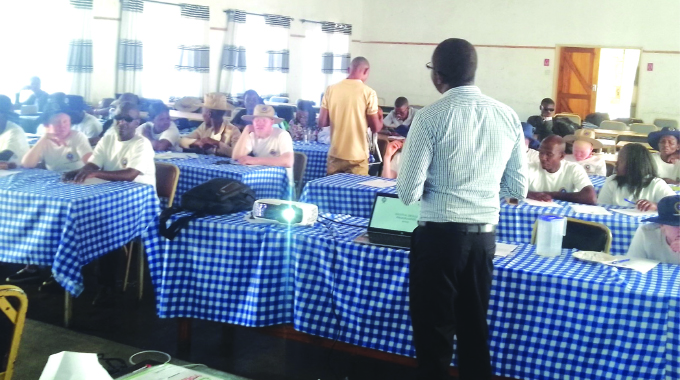
Muchaneta Chimuka
Herald Correspondent
PEOPLE with disabilities often have limited access to digital information communication technology despite it being a right.
It is important to create conditions under which disabled persons could get quality and competitive education, and could fruitfully participate in economic, cultural and social life of their countries.
Provision of access to up-to-date technologies and innovative tools for disabled people will increase their social and educational inclusion.
This will also benefit governments as it will ease their financial burden of special needs care, allowing them to invest in education of the disabled rather than provide them with passive support.
The New World Information and Communication Order (NWICO) aspires the contribution and dissemination of the comprehensive inclusive society concept with the agenda of raising awareness on the potential of ICTs for social inclusion and reducing the poverty of persons with disabilities among broad educational society, private sector and governments.
Ministry of Primary and Secondary Education director, Mr Taungana Ndoro, says the development of competencies of teachers/tutors, and other specialists involved in education and social rehabilitation of persons with disabilities, policy makers on e-accessibility and ICT usage for persons with various types of impairments is crucial.
“Spurring larger autonomy and full-scale participation in social life for persons with disabilities through development of e-accessible environment for their communication, learning and access to information is important and so is promoting computer literacy and vocational skills development among persons with disabilities through application of information technologies and resources,” he says.
“Training of teachers and specialists engaged in education of persons with special needs, development of training and information materials to make educational personnel familiar with best practices and incentivise them to enhance digital teaching opportunities is also important to bridge the gap.”
Mr Ndoro says there is need for the establishment of network of resource centres equipped with specialised assistive devices to provide access to information and knowledge for persons with disabilities, as well as to train educational personnel on the use of ICTs in special needs education and creation of an online platform that would collect a database on best practices and case studies on implementation of digital opportunities for teaching people with special educational needs.
The Ministry of Public Service, Labour and Social Welfare in collaboration with the Postal and Telecommunications Regulatory Authority of Zimbabwe (POTRAZ) and Internet Society of Zimbabwe recently embarked on an inception training programme for persons with disabilities with the aim of empowering them in ICT.
This initiative is expected to be spread to other parts of the country to bridge the digital gap.
The programme is a ground-breaking initiative to support the practical development and inclusion of people with disabilities towards a human rights model.
Prior to the training, some people with disabilities had been left behind as they did not have the basic skills to use computers in CICs.
Ministry of Public Service, Labour, and Social Welfare director of disability, Christine Peta, said training would ensure that people with disabilities are empowered to fend for themselves.
“This is the first group to be trained, and we will roll out the exercise to the other seven rural provinces, and later, Harare and Bulawayo,” she said.
“We want to move away from the charity model of disability to the human rights model, which ensures that their rights are considered. Persons with disabilities should receive the individual support which they require. They are not a homogeneous group, hence they should be supported in their different areas of need.”
Peta said the ICT programme would also be extended to the rural communities, especially in hard to reach areas.
“We are targeting persons with albinism, those who are visually impaired, those of hard to hearing and we also have cases of individuals who are deaf — blind and they need special training and in this case they use a mechanism called Palm Reading to grasp this concept,” she said.
“No one should be left behind in as far as ICT technology is concerned. We are in the era of information communication technology where everything has gone digital be it job seeking, buying and selling, banking and now that our banks are in our phones if we leave persons with disabilities behind we will be creating our own problems. We should train them and make them independent. That is the world we need.”
Peta said some information such as passwords, bank records among other things are confidential and sometimes people with disabilities are found divulging them just because they are always being aided which is not fair on their part.
POTRAZ director general, Gift Kalisto Machengete, said the basic ICT skills training course was aimed at introducing students to ICT who have no prior knowledge in this field.
“It explores the basic hardware components, how they work with software components and their skills. Certificates will be issued to the participants upon successful completion of the course,” he said.
“ICT will make persons with disability to have any easy way of doing business as it reduces the costs of travelling, among other things. Most persons with disabilities are in buying and selling business, hence online selling is the way to go and they can interact with people across the globe. We are going to beef our community information centres with enough computers such that everyone has access to the internet.”
He said, the Community Information Centres are found at all Zimpost offices around the country and they have set aside a certain portion of space which is reserved mainly for persons with disabilities.
Social Development Officer, Disability Department in the Ministry of Public Service, Shamiso Kabayahwaro who is also visually impaired, said it was important for persons with disabilities to be empowered with digital skills for the betterment of their well-being.
“As persons with disabilities we do not feel comfortable to be assistance all the time whenever we do our businesses or personal lives hence this training will empower us with skills and we can reach our full potential,” she said.
“Most of our colleagues were surprised to find their banks accounts empty after being duped by some individuals who purport to be giving assistance especially when doing bank transactions. If we are to do this independently after acquiring this knowledge we can be safe from such crimes.”
President Mnangagwa recently launched the country’s national disability policy whose thrust is to empower persons with disabilities at all levels.
The policy which was developed with support from various stakeholders including the UN, seeks to address the marginalisation and discrimination of Persons with Disabilities (PWDs), empower them to improve their own quality of life and enable them to contribute towards the national development agenda.
The policy also sets standards for the inclusion of people with disabilities in all facets of life, thereby serving as an overarching policy framework on disability across all sectors, including the public, private and development sectors.
He called for an end to harmful practices, discrimination, marginalisation and exclusion of PWDs from participating in different sectors of the economy, adding that Government departments should mainstream disability issues in their programmes.
The President called on citizens to stop treating people with disabilities as charitable cases but rather treat them as equals who are capable of productively participating in the building of Zimbabwe.
The policy was crafted as a measure to assist in domesticating provisions of the Convention on the Rights of Persons with Disabilities which Zimbabwe ratified.
It is estimated that about 1.4 million people have some form of disability in Zimbabwe.
Zimbabwe was one of the first countries to ratify the UN Convention on the Rights of Persons with Disabilities in 2013 and remain one of the few countries in Africa with legislation that specifically caters for people with disabilities.
By domesticating the UN Convention on the Rights of Persons with Disabilities, the country would have moved together with other progressive countries in putting disability on the national agenda.
The national disability policy will ensure that facilities such as ramps, for those on wheelchairs and Braille for the visually impaired among other disabled friendly facilities are found in all public places among other special needs.


 Online Reporter