Chronicle Editor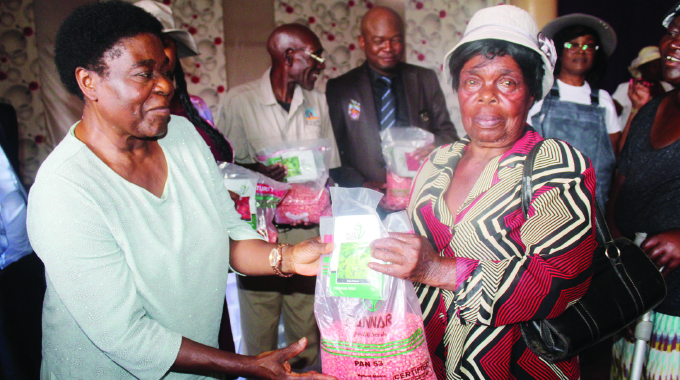
Peter Matika, [email protected]
FOLLOWING the launch of the Presidential Pfumvudza/Intwasa small-scale farming scheme by President Mnangagwa in October, the distribution of inputs started in Bulawayo province yesterday, marking the start of the urban farming inputs distribution programme.
Bulawayo Provincial Affairs and Devolution Minister, Judith Ncube, launched the scheme in the city’s Ward 2 area, where farmers began collecting the inputs. The Meteorological Services Department has forecasted normal to above-normal rains for the planting season.
Farmers have high expectations for a good season following predictions of normal to above-normal rainfall, despite a hesitant start. The Government has created a conducive environment for a successful season through the early distribution of inputs to farmers.
Minister Ncube emphasised that urban farming is as important as large-scale farming, as it helps less privileged families stock up on food.
“This is to ensure food security for all. The Government has introduced various farming methods to ensure that our plants survive the seasons. The land is ours, and we can only develop and improve our economy through farming. This is what we and our forefathers fought for. The current lifestyles that many are living do not ensure wealth but instead deprive you of your wealth.

“Let me take this opportunity to applaud the Ministry of Lands, Agriculture, Fisheries, Water and Rural Development for focusing on the transformation of urban communities. Particularly with the collective aspirations and consistent determination of the people of Bulawayo province to become an empowered and prosperous upper middle-income society by 2030, as charted by our visionary leader, His Excellency, The President of the Republic of Zimbabwe, Cde Dr ED Mnangagwa,” said Minister Ncube.
She highlighted that agriculture is at the epicentre of the country’s growth matrix, as Zimbabwe is predominantly an agro-based economy.
“In line with this, our Government, led by President Mnangagwa, in the transformational Vision 2030 mantra of leaving no one and no place behind, the Ministry of Lands, Agriculture, Fisheries, Water and Rural Development’s eco-chamber strategy is ‘development that leaves no household and no village behind’,” she said.
Minister Ncube explained that the Pfumvudza/Intwasa programme was adopted during the 2020/2021 farming season to ensure household food security while adopting smart farming technologies in the face of climate change.
“Climate change impacts are characterised by poor rainfall seasons, prolonged mid-season dry spells, very high temperatures during the growing period, and the early cessation of rains, all resulting in poor crop harvests. The Pfumvudza/Intwasa programme has proven to be a major contributor to household food security, and its replication across the African continent is pleasing,” said the minister.

She noted that emerging from the worst drought in 43 years and anticipating a good 2024/25 rainfall season, farmers are expected to produce enough to feed their families.
“The lesson learnt from the 2023/2024 season El Nino-induced drought is that we have to further consolidate climate-proofing of our agriculture, both at household and national levels. At the household level, the adoption of the Pfumvudza/Intwasa programme, which is based on conservation agriculture principles, will climate-proof agricultural production and ensure household food security,” said Minister Ncube.
She added that the Pfumvudza/Intwasa programme, like all other agricultural programmes, requires a robust and well-capacitated extension provision system for technical training, tracking, and monitoring.
“The success of this programme is anchored on robust extension services provided by the Ministry of Agriculture. Besides crops, there is a need to look into other livelihood options since they also provide for income and food security at the household level.

“The Government has established the School Business Units (SBUs) and Community Business Units (CBUs) to address nutrition security and income generation.”
Following the El Nino-induced drought that ravaged most parts of the country, farmers have a chance to grow more for ordinary needs and to rebuild reserves depleted during the drought.
Pfumvudza/Intwasa inputs vary according to agro ecological zones to ensure optimised production. Land preparation is in full throttle, with farmers having prepared about 70 percent of the targeted Pfumvudza plots, which are ready for planting.
Inputs are distributed according to ecological regions, with the country’s hottest areas that receive minimal rainfall receiving traditional grains.
This season, the Government is targeting 9,5 million plots to combat drought and ensure enhanced food security through increased production and the empowerment of smallholder farmers. About 3,5 million households will benefit from the scheme this year.


 Online Reporter