admin
admin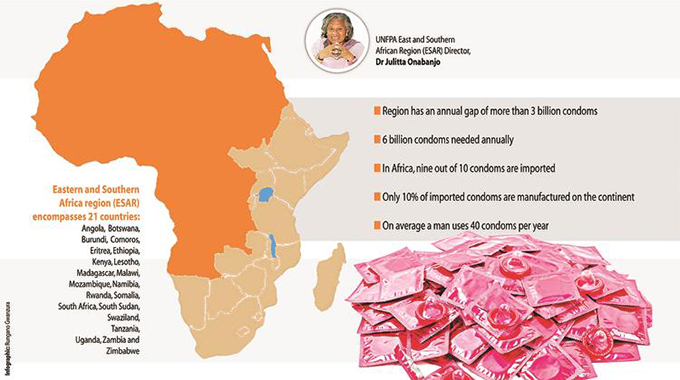
Roselyne Sachiti Features, Health and Society Editor
George Tafirei (not real name) doubles as a tout and vendor at Mbudzi Roundabout long-distance bus terminus which services a busy route used by human and vehicular traffic to and from the southern parts of Zimbabwe and beyond.
At this transit terminus, haulage trucks and buses from as far afield as Malawi, Democratic Republic of Congo (DRC) and beyond travel to and from South Africa via Zimbabwe.
Tafirei (38) has been married for five years and is a father of two.
In the course of his married life, he has on multiple occasions failed to resist temptation and strayed from this marital bed, temporarily seeking sexual favours elsewhere, something he is not proud of.
Tafirei says in all the extramarital sexual escapades, he has used protection, in this case, condoms.
“I protect. I will stray, but will not give my wife sexually-transmitted infections,” he told The Herald.
Since January this year, he has used an average of three condoms per month, which translates to 30 condoms since the beginning of the year.
However, sometimes he is too drunk, having taken the highly potent Musombodiya, an illicit brew.
“At times it can be four condoms per month, I am not too sure as I would be drunk,” he said.
As he spoke, a haulage truck made a screeching halt. He dashed towards it and began a conversation with the driver.
Moments later, two women and a man boarded the haulage truck.
On the haulage truck driver’s seat, a 42- year-old man sat comfortable.
He was travelling from Malawi and in transit to South Africa. He said his name was Joshua, was married and a father of three.
Because of the nature of his job, he regularly carries condoms whenever he is away from home.
“Sometimes things happen when you are in transit and you need some form of protection.
“I usually spend three weeks away from home, depending on which destination I am assigned to deliver goods or pick up products. The period I am away from home also depends on the country I will be assigned to. DRC takes more time, so I carry more condoms,” he added.
As such, he uses an average of six condoms a month.
He explained: “My wife is not worried. She is the one who packs them for me. We learnt a lot about condom use when we visited the clinic for her prenatal classes.”
Sometimes, he complained, condoms were difficult to find, especially when travelling long distances in between huge thick forests.
It is harder when one has a breakdown and has to be on the roadside for longer, he further grumbled as he turned on the key to signal the end of the interview.
When used consistently and correctly, condoms are highly effective in preventing HIV and many SADC countries have encouraged use of this intervention.
They are also effective in preventing sexually-transmitted diseases (STDs) that are transmitted through bodily fluids such as gonorrhoea and chlamydia.
According to AVERT, a United Kingdom-based charity that has been providing information about HIV and sexual health worldwide for over 30 years, more than 40,4 million condoms were distributed in Malawi in 2013-2014.
“However, only 24,1 million of these were free of charge. The remaining 16,3 million condoms were for sale (sometimes referred to as ‘socially marketed’). Despite the total number of condoms distributed being double the amount distributed the year before, this figure was 40 percent short of Malawi’s yearly target. However, the yearly target for commercial condoms was surpassed by 64 percent.”
AVERT further points out that Malawian men demonstrate one of the highest rates of condom use at last high-risk sex (with a non-marital, non-cohabiting partner) in Eastern and Southern Africa, at 76 percent (in 2015).
This could explain why Joshua had so much knowledge and keen to use condoms.
However, condom use among Malawian women engaging in high-risk sex is significantly lower at 50 percent.
Zimbabwe, AVERT further points out, has one of the highest HIV prevalences in sub-Saharan Africa at 12,7 percent, with 1,3 million people living with HIV in 2018.
“The availability and distribution of condoms in Zimbabwe is good, with 109,4 million male condoms and 5,6 million female condoms distributed in 2015.
“This equates to 33 male condoms per man per year, making Zimbabwe one of only five countries to meet or exceed the United Nations Population Fund (UNPF) regional benchmark of 30 male condoms per man per year.”
However, the use of condoms in multiple concurrent partnerships (when one or both partners have sexual relationships with other people) remains low, according to AVERT.
“Survey data from 2015 reported that, of respondents who had two or more sexual partners in the past 12 months, only 50 percent of women and 37 percent of men used a condom the last time they had sex.
“However, this is a slight increase from the 2010-2011 survey, which reported 48 percent of women and 33 percent of men in multiple concurrent partnerships using a condom the last time they had sex.”
In Zimbabwe, supermarkets, fuel stations, night clubs and pharmacies, among others, sell various brands of commercial condoms which cost between $15 and $20 each. The cheapest brand, Protector Plus costs $6 for a packet of three.
The Zimbabwean Government and its partners provide free condoms in public health institutions, tertiary institutions, bars, lodges and some public places, especially where high risk populations are.
Annually, the country needs at least 173 million male and female condoms to meet demand, but has received 136 million condoms this year, 37 000 000 short of the requirement. Yet, because of high costs of commercial condoms and shortages, those with access to the free condoms are selling them in the country’s capital Harare.
In Epworth, a single condom supposed to be distributed for free is selling for $2, while prices go up to $5 in the central business district (CBD).
This reverses efforts being made by the Government and its partners in ensuring access to condoms for all.
This also creates further gaps.
In SADC and East Africa, a significant gap exists between the “regular supply” of condoms and people’s “requirements”.
At the just-ended International Conference on Population and Development (ICPD25) Summit in Nairobi, Kenya, UNFPA East and Southern African Region (ESAR) Director Dr Julitta Onabanjo told journalists that the region has an annual gap of more than three billion condoms.
This, she said, is against a total need of six billion condoms annually.
She further revealed that in Africa, nine out of 10 condoms are imported and not manufactured on the continent.
She added that on average, a man uses 40 condoms per year.
“This gap is staggering and it will continue to hinder progress for many countries, including most ESA countries, towards the 2030 Sustainable Development Goals relating to health,” she pointed out.
She said only a few SADC countries were manufacturing condoms.
Sadly, she noted, none of these manufacturing units meet the pre-qualification standards set by the World Health Organisation (WHO) and the United Nations Population fund (UNFPA).
“This limits their ability to participate in global procurement drives. UNFPA is supporting these units, as well as other potential investors and manufacturing units, to improve their manufacturing practices for meeting the pre-qualification standards,” she expounded.
Dr Onabanjo said as a result of the gaps in condoms provision, there has been an emergence of new infections in nations that previously had low HIV proportions.
“The region has been experiencing a surge in new HIV infections in young adolescent girls, despite a reduction in infections in other countries around the world.
Countries such as Botswana, Madagascar, Eritrea, Burundi and Ethiopia have been recording increases among young girls since 2010,” she said.
Dr Onabanjo made reference to a feasibility study undertaken by the SADC Secretariat in 2016, which noted that the total SADC male condom market was four billion units worth US$105 million, almost all of which are imported from outside the region.
“Only 10 percent were produced by factories from Botswana, Namibia and South Africa. It is thus imperative to tap into the huge market in the SADC region,” she noted.
She further revealed that Africa, and in particular the ESA region, needs a sense of urgency to identify, plan and develop condom-manufacturing plants as viable operations.
Local production of condoms in the region most affected by the HIV epidemic has a number of distinct advantages, she pointed out.
Firstly, she explained, it helps to meet the need for the billions of condoms required to prevent transmission of HIV, STIs and unintended pregnancies.
“Secondly, increased availability of condoms manufactured on the continent will help ensure a speedy supply due to geographic proximity, especially in response to emergency supplies for avoiding stock-outs, and it will encourage improved local procurement and supply chain management.
“Thirdly, this will create employment opportunities, skills development, sustainable transfer of know-how and technology, promote trade within the continent, save much-needed hard currency for the continent, and involve the private sector in assisting governments to tackle HIV, STIs and unintended pregnancies.
“More importantly, this will help meet several targets of the 2030 Global Goals,” she added.
She called for the strategic engagement of all stakeholders, including investors, manufacturers, governments and development partners as one of the keys to making it happen.
There is also need to ensure condom programming and information always involves and is made user-friendly for persons with disabilities.
UNFPA Country Director for Kenya Dr Ademola Olajide said condoms are important both for family planning as well as prevention of sexually transmitted infections including HIV.
He said a secure supply of condoms is important if national and continental health (and wellbeing ) objectives is to be attained.
Where the continent is dependent on the international market for condoms, a long term security of cost effective supply cannot be guaranteed.
“Where production is local/on the continent, we are better able to verify the source of production and the quality. It contributes to industrial development, agriculture (rubber), economic growth and job creation, however remotely,” he said
According to Dr Olajidem, markets are currently fragmented in the 55 African Union states.
“Current manufacturers cannot leverage the economies of scale. There is also the challenge of access to sustain quality raw materials – that can be scaled up to supply as manufacturer’s capacity scales up,” he revealed.
Funding, he added, is also a problem, the funding vehicles available may not be properly adapted to the needs of that industry.
“The continent should harmonize processes (under the auspices of the AU) for quality assurance as well as leverage the Africa Free Trade Zone (African common market), ensuring that countries with the comparative advantage is supported to booster production capacity” he added.
According to New Era newspaper, Namibia, the SADC Secretariat in April this year expressed concern that only two countries — Namibia and South Africa — are currently manufacturing condoms in the region.
“The SADC Potential Projects in Pharmaceutical and Minerals Sector report said with a total population of over 300 million, the SADC region remained a key market for condoms.
“Currently, manufacturing of condoms is undertaken in two countries; namely Namibia and South Africa, but these essentially only serve their domestic market.
“There is thus a need for increased production in the region,” the report indicates.
As Dr Onabanjo rightly puts it, condom-manufacturing has become a critical health and economic imperative for Africa which should no longer be delayed. — @RoselyneSachiti.



 Online Reporter