Online Reporter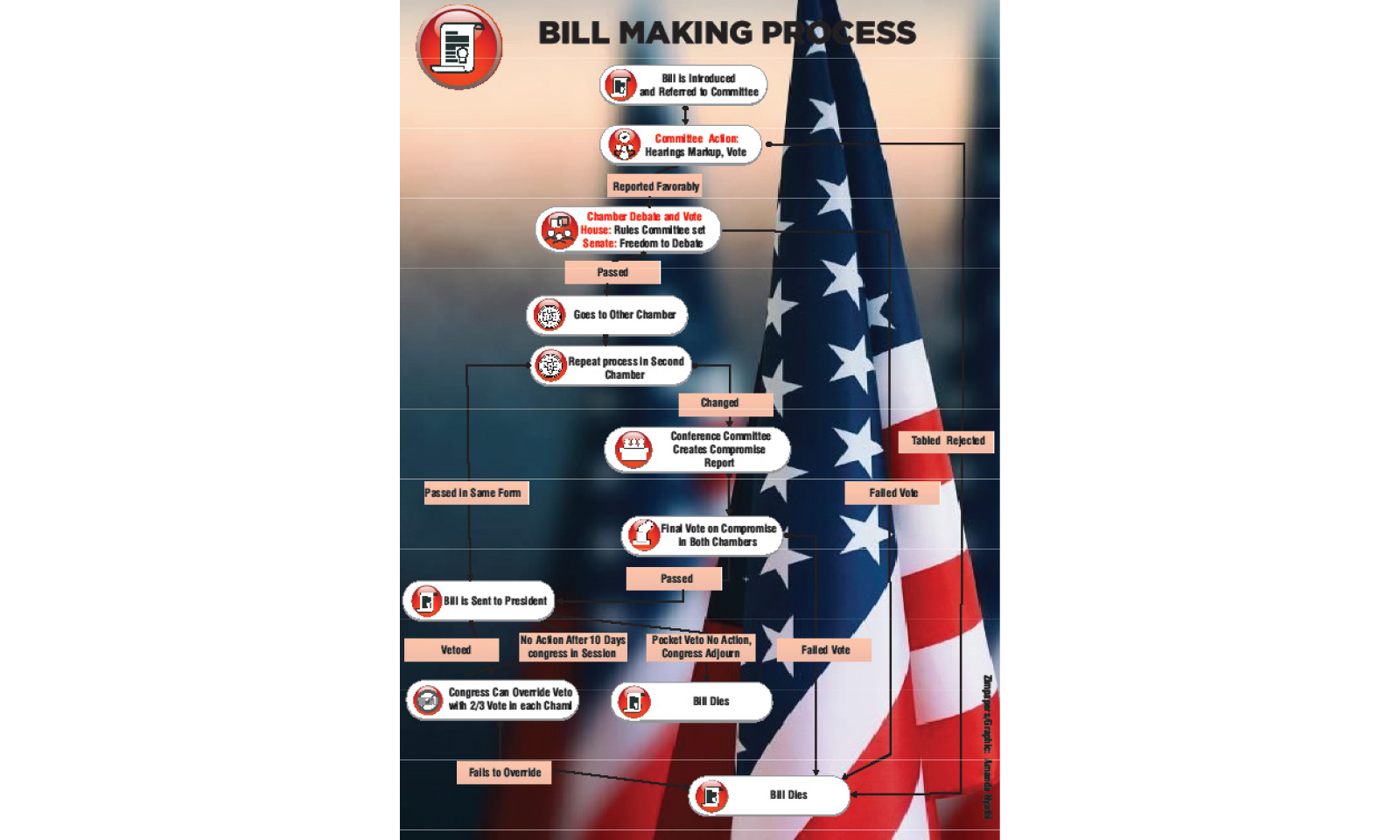
Sunday Mail Reporter
ON September 11, Brian Mast, who is a Republican Representative for Florida and chairperson of the House Foreign Affairs Committee, introduced an omnibus Bill in the United States House of Representatives, one of whose key provisions is to repeal the Zimbabwe Democracy and Economic Recovery Act (ZDERA), a law enacted in 2001 to punish Zimbabwe for the Land Reform Programme. But before being passed into law, the Bill must be approved in identical form by both chambers of Congress — the House of Representatives and the Senate — and then be signed by the US president. Experts say the process is intentionally complex and designed to encourage debate, compromise and careful consideration. Below, we publish some of the key steps in the US law-making process.
***********************
Step 1: Introduction and referral
Only a member of Congress can introduce a Bill.
House: A representative introduces a Bill by placing it in the hopper, a special box on the House floor.
Senate: A senator introduces a Bill by presenting it to a Senate clerk or from the Senate floor.
The Bill is assigned a number (for example, HR 1 for House Bill 1 or SB 1 for Senate Bill 1).
In this instance, the Bill that will repeal ZDERA, which has been proposed by US representative for Florida Brian Mast, has been marked HR 5300.
The Bill is referred to one or more standing committees that have jurisdiction over the Bill’s topic (for example, a tax Bill goes to the House Ways and Means Committee).
Step 2: Committee action (Where most Bills die)
This is the most critical and often overlooked stage.
Committees are the “workhorses” of Congress.
Hearings: The committee holds hearings to gather input from experts, executives and other stakeholders.
Mark up: The committee meets to “mark up” the Bill, debating, amending and rewriting it.
Vote: The committee votes on whether to “report” the Bill favourably to the full chamber.
If the committee votes not to advance it, or if the team’s chairperson simply ignores it, the Bill “dies” in committee.
Step 3: Chamber floor action
If the Bill is reported out of committee, it goes to the full House or Senate for debate and vote.
In the House: The Rules Committee sets the rules for debate (for example, time limits amendments are allowed). This is a powerful step that controls the Bill’s fate.
Debate is limited, and the process is more structured.
In the Senate: Debate is unlimited. This is where the famous filibuster comes into play. A senator can talk indefinitely to delay or block a vote.
To end a filibuster, the Senate must invoke cloture, which requires a three-fifths majority (60 votes) to proceed to a vote on most legislation.
The amendment process is much more open, and senators can offer “riders” (unrelated amendments) to a Bill.
Final vote: After debate, the full chamber holds a final vote. If it passes, the Bill moves to the other chamber.
Step 4: Action in the
other chamber
The Bill is sent to the other chamber (if it started in the House, it goes to the Senate, and vice versa).
The Bill must go through the exact same process all over again: committee review, hearings markup and floor debate/vote.
The second chamber often makes changes to the Bill.
Step 5: Resolving differences (conference committee)
If the second chamber passes a different version of the Bill (which is very common), the two versions must be reconciled.
A temporary conference committee is formed, with members (conferees) from both chambers.
They negotiate a single, compromise Bill (known as a “conference report”).
This compromise Bill is sent back to both the House and the Senate for a final up-or-down vote. No further amendments are allowed.
Step 6: Presidential action
Once both chambers have passed an identical Bill, it is sent to the president, who has four options:
- Sign it into law: The Bill becomes law.
- Veto it: The president returns the Bill to Congress with a message explaining the veto.
Congress can override a veto with a two-thirds vote in both the House and the Senate. If successful, the Bill becomes law without the president’s signature. This is very difficult to achieve
- Take no action: If Congress is in session, the Bill becomes law without the president’s signature after 10 days (excluding Sundays).
If Congress adjourns before the 10 days are up, the Bill does not become law. This is called a “pocket veto”.
- Use the “pen and phone”: While not a formal constitutional option, a modern president can issue a signing statement when signing a Bill, indicating how they intend to (or not to) enforce specific provisions.
Key obstacles and realities
- High mortality rate: Only a tiny fraction of introduced Bills become law. The process is designed to kill Bills, not pass them.
- Filibuster: The 60-vote requirement in the Senate is a major hurdle for most non-budgetary legislation, forcing bipartisan compromise.
- Committee power: A powerful committee chairperson can single-handedly block a Bill by refusing to bring it up for a vote.
- Reconciliation: A special process tied to the budget that allows certain fiscal Bills to bypass the Senate filibuster and pass with a simple majority (51 votes). This is how major tax and spending Bills are often passed.
This complex process ensures that legislation is thoroughly vetted but also creates significant opportunities for gridlock.