Online Reporter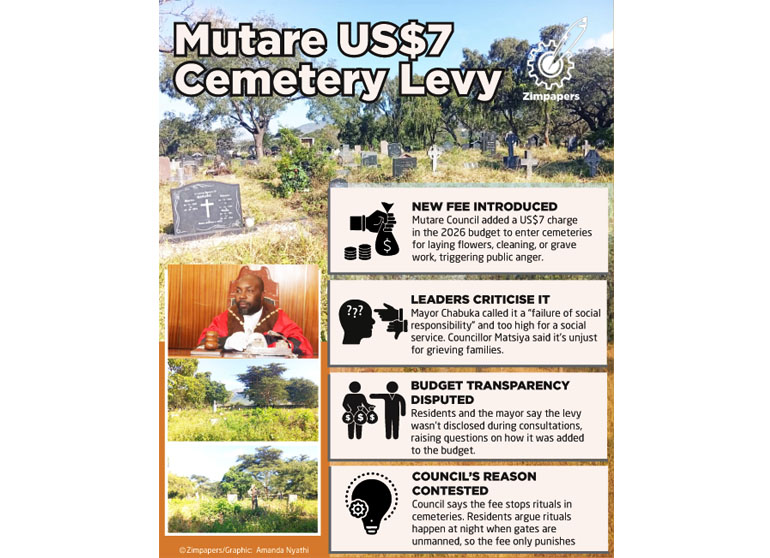
Ray Bande
Senior Reporter
ANGER is boiling over in meeting halls, pubs, on social media, and across the streets of Mutare after city council slapped residents with a shocking US$7 charge to visit graves and honour their departed loved ones.
The controversial fee, buried in the 2026 budget, makes it compulsory for residents to pay before entering cemeteries to lay flowers, repair, or erect tombstones.
Even Mutare mayor, Councillor Simon Chabuka, blasted the move, calling it “a failure of social responsibility.”
During the council’s 1 335th full meeting last week, Ward 10 councillor, Councillor Calvin Matsiya tore into the decision, warning it was an unbearable burden on grieving families.
“If you have seven relatives buried across the city, that is US$49 just to clean or lay flowers. How many families can afford that? It is an act of injustice,” he thundered.
City housing director, Mrs Emma Mandiziba defended the fee, claiming it was meant to deter people performing rituals in cemeteries.
But critics pointed out that such practices usually happen at night when gates are unmanned, and those involved can afford to pay anyway.
Ordinary residents, driven by cultural duty and family love, are the ones now being punished.
Councillor Chabuka also ordered cemeteries to be cleared of overgrowth to make them tidy and accessible.
Residents speaking to The Weekender and venting online branded the US$7 levy “exploitative” and “insensitive,” demanding council scrap the charge or exempt genuine mourners.
“In my analysis of the report, it appears the mayor was unaware of the US$7 charge and only learnt of it when it was pointed out during the full council meeting that it was in the 2026 budget. If the mayor did not know, how was the US$7 fee slipped into the budget? It was not mentioned during the budget consultation meetings, and presenters never raised it,” said Mr Fungai Dombo.
“Presenters highlighted the re-introduction of the US$1 Education Levy, but were silent on the new US$7 cemetery visit charge. It appears there is no transparency in budget formulation, and the budget committee must explain why the fee was not highlighted during the consultations. If our councillors, who attended ward meetings, remained silent, what are they doing to represent their wards by allowing the committee to sneak in a US$7 charge under their noses?”
Another resident, Mr Tenadi Marinda, said the US$7 fee charged by the council to place flowers on a grave was unjust and un-African.
“It is not fair for the council to charge the bereaved,” he said.
Mr Gift Sithole also weighed in, saying the local authority had gone berserk by resorting to such fundraising tactics.
“I think you people are going berserk! You charged us for the grave to bury our loved ones. Now you charge US$7 to put flowers. Are you people normal? Charging so much to access a deceased relative’s grave? Your love of money should end where we erect a tombstone, and anything beyond that is tantamount to extortion,” said Mr Sithole.
One resident, Mr Rwodzi, said: “Cemeteries should be kept clean by the council to justify the fees. Workers use slashers instead of grass-cutting machines. Someone is sleeping on the job. Perhaps some of these officials do not have relatives buried at our cemeteries.”
Mr Blessed Bismack said: “The fee will not stop the rituals that may be performed there, even if they charge US$100 for a visit. A visitor’s log book is enough to keep track of everyone who comes in. Anyone who visits must write their details in the log book.”
Contacted for comment, Councillor Chabuka said he would issue a comprehensive statement after receiving a report he had requested on the matter.
“There was an outcry from residents. Some wanted to place flowers at graves and were being charged US$7; others wanted to visit a cemetery simply to show a grave to a relative who was absent during the funeral and were also being charged US$7. So I carried out my own investigation. I spoke to the deputy director of housing, who told me that if you go there to place flowers you are not charged – and that the fee applies to grave maintenance, such as repairing cracks or installing tombstones.
“We then raised the issue with the director, who said entry to the graveyards is US$7, as approved during the budget consultations. I felt this was unfair and asked for a report so we could agree on the interpretation of the clause – whether the US$7 applies to repairing graves or to simple visits.
“They (council management) say graves are a protected area under the law, so entry must be restricted.
“Once I receive the report I requested, along with the 2026 budget policy, and we agree on the interpretation – whether the US$7 is for normal visits or for grave maintenance – I will issue a comprehensive response,” he said.
Asked whether the US$7 is fair even for maintenance, Councillor Chabuka said:
“If that is what was agreed during the budget consultations, we cannot change it before the budget cycle ends. Personally, I feel US$7 is too much given that the area falls under social amenities, but if that was agreed our hands are tied.”