Chronicle Editor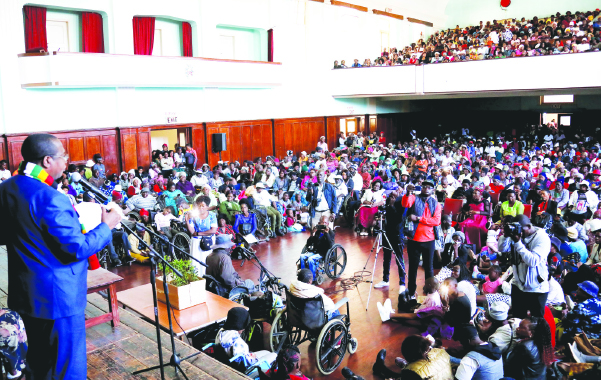
Peter Matika, [email protected]
FINANCE, Economic Development and Investment Promotion Minister, Professor Mthuli Ncube, has donated US$80 000 to support women-led economic projects and the people with disability in Bulawayo as part of efforts to empower vulnerable groups to generate income.
From the lump sum, a total of US$50 000 will be channelled towards women while US$30 000 will be channelled towards projects being undertaken by people with disabilities.
Prof Ncube made the announcement during a Zanu-PF Women’s League meeting held at the Large City Hall in Bulawayo on Saturday.
The announcement was met with great enthusiasm and gratitude from the recipients.
The funding is expected to boost socio-economic projects and promote gender equality while advancing the rights of women in Bulawayo.
“Likewise, disabled persons in the community can look forward to increased support and accessibility with the financial assistance. This boost will undoubtedly make a significant impact in improving the quality of life for individuals with disabilities in Bulawayo,” said Prof Ncube.
Empowering women and other marginalised groups including the youth and people living with disabilities is a key focus area for Government and other partners, said the minister.
Women make up more than half of the world’s population, yet too often they face barriers that hinder their full participation in social, economic, and political spheres, he added.
“Gender discrimination, unequal access to education, limited economic opportunities and cultural biases continue to impede the advancement of women globally,” Prof Ncube said.
He said in many societies men continue to claim ownership and control over productive resources and assets such as property, inheritance and land, as well as financial resources.
“This in turn leaves most women without the collateral necessary to seek out loans from the formal financial sector business. As Government, we recognise the crucial role played by women and women-led Micro Small and Medium Enterprises (MSMEs) in driving the national economic development agenda through wealth creation, employment creation, improved livelihoods, poverty alleviation and entrepreneurship development,” said the minister.
He said Zimbabwe has made significant strides in recognising the vital role women play in society and the economy at large but pointed out that more work still needs to be done to ensure women including those living with disabilities have equal opportunities and access to resources.
According to the Zimbabwe FinScope MSMEs Survey of 2022, women-owned MSMEs account for more than 60 percent of the total MSMEs in Zimbabwe, making them a key driver in addressing the gender gap.
These contribute up to 60 percent to the Gross Domestic Product and employ approximately 3,3 million people in Zimbabwe,” said Prof Ncube.
The Government, in collaboration with the Central Bank, has taken a keen interest in promoting women and marginalised groups through financial inclusion.
“Government has been implementing various projects aimed at empowering women and promoting gender equality. It is common knowledge that women are good with money and as such the Government established the Women’s Microfinance Bank, Empower Bank and Women Development Fund, among other funds, which are funded through the national budget to cater specifically to women’s financial needs,” said Prof Ncube.
“To date, these institutions have made significant inroads in reaching out to women and women-led MSMEs,” said Prof Ncube.
He said all banks and deposit-taking microfinance institutions have been directed to set up Women’s desks and MSMEs desks to provide assistance to women and MSMEs requiring financial services from banks and microfinance banks.
Prof Ncube said the banks and funds offer loans at very low cost, and other financial services to support women’s economic independence.
“They also provide financial literacy to women entrepreneurs, helping them start or expand their businesses and contribute to the country’s economic growth,” he said.
In 2024, the Zimbabwe Women’s Microfinance Bank was allocated $10 billion, Empower Bank, $13,1 billion, Community Development Fund $5,2 billion, Small and Medium Enterprises Development Corporation (SMEDCO) Z$10 billion and the Women Development Fund $11,4 billion.

“We also have other national projects that directly benefit women both in rural and urban areas. One such example is the presidential borehole drilling scheme, accompanied by nutritional gardens,” said Prof Ncube.
“These gardens provide women with opportunities to engage in horticultural activities, ultimately generating income through the sale of their produce.
“This initiative not only enhances food security but also promotes financial independence for women in communities across the country.”



 Online Reporter