dyton mupawaenda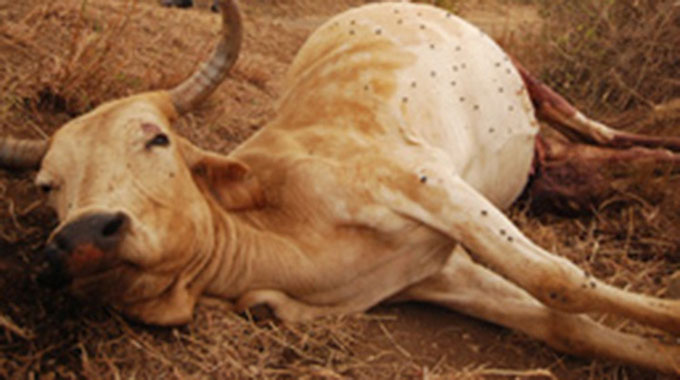
Precious Manomano-Herald Reporter
The Veterinary Services Department has started vaccinating cattle against anthrax in Binga along the Zambian border as a precautionary measure to curb the spread of the disease in the country.
This follows a report from the World Health Organisation that Zambia, Malawi, Kenya, Uganda, and Zimbabwe are experiencing anthrax outbreaks, with more than 1 100 suspected cases among cattle and 20 related deaths reported since the start of the year.
Chipinge, Gokwe North and Gokwe South districts are affected by anthrax. Vaccination is in progress and awareness campaigns are being scaled up.
Department of Veterinary field services director Dr Jairus Machakwa said vaccination of anthrax in hotspots areas will be done across the country; the department plans to order the rest of the needed vaccines from Botswana.
“Annually we require 1,2 million doses. We currently have 426 000 doses in stock. We are currently expecting to order the remaining vaccine at a cost of 13 million pula from the Botswana Vaccine Institute to meet the full requirement. With the stocks at hand, the department is able to contain current threats,’’ he said.
The situation in Zimbabwe was stable and the department was on alert and able to control the anthrax outbreaks should they occur.
“Currently there are three districts where anthrax has been reported, where there have been a few animal cases. These districts are Chipinge in Manicaland, and Gokwe North and Gokwe South in Midlands. The affected districts are all in the designated anthrax areas of the anthrax regulations. The situation is very stable and under control,” he said.
“However, all provinces are holding anthrax awareness campaigns and surveillance. Anthrax districts are vaccinating as we gear up following the Zambia outbreaks and the onset of rains here.
“The public is advised to not panic, but to be aware of the possibility of anthrax particularly in anthrax areas this time of the year, as the rains begin.”
The Government of Zimbabwe recognises the importance of anthrax, which is a notifiable disease in the country under the Animal Health Act.
According to this Act, some rural districts have been designated as anthrax endemic areas, later called high-risk zones, based on history and incidence of past disease outbreaks. Such areas have been gazetted.
The last update of anthrax endemic areas was Statutory Instrument 221 of 1982, the Animal Health (Anthrax Areas) Order, 1982.
Anthrax outbreaks are quite common during this time of the year due to the grazing of animals close to the ground as they ingest soil contaminated with anthrax spores in the process.
Since the 1970s, Zimbabwe has officially gazetted designated anthrax areas quoted in the Animal Health Regulations.
This helps authorities to be on top of the situation as resources are allocated for the control of this important animal disease which can also humans, termed a zoonotic disease. Dr Machakwa said the vet department was running joint public awareness campaigns with the Ministry of Health and Child Care, and in particular the department of environmental health.
Cross border meetings were being held with neighbouring countries for coordinated disease control efforts. Anthrax is a soil-borne disease caused by the bacterium Bacillus anthraces. Anthrax is most common in wild and domestic herbivores for example cattle, sheep, goats, camels,hippos and antelopes which pick up the bacterial spores from the ground while grazing.
Full story on: www.herald.co.zw
He warned the public against eating meat from animals that die from suspected cases, adding that animals that die of anthrax should be excluded from the food chain, and should be disposed safely by the members of the veterinary services. In any case all anthrax cases must be notified to the veterinary services.
Signs of anthrax include sudden death of livestock, rapid decomposition of the bloated carcasses and tarry blood coming out of all natural openings. Blood from a contaminated carcass is brownish and does not clot.
Besides anthrax, livestock farmers face greater potential losses from tick borne diseases.
Zimbabwe lost over 500 000 cattle due to tick borne diseases since 2016 and the major issue was that most farmers do not dip their cattle leading to the spread of these diseases.
Livestock farmer, Mr Chamunorwa Masangwi, of Zvimba said farmers should always dip, dose and vaccinate their livestock even when there was no disease outbreak.
“We should get a vaccination calendar or get education on vaccinations so that we do not continue losing our cattle,” he said.
Ms Margaret Munemo of Banket said farmers believe in keeping large numbers of cattle but cannot afford to buy chemicals for dosing.
“Another challenge is that we are attached to our livestock and we do not want to sell. Instead of selling part of the herd to get money to buy feed and vaccines, we maintain the large herd which may later be affected by diseases,” she said.
It is advisable for farmers to vaccinate their cattle during the dry season so that they will produce enough antibodies that will fight the disease in wet conditions since more infections are also found in wet season.



 Online Reporter