Online Reporter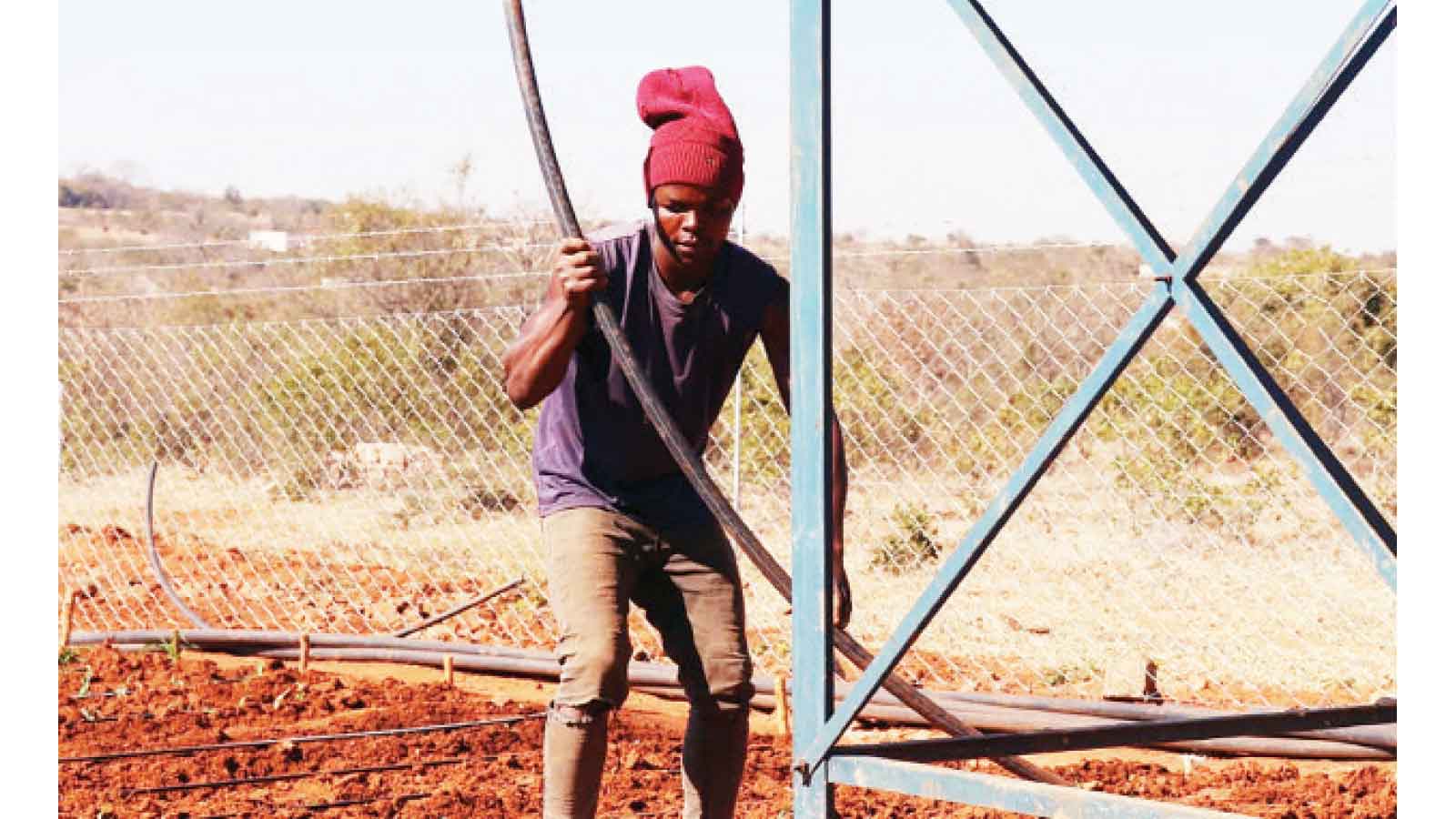
Theseus Mauruki Shambare-Features writer
FOR 26-year-old Forward Hlongwani, the sound of water flowing through a drip irrigation line is more than just the sound of a farming system working.
It is the sound of possibility.
Each time he bends down to repair a faulty drip line, working alongside the Village Business Unit (VBU) security officer, he is not only fixing equipment. He is helping protect a future he once thought was beyond his reach.
For years, Hlongwani’s biggest challenge was not a lack of willingness to work. It was a lack of opportunity.
After his family could no longer afford school fees, he dropped out in Grade Seven, ending his formal education journey before he could complete his studies.
Like many young people in rural communities, he had to find other ways to survive.
“I wanted to continue with school, but my family could no longer afford the fees. After leaving school, life became difficult because opportunities were limited,” he said.
“I survived through maricho (casual labour) and looking after other people’s livestock. Sometimes you would work the whole day, but there was no guarantee that you would find work the next day.”
In Chigume Village, Ward 3 of Chivi District, Masvingo Province, such struggles have been part of the rural reality for generations.
For many young people, the village represented a place where opportunities were scarce, forcing them to migrate to towns and cities in search of employment.
But a quiet transformation is taking place. A new generation is beginning to see rural communities differently.
The arrival of Village Business Units is creating a new possibility — that young people can build livelihoods without leaving their communities.
For Hlongwani, the one-hectare Chigume VBU has become more than a farming project. It has become his workplace.
Although he is not the manager of the production unit, he has found a role that allows him to contribute his skills and energy.
Working with the security officer, he assists in maintaining the irrigation system, attending to faulty drip lines to ensure water continues reaching crops.
“I may not be the person in charge of the project, but my contribution is important. When a drip line has a problem and we repair it, we are protecting the crops and protecting our investment,” he said.
“I feel proud because this is something that belongs to us. We are not just waiting for someone to employ us. We are playing a role in building something in our community.”
For Hlongwani, the biggest change has been psychological. The VBU has changed how he sees himself.
“As a young person, I now feel like an employer because I am part of the VBU. I wake up knowing that I am investing my time into something that can benefit me and my community,” he said.
His story represents a wider challenge facing rural Zimbabwe — how to create meaningful opportunities for a youthful population in communities where agriculture remains the main economic activity.
Zimbabwe’s rural areas have traditionally experienced youth migration, as young people move to urban areas and neighbouring countries in search of jobs.
However, climate change, unemployment and limited formal opportunities have forced communities to rethink how agriculture can be used not only for food production, but as a source of employment.
The Village Business Unit model is emerging as one response. By combining irrigation infrastructure, organised production and community ownership, VBUs are transforming rural agriculture into an enterprise.
Chigume VBU is one example.
Established in April this year ahead of another potentially challenging rainfall season, the project has 50 members, including 21 youths and 48 women.
The group is producing sugar beans and green mealies under irrigation, with plans to supply markets and generate income for members. The project is located in Chivi, a district largely situated in agro-ecological Regions IV and V, where rainfall is low and unreliable.
For farmers in these areas, depending entirely on rainfall has always been a gamble.
A season can begin with hope and end with disappointment when prolonged dry spells destroy crops.
Agricultural assessments, including studies by the Food and Agriculture Organisation (FAO), have highlighted the vulnerability of smallholder farmers in dryland areas, where climate variability continues to threaten food production and household incomes.
For young people, these challenges have often made agriculture appear unattractive. But access to irrigation is changing that perception.
Agricultural Planning and Development Director Mr Leonard Munamati said the inclusion of young people in Village Business Units was deliberate as the Government sought to change perceptions around agriculture and create rural employment opportunities.
He said youths should not only view agriculture as a means of producing food, but as a business sector where they can develop skills, generate income and build sustainable livelihoods.
“Village Business Units are also targeting youths because we know that young people are the future of this country. We want them to see agriculture not just as farming, but as a business where they can make a living,” said Mr Munamati.
He said the participation of youths was critical in ensuring that rural communities remained productive and agriculture continued attracting a new generation.
“When we bring youths into these Village Business Units, we are not only looking for people to work in the fields. We are creating opportunities for them to participate in different areas of agriculture — from production, irrigation management, marketing and other services that support the business unit,” he said.
Mr Munamati said the model was helping rural youths develop practical skills while creating opportunities closer to home.
“We do not want a situation where every young person believes that the only way to succeed is to leave the rural areas. If we provide them with the necessary resources, water and support, they can create livelihoods within their own communities,” he said.
He said empowering young people through agriculture had a multiplier effect on rural development.
“When we empower youths and women, we are empowering families, communities and the nation because these are the people who drive economic activity at household level,” he said.
Permanent Secretary in the Ministry of Agriculture and Water Resources Development, Professor Obert Jiri, said Village Business Units were designed to make agriculture attractive to young people by introducing technology, irrigation and commercial thinking into rural production.
He said the traditional perception of farming as a low-return activity was changing as communities adopted modern production systems.
“A Village Business Unit is essentially a one-hectare, drip-irrigated, solar-powered production centre,” said Prof Jiri.
“It produces crops all year round because it is enabled by water availability. The name speaks for itself. These are businesses run by the people who live there.”
Prof Jiri said the availability of irrigation and organised production was important in changing how young people viewed agriculture.
“When a young person sees farming only as waiting for rainfall, they may not see it as an opportunity. But when they see a production system supported by water, technology and business principles, they begin to understand that agriculture can be an enterprise,” he said.
He said Village Business Units were creating spaces where young people could apply their skills while contributing to rural economic development.
“Youths have energy, innovation and the ability to embrace new technologies. They are important players in transforming agriculture and ensuring that rural communities remain productive,” said Prof Jiri.
The transformation taking place in Chigume is also changing the economic position of young women.
Among the members of the VBU is 36-year-old Tendai Mativenga, who believes the project is giving young women greater financial independence.
“As a young married woman, there are many things I want to buy for myself without always asking my husband. A woman also wants to feel that she is contributing something meaningful to her family,” she said.
“When you have your own income, you can support your family, help with children’s needs and contribute when challenges come.”
For Mativenga, agriculture is becoming more than a means of survival. It is becoming a pathway to dignity.
Across Chivi, the quiet transformation is challenging old assumptions about rural communities. The village is no longer only a place where young people wait for opportunities elsewhere. It is becoming a place where opportunities can be created.
For Hlongwani, the boy who left school in Grade Seven, the future he once imagined losing is slowly taking shape in the fields around him.
He may not hold a formal title at the VBU. He may not manage the entire production unit. But every repaired drip line, every growing crop and every successful harvest is proof that his hands have value.
And in Chivi, a new generation is beginning to discover that they do not always have to leave home to find a future. Sometimes, the future can be grown where they stand.